If you're in the construction industry, you know that accounting and financial management can be more complex than in other industries.
In this guide, we'll review construction accounting processes and how they differ from standard accounting processes. You'll also read about specific elements of construction accounting that are unique to the industry and how construction accounting software can empower construction firms to manage their finances more effectively.
What is Construction Accounting?
Construction accounting is a specialized form of accounting that helps contractors track, manage, and report their financial data more accurately than standard accounting. Standard accounting is great for many businesses, but most construction firms need something more robust.
Construction Accounting Vs Regular Accounting
The main difference between construction accounting and standard accounting is that construction accounting must consider the unique features of construction projects.
For example, construction accounting must track progress payments, retainage, change orders, and other project-specific financial data. This data must be accurately tracked and reported to effectively manage construction projects and determine their profitability. This, in turn, impacts the profitability of the construction business.
“Recognizing the distinction between construction accounting and standard accounting lays the groundwork for accurate financial management, enabling contractors to navigate the unique challenges and complexities of their field with precision and confidence.”
Free Video Series
Construction Accounting University
Take the first critical step towards being a construction accounting expert and jumpstart your journey on making your construction business more predictable and profitable.
Key Aspects of Construction Accounting That Make It Unique
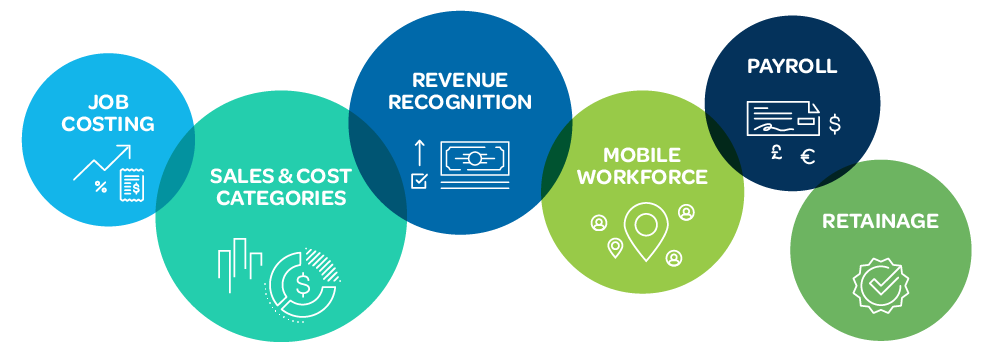
1. Job Costing
Job costing is important in construction accounting because contractors need to accurately track project costs to make a profit. Many factors go into accurate job costing, including labor, materials, equipment, and overhead costs.
The details included in accurate job costing allow a construction business to calculate how much it costs to complete a specific job or project. This information can then be used to make financial decisions, set prices for future jobs, and help decide whether a project is worth undertaking.
In standard accounting, all financial transactions are recorded in the general ledger. The general ledger includes all income and expense accounts for a business, but it is not tied to a project.
This is where job costing comes in.
In construction accounting, transactions are recorded not only in the general ledger but also in a job costing system. It is crucial that they balance so that you have accurate reporting.
In job costing, each project is assigned its own set of work breakdown structures (WBS) that capture the income and expenses tracked across the project's phases. This allows construction managers and contractors to see how much is spent on each scope and the entire project.
Job costing also allows contractors to easily adjust projects when necessary. This helps them better understand business cash flow and make changes to maximize the profitability of a particular job.
“Job costing in construction is the compass that guides us through the complexities of each project, ensuring every nail, every brick, and every hour invested is accounted for with precision and purpose.”
2. Sales and Costs of Sales Categories
Construction accounting includes several sales and expense categories not found in a standard accounting chart of accounts. This is due to the level of detail required to track construction projects.
A chart of accounts lists all the accounts a business uses to record transactions in its general ledger.
Additional types of revenue/sales categories in the construction industry may include:
- New Construction Income
- Remodel/Renovation Income
- Service Income
- Rental Income
These additional income categories give the contractor a better idea of the type of revenue the project is bringing in and enables them to determine where they see the most profit. Income and expenses should be tracked separately for each job. Cost categories are broken down into direct, indirect, and committed costs.
- Direct costs can be directly traced to a specific project, such as materials, labor, equipment rentals, and subcontractor costs.
- Indirect costs are overhead expenses allocated to a specific project, like staff salaries and administrative costs. A common indirect cost in the construction industry is equipment usage, where the cost of using a contractor's owned equipment must be allocated to each job that it is used on. This cost should be allocated to jobs based on standard rates, such as a daily internal rental rate or per hour of usage. To calculate this rate, you can divide the number of equipment hours used on a project by the equipment hours incurred by the company for the period in which the indirect costs are being allocated.
- Committed costs occur when a company agrees to buy something via a purchase order or contract. For example, if a general contractor has agreed to hire an electrician for a project and has signed a contract specifying the scope of work and the amount to be billed, this is a committed cost. Other examples include unposted payroll, purchase orders in which you are waiting for delivery, or the bill for the materials has not been paid yet, and open contract or subcontractor agreements.
3. Revenue Recognition
Revenue recognition is important in construction accounting because revenue from construction projects is recognized based on the amount of work completed and not the amount that has been billed. Unlike standard accounting, construction accounting offers several methods for recognizing revenue.
To comply with revenue recognition principles, contractors must carefully track the progress of each project. This information determines how much revenue has been earned and when it should be reported.
For each project, at a minimum, the construction contract should specify the price, project schedule, payment schedule, and the scope of work to be performed.
5 Steps to Recognize Revenue in a Construction Firm
There are five essential steps to recognizing revenue in the construction industry:
- Identify the contract with a customer: While most contracts are written, they can also be verbal or implied and should outline important topics such as scope, fees, fee terms and conditions, and any other rights you or your customer agree upon.
- Identify the scope of work: The scope of work is the agreed-upon services to complete a project or series of projects between a business and a customer, otherwise known as a performance obligation.
- Complete your take-off and mark-up price: Take-off is the process of determining the quantity of materials needed to complete a job. Your mark-up price is the difference between the cost of materials or services and the price you would charge for them.
- Allocate the transaction price to each performance obligation: Each individual performance obligation identified in the scope of work is assigned a price.
- Recognize revenue: Revenue recognition should occur when (or as) each performance obligation is satisfied.
Revenue Recognition Methods
With standard accounting, revenue is recognized when the service is performed, but things aren't that straightforward in the construction industry.
There are two revenue recognition methods in the construction industry: the cash method and the accrual method.
Under the accrual method, there are also the completed-contract method and the percentage-of-completion method.
The most common way to recognize construction revenue is the percentage-of-completion method, because in construction, revenues and costs can be reasonably estimated.
- Cash method: Under the cash method of revenue recognition, revenue is recognized when cash is received, and expenses are recognized when they are paid. This means that if a construction project is completed in December, but the customer doesn't pay until January, the revenue from that job would be reported in January. Expenses would be reported when they are paid for. If they are purchased with cash before the job is completed, it could cause a mismatch between revenue and expenses.
- Accrual method: Under the accrual method, revenue is recognized when the service is performed, and expenses are recognized when they are incurred (but not necessarily paid for). This means that if a construction project is completed in December but the customer doesn't pay until January, the revenue from that job would be reported in December, when the customer is billed.
The main benefit of the accrual method is that it provides a more accurate picture of a construction company's financial health. This can give construction firms a clearer picture of their true profitability and help them make more informed decisions about job costing and which projects to take on. - Percentage of completion method: The percentage-of-completion method is another accrual method used for revenue recognition in the construction industry. Under this method, revenue is recognized as the construction project progresses. This gives the contractor an opportunity to recognize income as a percentage of total income based on the amount of the job completed.
The main benefit of using the percentage-of-completion method is that it provides the most accurate picture of a construction company's financial health. This is because revenue is recognized as the project progresses rather than when the customer pays. This can give construction firms a clearer picture of their financial position and help them make more informed decisions.
ASC 606 Standards
Businesses in the construction industry also need to be aware of ASC 606.
This revenue recognition standard affects businesses that enter into contracts with customers. These standards help companies report and track their income from construction projects.
The goal of these guidelines is to create a more accurate picture of a company's financial situation and to ensure that businesses across the construction industry report revenue consistently in a standardized way.
4. Mobile Workforce
Dealing with a mobile workforce is one of the biggest challenges in construction. Unlike many other industries, in the construction industry, the work takes place at the job site. It can be challenging to track labor costs when a construction company has employees working at multiple job sites. To comply with payroll regulations, construction companies must track employees who work on multiple jobs and at multiple locations each day.
If you have a mobile workforce, tracking income and expenses on a per-job basis is important. This includes payroll expenses.
Payroll in the construction industry is made even more complex by variables such as:
- Changing jobs and worker classes
- Different pay rates based on job and/or type of work
- Fringe benefits
- Wage and payroll regulations
- Unions
- Federal, state, and local taxes are based on the location of the job
Having field applications and cloud technologies that enable your workforce to do their job on the go and from multiple locations is important for all construction firms.
5. Payroll Requirements
There are many different construction payroll requirements, depending on the type of job and the worker classification. For example, hourly workers must be paid for all hours worked, including overtime.
If you're a construction company owner, it's important to understand the specific payroll requirements for the construction industry. This will help ensure you comply with all labor laws and avoid penalties for non-compliance.
Managing payroll, including employee time tracking, managing project finances, and generating accurate reports, are important steps to helping you make informed decisions about your business.
Construction workers are also entitled to many fringe benefits, including health insurance, vacation pay, and retirement benefits. Some benefits are taxable, and others are not. Along with wages, this information is reported on W-2s and 1099s for your employees and subcontractors at the end of the year.
With construction accounting software, a successful construction business can more easily manage its own payroll. When choosing payroll software for your construction business, consider your company's specific needs. This includes:
- Supporting local, state and federal payroll regulations
- Tracking employee time and expenses across multiple job sites
- Generating accurate and detailed reports for each job site
Prevailing Wages
The Davis-Bacon Act of 1931 requires workers on federally funded projects to be paid the "prevailing wage." The U.S. Department of Labor determines prevailing wage rates based on wages paid to workers in the same occupation in the area where the project is located.
For construction companies, it's important to understand the prevailing wage requirement for the areas where you have ongoing jobs. Staying up to date on this will ensure you are paying your employees what they are entitled to while maintaining compliance with all labor laws.
Union Payroll
When it comes to unions and payroll, there are other regulations and deductions you need to watch out for.
Unions place specific requirements on pay rates and deductions for things like union dues and fringe benefits, such as pension and health insurance payments.
Depending on the union, deductions can also include things like political contributions and annuity funds. You will want to ensure you comply with union requirements when preparing your payroll.
Multi-level Payroll
It is important for your construction accounting software to tie tax rates to your job sites so that every federal, state, and local tax rate is taken into account, ensuring the accuracy of your workers' paychecks. This can be a complex and time-consuming task if your payroll software isn't up to the task.
“In construction, payroll requirements aren't just paperwork; they're the nuts and bolts that hold the industry together. Understanding these unique demands ensures a solid groundwork for success in the field.”
6. Retainage
In the construction industry, retainage is the percentage of each progress payment that is withheld by the client until the project is completed.
Percentages typically range between 5% and 10% of the progress billing/payment. The purpose of retainage is to ensure that the contractor completes the project as agreed.
Retainage provides a financial incentive for contractors to complete projects as agreed. It also protects against substandard work and incomplete projects.
If a contractor does not complete the project or delivers substandard work, the customer can use retainage withheld to cover the cost of repairs or completion of the project by others.
The impact of retainage is far-reaching. Contractors hold retainage on their subcontractors, thereby impacting construction firms as well as the people they work with. Wages, insurance,, and equipment expenses all need to be paid, which can be difficult if retainage is putting a strain on cash flow.
You can avoid potential customer disputes and ensure you receive all the retainage due to you by maintaining effective communication with your customers, completing a job as specified in the contract and tracking payments and retainage. Tracking retainage and progress payments will also help identify any cash flow problems.
Guide
Build A Stronger Construction Accounting Strategy
Learn the 9 most common construction accounting mistakes and 7 best practices to drive business growth and maximize job profitability.
Common Reports in Construction Accounting
Many accounting reports are required to analyze the financial health of construction businesses.
Some of these reports, such as the trial balance, aged accounts receivable, aged accounts payable, profit and loss statement, the balance sheet, and the cash flow report, are borrowed from standard accounting.
Other reports, such as job cost reports, job profitability reports, earned value, work in progress, and estimates vs. actuals, are project-based and specific to the construction industry.
Trial Balance Report
The trial balance is a list of all your construction company's general ledger accounts and their balances. It also serves as a check to ensure the debits and credits in your general ledger accounts balance.
Aged Accounts Receivable Report
The aged accounts receivable report shows all unpaid invoices grouped by the number of days past due.
This report is used to track outstanding invoices and manage collections. It lets you prioritize which invoices to collect first, identify which customers are consistently late in paying their invoices, and monitor how retainage affects incoming cash flow.
Aged Accounts Payable Report
The accounts payable aging report shows all unpaid bills, grouped by the number of days past due. This report is used to track outstanding bills, manage vendor payments, and monitor retainage.
Both the aged accounts receivable and the aged accounts payable reports can help you manage your business's cash flow.
The aged accounts payable report helps you manage your business's cash flow by showing all unpaid bills, grouped by how many days past due they are. This allows you to prioritize which bills to pay first.
Profit and Loss Statement Report
The profit and loss statement shows your construction company's income and expenses over a period, such as one month or one year.
This report tracks your company's financial performance during this period. You can then compare profit and loss statements over time to see how your company is doing from year to year.
Balance Sheet
The balance sheet shows your construction company's assets, liabilities, and equity at any specific point in time—commonly, month-end or fiscal year-end. This report tracks your company's financial position (also known as net worth).
Job Cash Flow Statement
The job cash flow statement shows your construction company's cash inflows and outflows throughout a project's lifecycle, allowing you to proactively assess cash needs and ensure you have the allocated cash for each phase.
The job cash flow statement will allow you to create a payment schedule throughout the project.
Job Cost Report
The job cost report shows the costs incurred on a specific project. This report is used to track project expenses and check that projects are profitable.
Information from a job cost report can also be used to make decisions about future projects.
Additionally, the job cost report can help you identify areas where cost savings could be achieved. The report measures project performance against the original estimates and current costs, allowing you to adjust for future projects.
Job Profitability Report
The job profitability report shows the profit or loss for a specific project. This report is used to track project profitability and identify problem projects.
This report is a project performance tool that shows the direct and indirect costs, revenue, and profit or loss for a specific project. It can be used to track project profitability and identify problems with certain projects.
Additionally, this report can help you make more informed pricing decisions for future projects.
Work in Progress (WIP) Report
The WIP report is a project management and accounting tool that shows the construction project progress and evaluates if a project is on budget and whether it is over- or under-billed.
The WIP report calculates the value of work completed and the revenue to be recognized based on the project's completion status.
This report is also important in helping a contractor understand their cash flow for each job. A job that is overbilled typically produces positive cash flow, while one that is underbilled produces negative cash flow. The over- and under-billings must be reflected in the contractor's financials as a liability (over billings) or an asset (under billings) on the balance sheet, and as an adjustment to revenue on the profit and loss statement.
Estimates vs. Actuals Report
The estimates vs. actuals report is a detailed financial reporting, comparing the estimated costs of a project to the actual costs incurred.
This report is used to track project costs and potential overruns, identify problem areas, and make adjustments during the project, as well as provide historical information when pricing future projects.
Several factors can affect construction cost estimates, including increases in material costs and labor rates from the time the estimate was created to when the project is underway. The scope of the project can also affect the estimated costs of a job.
Benefits of Using Construction Accounting Software
Accounting software that is designed for the specific needs of construction firms can make your job a whole lot easier.
Using tailored construction accounting software enables you to gain a deeper understanding of your business and reap benefits such as those listed below.
Proactively Predict Profits
Improving your profitability management through construction accounting software such as Deltek ComputerEase allows you to proactively manage your jobs rather than reactively—essentially predicting more accurate profits. By proactively managing your jobs, you can expand your services, enter new states, and potentially win larger, more complex projects.
Improve Job Visibility
When it comes to managing finances and projects, construction accounting software enables construction firms to produce detailed, accurate accounting reports compared to standard accounting software. It also gives more insight into potential risks that could affect you mid-project, such as change requests.
For example, a concept unique to the construction industry is work in progress (WIP).
Without the right software, construction firms cannot precisely manage WIP or prepare accurate financial statements, since standard accounting software is not built to support WIP. T
These accurate reports will help you better understand your business's financial performance and your job prospects, making it easier for you to secure financial assistance, such as a bond for a job or a line of credit.
Increase Cash Flow
Construction accounting software often integrates with other business applications, such as project management software and estimating software.
This integration provides construction firms with a complete view of their projects, from the initial estimate to the final invoice, helping you manage cash flow, employees, and job completion.
By using construction accounting software, you will avoid costly mistakes that decrease your cash flow, such as inaccurate time sheets, delayed invoices, and manual input errors and delays.
Accounts receivable and accounts payable automation can digitally transform a company's cash flow. Solutions like ComputerEase Payments can benefit your company by providing a modern experience, enhancing security and control, and reducing operational costs, such as manual payment processing.
Manage Construction Requirements
Construction jobs may have unique requirements that are not accommodated by standard accounting solutions, such as prevailing wage, AIA billing, certified payroll, unions, and complex local payroll tax scenarios.
Construction accounting software can help construction firms comply with government regulations by enabling them to track their jobs and expenses in accordance with those regulations.
This information can be used to generate reports showing how much money was spent on a project, which materials were used, and who worked on it. This information can be helpful in auditing projects and ensuring they are completed in accordance with the contract.
Access Customizable Reports
In the construction industry, contractors can vary by trade, region, union/non-union, or commercial/residential. It’s critical for your construction accounting software to be flexible, meet your unique needs, and deliver accurate, customizable reports so you can stay up to date with your financials at every stage of your job.
Improve Communication to the Field
It's often difficult for contractors to manage the jobsite from the office, as they lack visibility and connectivity to the field.
Solutions like Deltek ComputerEase offers a full suite of mobile field applications that syncs the office to the field so that you and your team can stay informed in real-time, whether it's tracking time, managing work orders, submitting field logs, or recording field expenses.
“Embracing construction accounting software is essential for contractors aiming to maintain profitability and effectively manage projects. It's the tool that transforms chaos into control, ensuring that every dollar is accounted for and every job stays on track.”
How Deltek Supports the Construction Industry
Deltek ComputerEase is the leading construction software provider of job cost accounting, project management, and payroll services—delivering solutions that help customers connect and automate the project lifecycle that fuels their business.
Deltek ComputerEase's dedicated team is committed to providing service excellence and product innovation, adapting to the evolving construction compliance requirements.
If you are currently using a generic accounting solution that's built for standard accounting processes, you will undoubtedly benefit from switching to a dedicated construction accounting solution. Contact us today to learn how Deltek ComputerEase can help you to boost your profitability.