Even in a growing marketplace, vendors and contractors still need to tailor their marketing to the specific needs of governments.
This article summarizes best practices in selling to all levels of government, whether your business focuses on federal sales or specializes more in government sales to state, local, and education (SLED) agencies.
How Does Selling to the Government Work?
If your business is more familiar with the private sector and is new to pursuing contracting opportunities in the government market, it's important to understand the basics of government contracting.
Essentially, governments often will release a bid, proposal, or quote to seek out one or more companies that can offer their goods or services to a government entity. If that offer is accepted, the parties will enter into a government contract.
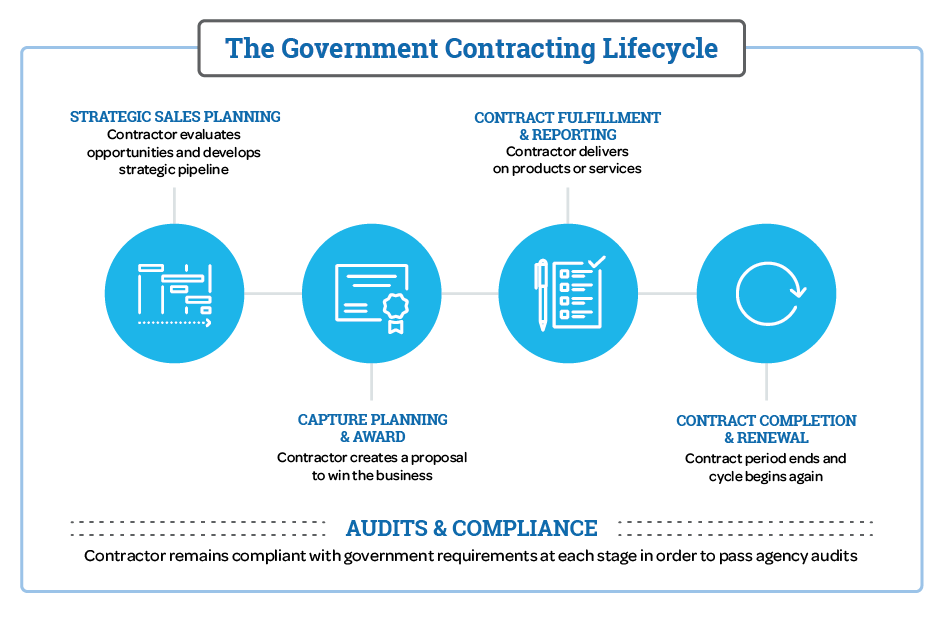
The entire process can be complex and is often referred to as the Government Contracting Lifecycle.
Guide
Win, Deliver, Renew, Repeat
Get a guide to the four stages of government contracting, plus why audits and compliance matter at every step along the way.
Strategies for Selling to the Government
Contract management and business development teams face several of the same challenges when working with the government. Often, they find it difficult to estimate and monitor resources, budgets, and schedules, while procurement professionals also continue to navigate persistent inflation.
Here are some common strategies businesses use to make selling to the government smoother and more rewarding.
Influence the Government Buyer
The most successful government contractors in many industries have a formal business development process for contacting buyers and influencing the development of project specifications well in advance. This includes following up on planned or budgeted items as well as unplanned future purchases.
Industry experts agree that influencing the buyer and building relationships before a bid or RFP is issued can dramatically improve win rates on government contracts.
However, you also need to be well-informed of government spending habits so you can offer relevant information to those buyers and position yourself as a knowledgeable, trustworthy resource.
It's important to consider the entire buying team, not simply the designated staff person. Individuals who can be involved on the purchasing end might include:
- Executive sponsor (who will have to sign off on the final decision)
- Internal champion (who has the most familiarity with your work or brand)
- Consultants (can be important in setting technical specs)
- Informants (administrative workers, assistants, etc.,, who can help connect you with resources and provide critical intelligence)
During outreach, best practices can include verifying the typical purchase cycle or trigger events, inquiring about their current satisfaction with their vendors and learning about the key factors that will help influence the buyer's decision.
Go Deeper
How To Win Government Contracts
The government contracting market is full of opportunity. Here are steps you can take to grow your public sector pipeline and win government contracts.
Capture Planning: A Guide for Government Contractors
This guide explains capture planning, along with steps your government contracting firm can take to win more contracts during the capture process.
Better Understand the Government Agency
Buyers are typically too busy to conduct extensive research and seek input from vendors who are sincerely interested in that agency’s needs and who offer useful information.
Procurement teams can often be too crunched for time to become knowledgeable about the entire range of products and services they may have to purchase. So when the time comes for SLED or federal agencies to tackle a new solicitation, they end up scrambling to catch up, reviewing older contracts, checking with their peers, and being open to advice from vendors. Your team may need 6-18 months to market a deal and to study the budget and CIP (Capital Improvement Plan) documents.
This makes it all the more important for a vendor to take the time to access all relevant government contracting resources when preparing for a procurement.
Here are a few of the things they should consider:
- Agency strategies and goals: Review and leverage official statements, their website, news, social media, and audits.
- Government sales cycles: Determine when your target government entities are most likely to be seeking out new prime contractors and releasing bids or RFPs.
- Technical requirements: Look at project requirements and determine whether a partner is needed.
- Competition: Study firms that have bid on or won earlier contracts.
- Contract type: Verify that you can fulfill the type of contract expected (i.e., IDIQ, multi-year term, etc.)
- Likelihood of making the purchase: Study draft documents, capital improvement plans, spending patterns, audits, etc.
Tools like GovWin IQ, the leading market intelligence platform that provides up-to-the-minute government contracting information and early notice of upcoming opportunities, can help add this critical government market information into your sales pipeline.
Guide
Build a Pipeline 3x Your Target
Get five best practices to grow your public sector sales pipeline, monitor competitors and early opportunities, and influence buyer decisions.
Selling to the Government Through Teaming Opportunities
Companies should not underestimate the importance of local economic impacts and local connections in contract decisions. In major projects, such as those in the construction industry, one strategy is for national firms to partner with or subcontract to a strong local company once the project is known.
In many federally funded projects, as well as some funded at the state or local level, set asides will call for small businesses, minority-owned businesses or women-owned businesses to be used – which are typically also local. This can lead to opportunities for firms to enter into teaming agreements to win the business.
Guide
Team With Primes to Win More
Fewer companies are winning prime dollars in today's competitive market. See why small businesses are teaming with primes to stay in the game.
Subcontracting with the Government
Maintaining a prime contracting position when selling to the government can be very costly, competitive, and challenging to meet the compliance requirements necessary to compete. This has led many contractors to choose to sell to the government as subcontractors instead.
Successful prime contractors often seek local subcontractors with specialized capabilities or unique value propositions to help differentiate their proposals. Larger, competitive prime contractors will normally influence local vendors, trying to convince them that they are the likely winner. They operate with a sense of urgency, realizing that the best subcontractors might have more than one offer.
Webinar
Don't Let Subcontracts Trip You Up
Learn how to identify and avoid the most common prime and subcontractor mistakes, from vague obligations to disputes with the government.
Tools to Enhance the Government Sales Process
Regardless of industry or level of government, the top strategies in government sales suggest that companies should invest time and effort in understanding the unique needs of their government prospects and clients.
Another common element is the importance of networking with and influencing the broader buying team, either directly or indirectly (through a teaming partner with local knowledge and contacts).
Now that you better understand the strategies for selling to different types of government agencies, you'll be better prepared to make the most of the government contracting market. You can do that with GovWin IQ – the most comprehensive source of market intelligence on state, local, and federal government contracting.