


Capture planning is the process of identifying and ultimately winning potential opportunities to expand your government business.
This article explains the ins and outs of the capture process, along with the steps your government contracting firm can take to increase its chances of success.
What is Capture Planning?
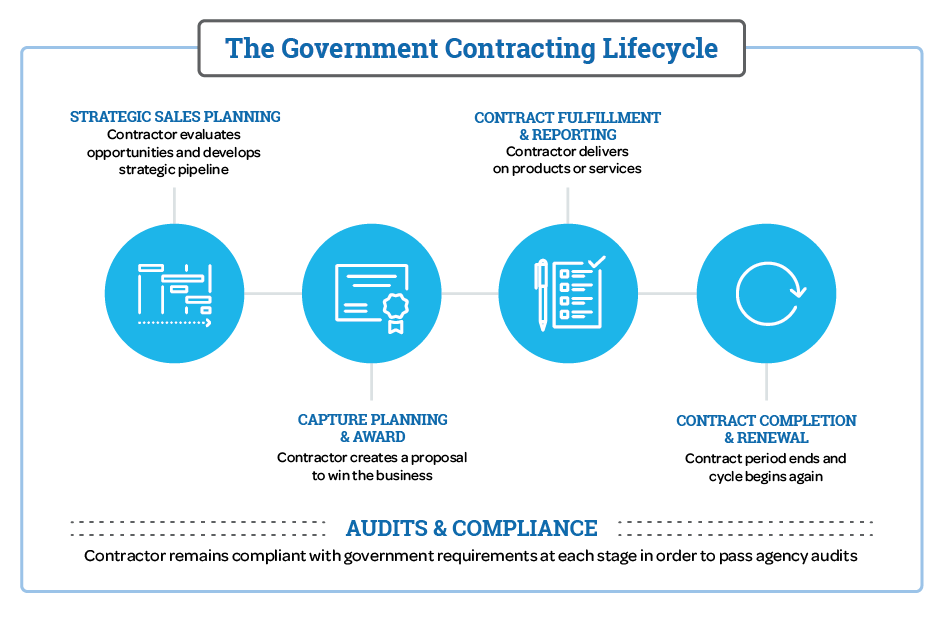
Capture planning is an important part of the Government Contracting Lifecycle.
As a government contractor, your first step towards growing your government sales is strategic sales planning, which involves evaluating opportunities and creating a pipeline of potential government sales leads.
Once you have that pipeline built, though, you'll need to be prepared to capitalize on it, or else all that advance planning will go for naught. This happens at the crucial second stage in the lifecycle, the capture planning and award stage.
With proper capture planning, your capture team can put together a winning proposal plan and turn those government sales leads into government sales wins.
Guide
Win, Deliver, Renew, Repeat
Get a guide to the four stages of government contracting, plus why audits and compliance matter at every step along the way.
How to Pursue the Right Types of Government Contracts
When the government is ready to formally seek out vendors to provide it with goods or services, it will release a bid, RFP (request for proposal), or contract opportunity in one of several forms. Generally, these contract opportunities fall into one of two categories: fixed price and cost-reimbursement.
The contract type is hugely important. It defines the expectations, obligations, incentives, and rewards for both the government and the contractor during an acquisition.
The contract type also determines how much responsibility the contractor takes on and how much profit incentive is offered for meeting or surpassing its goals.
If you are going to take the time to put together a strong proposal, you'll want to understand what the potential reward is for a job well done.
Capture Planning for Fixed-Price Contracts
Fixed-price contracts are used by all federal agencies and generally (though not always) provide a set and firm price. Fixed-price contracts are considered relatively straightforward and easy to manage compared to other types, as they provide more certainty for budgeting and overall costs.
Capture Planning for Cost Reimbursement Contracts
Cost-reimbursement contracts generally pay a contractor all of its expenses up to a set limit, plus an additional payment to allow the company to make a profit. Generally, projects with an uncertain scope or a higher degree of risk are the best fit for cost-reimbursement contracts.
While these two types are the most common, it's worth taking some time to review the differences between all the various types of government contracts so your business cano best prepare its proposal.
Guide
Speak the Language of GovCon
This free guide breaks down fixed-price, cost-reimbursement, and IDIQ contracts, plus teaming agreements and other indirect ways to get your foot in the door.
Small Business Set-Asides and Teaming Agreements
Not every company begins on the same playing field when entering the capture planning process. Larger, enterprise businesses have many more resources than those with only a few employees.
To improve your competitive position, consider including set-asides or teaming agreements in your capture plan.
Regardless of the size of your business or the industry you operate in, identifying the right solicitations to pursue is a crucial part of the proposal process. It's difficult to identify opportunities that offer the best chance of winning if you have an incomplete picture of the competitive landscape, are unaware of your target agencies, and have limited knowledge of industry labor rates.
Small Business Set-Aside Capture Planning
The federal government designates a certain number of contracts for small businesses and those that fit into particular categories, such as 8(a) businesses, women-owned small businesses (WOSB), and service-disabled veteran-owned small businesses (SDVOSB).
Having the right information and tools on hand to provide a complete view of the market is vital to making a better bid/no-bid decision about which opportunities to include in your capture plan.
Contracts and pre-notification alerts for these types of opportunities can be found on GovWin IQ’s market intelligence platform.
enter new fields or gain contracting experience through teaming agreements, such as subcontracting and serving as part of a prime contractor's team
Why You Should Consider Teaming Agreements
Outside of set-asides, small businesses often enter new fields or gain contracting experience through teaming agreements, such as subcontracting and serving as part of a prime contractor's team.
This tactic is a way to gain experience that often allows them to avoid some of the complex compliance requirements and challenges of competing against more established vendors, while gaining experience and building a track record.
For larger businesses, teaming up with a smaller partner can be a way in to opportunities they might not otherwise qualify for.
Guide
Team With Primes to Win More
Fewer companies are winning prime dollars in today's competitive market. See why small businesses are teaming with primes to stay in the game.
How to Develop a Winning Government Capture Plan
Once you've decided to bid on a government contract and have gathered all the background information you need, it's time to develop a capture plan and put together a strong proposal to win the business.
Here are four steps you can take to do that:
1. Know How to Respond to the RFP
Setting aside the time to understand the rules and regulations of the government contract you would like to secure is a non-negotiable necessity. If you don’t prepare well in advance and understand the technical requirements of the RFP, you're not going to be in a position to win the business.
2. Determine Who to Partner With If Necessary
As mentioned above, teaming and subcontracting are valuable strategies that can open the door to more business. If you can find partners that complement your company's strengths and mitigate your relative weaknesses, you'll have a leg up on the competition.
3. Rely on Fact-Based Information and Detailed Analysis
This element is crucial when performing a competitive analysis: If the analysis and data are inaccurate about an opportunity, vendors will be ill-prepared, less likely to respond appropriately, and less likely to win the contract. Make sure you have a reliable data source that you can trust.
4. Articulate Your Past Experience and Expertise
Just like in the commercial sector, at the end of the day, government buyers buy from people and companies they know and trust. Position your firm as an industry expert in advance and demonstrate this expertise when it comes time to put together your proposal.
The steps above are all important elements in proposal preparations. Government contracting proposal management is a complex field, and bidding on an opportunity without all the right information can be daunting – especially when the average proposal costs upwards of $10,000.
But well-written proposals can help make businesses of any size competitive in federal, state, and local, as well as Canadian government contracting, and give them the best chance of winning a contract award.
Power Your Capture Planning with the Help of GovWin IQ
Smart businesses know they can't simply register to sell to a government agency and begin winning federal, state, and local government contracts immediately.
Companies across industries can start a successful capture planning strategy by using solutions like Deltek GovWin IQ to understand the nuances of how government agencies operate and their preferences, to create a powerful proposal, win a government contract bid, and expand their public sector sales pipeline.
Are you prepared for GovWin IQ to help you and your business with its capture planning initiatives? Try GovWin for free today.


