


The government contracting market is complex but full of opportunity. Here are the steps you can take to grow your public sector pipeline and win more government contracts.
After finding government contracts and best-fit opportunities for your business, there are specific actions you can take to connect with the right decision-makers and put your best foot forward in order to beat out the competition.
By understanding the value of proactivity, how to get ahead of the bid or RFP process, and the competitive landscape, you can position yourself to win government contracts.
Guide
Build a Pipeline 3x Your Target
Get five best practices to grow your public sector sales pipeline, monitor competitors and early opportunities, and influence buyer decisions.
Understanding the Government Contracting Acquisition Lifecycle
Successful government contractors prepare in advance by targeting specific agencies (such as specific states or federal departments they wish to sell into), building key relationships, and developing a strategic plan to grow their business.
To do this, they must understand the contracting acquisition lifecycle to know which actions to take and when to set their business up for success.
The stages of the acquisition lifecycle generally look similar to this:
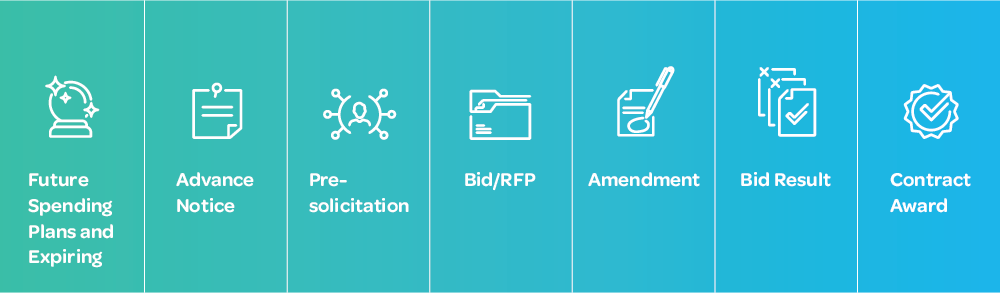
As you prepare in advance to win government contracts, keep an eye out for information and analysis that may help improve your ability to compete before, during, and after the opportunity is put out for competitive bidding.
Pre-RFP Intel in Budgets and Spending Plans
Forward-looking businesses can gain an advantage by gathering advance notice and pre-solicitation information on upcoming projects found in agency budgets, expiring contracts, and capital spending plans.
Currently Open Solicitations Like Bids and RFPs
While these and other common competitive solicitation types are the "bread and butter" of government contracting, being informed well before an opportunity goes to bid helps during the proposal preparation process.
Contract Award Information
Understanding data from bid results and contract awards showing where your competitors are winning, agency evaluation criteria, pricing, re-compete opportunities and mor,e can help set you up for the next opportunity.
Guide
Win, Deliver, Renew, Repeat
Get a guide to the four stages of government contracting, plus why audits and compliance matter at every step along the way.
How to Find and Bid for Government Contracts
In order to win government contracts, it first helps to identify best-fit opportunities before your competitors do.
For your business to get government contracts that fit your areas of strength, you will need to zero in on your target market, be that federal, state, local, or education, and look for government contracts that align with your strengths as a business.
How to Win a Government Contract Bid
Smart businesses know that they can't simply register to sell to a government agency and begin winning federal, state, and local government contracts immediately. Companies across all industries must understand the nuances of how government agencies operate and their preferences to win government contract bids and expand their public sector sales pipeline.
Architecture and Engineering Contracts
Successful architecture and engineering (A&E) business owners selling to the government must understand their target agency's goals, recent initiatives, and preferences. The better an understanding of how an agency operates, the better A&E organizations can position themselves to meet their needs and win more business.
Construction Contracts
Getting ahead in the bidding process can make the difference between winning a new construction contract and being too late to make an impression. Major construction projects like roadways and bridges take time, so gaining awareness of government construction contract spending years in advance is a must for construction business contractors to beat out the competition.
Information Technology Contracts
Winning contracts to provide cybersecurity, cloud-based solutions, consulting, telecommunications, wireless, hardware, or software services requires strategy. Studying past procurement habits and identifying upcoming contract renewals can help a Canadian, SLED, or federal contractor target IT contracts they're most likely to win.
Professional Services Contracts
Professional services companies support government business operations through management consulting, personnel and HR services, advertising and PR, or legal and accounting services. To win contracts, they must present their services in a way that is specifically tailored to the needs of their target agencies.
How to Win Federal Government Contracts
When an agency within the federal government needs to acquire a new product or service, or has an expiring contract for a product or service it intends to buy again, it will release an opportunity for bid, a request for proposal (RFP), or another type of contract, like sole-source contracts.
The federal contracting market is highly lucrative, accounting for billions of dollars in government contracting opportunities each year, but federal contractors should take time to understand its intricacies.
Federal Contracts
Federal contracts come in several different types, and each type of contract requires a unique approach to both bidding and performing the work.
Breaking down a federal contract to properly prepare to answer all the questions within it is essential to proposal management and creating a proposal to win a federal government contract. This part of the process is so critical that there are countless businesses available, such as Red Team, to help you do this right.
Federal Agencies
There are 15 executive agencies within the federal government, and there are hundreds of federal agencies and commissions with various responsibilities within each department. This can make it challenging to identify the right contracting officer and to track federal business opportunities from each agency you are interested in working with.
When you are preparing to win federal government contracts, a winning strategy can be to use market intelligence tools to identify federal spending areas well in advance, determine who to reach out to at your target agency, and then prepare your company's go-to-market strategy for when those opportunities are released in order to get out ahead of the competition.
Tools such as GovWin IQ track government projects that your business is a good fit for up to five years before a bid or a request for proposal (RFP) is actually issued, and can help you identify key decision makers to target for building relationships.
Guide
Federal Contracting, Simplified
This free guide breaks down how to register your business, find federal contracts, and understand the different types of contract vehicles.
How to Win State and Local Government Contracts
A strategic focus is required to win state and local (SLED) government contracts. SLED government agencies spend more than a trillion dollars every year, spread out across 50 states and a huge number of cities, counties, and other districts, so the opportunity is immense – but so is the challenge.
To succeed, state and local government contractors must be able to identify target buyers that are a good fit for the solutions that their organization provides, either by sifting through huge numbers of potential contracting opportunities and managing rules and processes that are unique to each government entity, or leaning on tools designed to support businesses that don't already have the institutional knowledge and processes in place.
Those businesses that focus on mastering the ins and outs of the SLED proposal process and scaling their approach as they grow will put themselves in a better position to submit winning government contract proposals on the state and local government contracts that best fit their core competencies.
Guide
Your Guide to the SLED Market
This free 101 guide breaks down which entities make up the SLED market, how to register and compete, and how to build a winning strategy.
Winning Government Contracts for Small Businesses
The environment for companies seeking to win small business government contracts is unique. Government entities such as the SBA (Small Business Administration) offer a number of small business set-aside contract opportunities through programs like these:
- 8(a) Business Development
- HUBZone
- Women-Owned Small Business (WOSB) Programs
- Minority-Owned Small Business (MOSB) Programs
- Service-Disabled Veteran-Owned Business (SDVOSB) Programs
- All Small Mentor-Protégé Program
Small or disadvantaged businesses can compete on a more level playing field by first determining which socioeconomic categories, if any, apply to their business. Registering with the SBA and reviewing which categories their business aligns with can help to spotlight opportunities they are most likely to win.
Guide
How to Win Small Business Government Contracts
Download this guide to learn how to get your small business started in government contracting and get tips on bidding on contracts and developing a strong proposal.
How to Win Canadian Government Contracts
The opportunity to win Canadian government contracts is one that is worthwhile but not without challenges.
Historically, businesses have struggled to maximize growth in Canada's public sector market – largely due to the fragmented nature of public sector spending across federal, provincial, and municipal levels of government. That, coupled with the unfamiliarity of this market and its bidding process to many U.S.-based businesses who are unfamiliar with how to get government contracts in Canada, has created a relatively untapped pool of potential revenue.
For a business to submit a successful proposal for Government of Canada contracts, there are a few key steps to follow that will best position it, to make a winning bid.
The first step to successfully doing business in Canada is understanding the market and where your business is likely to be effective by determining which entities buy which goods or services, how much these governments have bought before, how these governments have bought and plan to buy goods or services of interest and which regions or jurisdictions are most attractive to your company. That information, along with a full pipeline of best-fit leads, will give your business the best chance to win government contracts in Canada.
Guide
Break Into Canada's $200B Market
Get a 101 guide to selling into Canadian federal, provincial, territorial, and municipal governments, plus the basics on fiscal years and market entry.
Teaming and Subcontracting Opportunities
Small businesses often break into new markets or gain contracting experience through subcontracting and serving as part of a prime contractor's team.
It is a way to gain experience that often allows you to avoid some of the complex compliance requirements and challenges of competing against more established vendors for prime contracts, while building past performance and opening up more contracting opportunities.
Larger businesses can also benefit by teaming up with the right small business, allowing them to seek a broader range of government contracts. Developing relationships is a valuable tool that can help build a public sector sales pipeline.
Guide
Team With Primes to Win More
Fewer companies are winning prime dollars in today's competitive market. See why small businesses are teaming with primes to stay in the game.
How to Price, Submit, and Negotiate Proposals
To price your proposal skilfully, you'll need to strike a strategic balance between competitive positioning and realistic cost forecasting.
Start by conducting a detailed cost analysis that includes both direct and indirect expenses, ensuring every element of the project is financially accounted for. Use competitive analysis and historical data to benchmark your pricing, ensuring it aligns with industry standards while remaining attractive to government agencies.
The next step is submitting the proposal, where precision and compliance are paramount. Ensure your proposal is comprehensive, clear, and aligns with all solicitation requirements. It should effectively communicate the value of your solution, backed by robust evidence and clear, concise financial documentation. Pay close attention to the formatting and submission guidelines specified by the agency, as deviations can lead to disqualification.
Negotiation is the final hurdle in securing a government contract. Be prepared to defend your pricing structure with detailed, data-filled justifications. Understand the government's objectives and be ready to make adjustments that accommodate their needs while protecting your margins. Effective negotiation strategies involve flexibility, transparency, and a thorough understanding of the procurement process.
Pro tip: Maintain open lines of communication with your contracting officials to foster trust and facilitate a win-win agreement.
Leveraging tools like Deltek ProPricer can revolutionize your bidding process. Efficiently aggregate costs, fine-tune pricing strategies, ensure consistency in proposal submissions, and enhance your negotiation skills—all much more quickly than through Microsoft® Excel®.


