Workarounds became the workflow. That’s finally changing.
Ask a pricing analyst where the labor category mapping lives on a services proposal. They'll point you to a spreadsheet.
Ask an estimator how BOM data gets from the ERP into the proposal. They'll describe a process that involves exports, reformatting, re-entry, and reconciliation — repeated with every design change and supplier update.
Ask a proposal analyst how they set up a new cost volume document. They'll tell you they configure the same report parameters again. From scratch. Every time.
None of these teams chose these workflows. They adapted to them. They built processes that worked well enough, delivered proposals on time, and survived the intensity of an increasingly demanding contracting environment.
But as proposal complexity grew, those workarounds began to show their limits.
More labor categories. More material data. More audits. More proposals. More pressure to move quickly while maintaining complete confidence in the numbers being submitted.
The problem wasn't that proposal teams lacked tools. The problem was that critical parts of the workflow lived somewhere else.
The latest ProPricer release is about closing those gaps.
The Workflow Gaps We Learned to Accept
Every proposal team has a version of the same story. Important work happens outside the system of records. Not because anyone wants it there. Because that's where the process evolved.
Labor-Driven Proposals
For proposals built around labor — services contracts, T&M vehicles, cost-plus IDIQs — the gap begins with how labor categories are defined.
Government RFPs define their own labor categories. Internal job structures rarely align with those requirements. Someone has to translate one into the other, assign rates, manage escalation across performance periods, and certify the result.
For years, that translation layer lived in spreadsheets. A pricing analyst built a separate model, reconciled it manually, and ran it alongside the pricing system until submission. The audit trail for that work lived in Excel. The version control was whoever sent the last email.
Material-Intensive Proposals
For proposals built around materials — complex hardware programs, manufacturing contracts, platform development bids — the challenge takes a different form. The Bill of Materials, or BOM, is the structured list of components, assemblies, and raw materials required to build what the contract demands. It lives in the ERP or primary system of records. Yet before it reaches the proposal, it passes through exports, spreadsheets, standalone estimation tools, and manual reconciliation steps.
The source data exists. The proposal exists. A governed path connecting them often does not. And when TINA applies, each manual handoff in that chain becomes part of the certified cost data story your team may eventually have to defend.
Proposal Administration
The third gap is less visible but no less real. Proposal teams accepted that document preparation meant repetitive configuration work. Every new document built from a cost volume template required the same report parameter setup — section by section, parameter by parameter, from scratch. It wasn't complicated. It was just something that had to be done. Every time.
Viewed independently, these look like different problems. One is a pricing problem. One is an estimating problem. One is a proposal management problem. But they share a common root cause: critical proposal work living outside the systems responsible for governing it.
What Happens When Critical Work Lives Outside the System
The immediate consequence is usually inconvenience. A few extra steps. A spreadsheet. A manual handoff repeated one more time. Over time, those inconveniences accumulate into something larger.
Proposal teams become experts at reconstruction.
Finding the right spreadsheet. Finding the right export. Finding the right version. Finding the person who remembers why a decision was made six months ago.
The challenge isn't simply efficiency. It's continuity. The best organizations don't reconstruct evidence after the fact. They generate it as part of the workflow.
The proposal teams that operate with the most confidence are the ones where the workflow generates the audit trail — rather than requiring it to be assembled afterward. As proposal volume, audit scrutiny, and contract complexity increase, reconstruction becomes increasingly difficult to scale. The manual chain that worked at lower volume starts to break under the weight of what modern government contracting demands.
What Changes When the Workflow Lives Inside the System
By now, the problem is clear. What changes is the answer — not abstractly, but concretely, workflow by workflow.
Services Proposal Pricing No Longer Needs a Parallel Process
The translation problem in services proposals was never going to solve itself. Government RFPs define labor categories. Internal systems have job grades. Those two structures don't align by default — and they were never going to. What changed is where the translation happens.
ProPricer now includes a purpose-built services pricing capability, including Rate Builder, that brings labor category mapping inside the governed system. Proposal teams can define RFP labor categories at the proposal level, map them to internal resources, control rates at the row level, and manage escalation across option years — all within ProPricer.
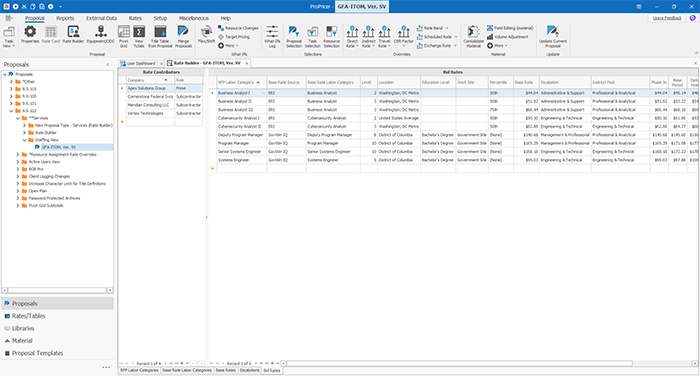
Services proposal pricing — labor category mapping inside ProPricer
The labor mapping that lived in a spreadsheet sidecar now lives inside the system responsible for the audit trail. The parallel process goes away. The traceability doesn't.
Material Estimating No Longer Needs a Separate Workflow
Material estimation and proposal pricing have always required the same data, the same accuracy, and the same auditability. What kept them separate wasn't logic — it was the absence of a governed path between the source system and the proposal.
Material Estimating in BOE Pro closes that path. BOM data flows directly from ERP systems — Costpoint, SAP and others — into a structured Material View inside BOE Pro, and from there into Contractor Edition for reporting.
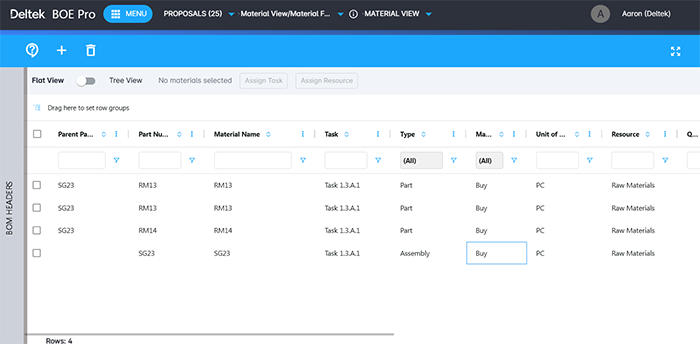
Material Estimating in BOE Pro — ERP-connected BOM workflow
The export, the re-entry, the reconciliation — the manual chain that repeated with every design change — is replaced by a single connected workflow. When DCAA asks about a BOM line item, the answer is traceable from source to submission. Not reconstructed. Already there.
Interested in the material estimating workflow?
Join our webinar on July 9 to see how BOM data moves from ERP systems into BOE Pro and Contractor Edition through a single governed workflow.
Configure Once. Reuse Everywhere.
Not every workflow gap announces itself as loudly as a spreadsheet. Some are simply repetitive work that proposal teams have learned to accept — configure, reconfigure, repeat.
Every time a proposal analyst created a new document from a cost volume template, they manually reconfigured report parameters for each section. The template existed. The configuration didn't transfer. So, the work repeated.
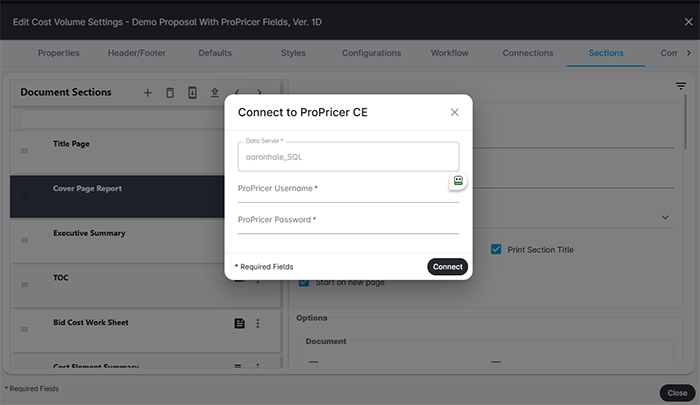
Cost Volume Pro — report parameters saved at template level
Templates now store complete report parameter configurations. New documents inherit those parameters automatically. Document-level overrides remain available where needed, but the default is no longer starting from scratch. The value isn't that teams can configure templates. It's that they no longer have to keep doing it.
The Bigger Shift
For years, government contractors have accepted a reality that never made much sense: some of the most important work behind a proposal happened somewhere other than the system responsible for governing it.
Labor pricing happened in spreadsheets. Material estimating happened between ERP exports and disconnected tools. Proposal teams repeated the same setup work because there was nowhere else for it to live. Over time, those processes became normal. Teams adapted to them. The workaround became the workflow.
What changed isn't the work itself. Proposal teams still need to map labor categories, estimate materials, and build compliant documentation. What changed is where that work happens.
This release doesn't eliminate proposal complexity. It eliminates more of the complexity involved in managing it. And proposal teams should no longer have to accept that critical work lives outside the system responsible for governing it.
See it in Action
Join us June 30 for a live look at how services proposal pricing now happens inside ProPricer.
From RFP to Submission: Take Control of Services Labor Pricing
We'll show exactly what it looks like when labor category mapping, rate governance, and services proposal pricing happen inside ProPricer — from the moment the RFP arrives to the moment the bid goes out.