Services contracts represent the majority of what the federal government buys.
Yet for most government contractors, the pricing workflow behind those contracts has never actually lived inside the pricing system.
It lives somewhere else. In a separate model. A parallel process. A spreadsheet that runs alongside the system of records until the proposal goes out the door.
Most proposal teams didn't choose this. They adapted to it. They built workarounds that worked well enough, and over time those workarounds became part of how the business operates.
That's worth pausing on.
An entire category of proposal pricing — making up the majority of federal contract spending — has been running outside the system designed to govern it. Not because teams made the wrong choice. Because the right tool didn't exist.
That's not an operational gap. That's a category gap.
And it's been hiding in plain sight for years.
The Problem Was Never the Spreadsheet
It's easy to look at the spreadsheet and assume it's the problem.
It isn't.
Services proposals operate differently from most traditional pricing workflows. Labor categories are defined by the RFP — not by the contractor's internal structure. Every opportunity brings its own categories, its own rate requirements, its own escalation logic across performance periods. Someone has to bridge the gap between what the government defines and how the contractor actually staffs the work.
For years, no purpose-built pricing tool was designed to handle that translation inside a governed environment.
So, teams built workarounds. They persisted because there was no governed alternative designed specifically for labor-driven proposal pricing.
That's what makes this more than a conversation about tools. For an industry where accuracy and defensibility aren't optional, it's a surprisingly large gap to have accepted for this long.
What Happens When the Workaround Becomes Infrastructure
A single spreadsheet supporting a single proposal is manageable.
The problem is what happens as the business grows.
Proposal volume increases. Teams distribute. Subcontractors multiply. Option years compound. What started as a practical solution to a specific problem quietly becomes load-bearing infrastructure that was never designed to carry that weight.
Knowledge concentrates on the people who built the model. Reconciliation becomes a fixed cost of every proposal cycle. Version control becomes a source of risk. And at some point, the challenge stops being how to price the work.
It becomes how to manage the process required to price it.
The question was never whether spreadsheets can work. Many teams have made them work for years. The harder question is whether they remain the right foundation for a process that has become more strategic, more complex, and more scrutinized — and where the proposals that matter most have the least tolerance for a fragile process underneath them.
Services Pricing No Longer Needs a Parallel Process
For years, services proposal pricing has existed alongside the pricing system.
One workflow held the official record. The other held the labor category mappings, rate assumptions, escalation logic, and proposal-specific decisions that made the bid work.
Two workflows. Two sources of truth. One proposal.
Teams accepted that arrangement because there was no practical alternative.
With ProPricer's latest release, there is. The model that runs alongside the system moves inside it.
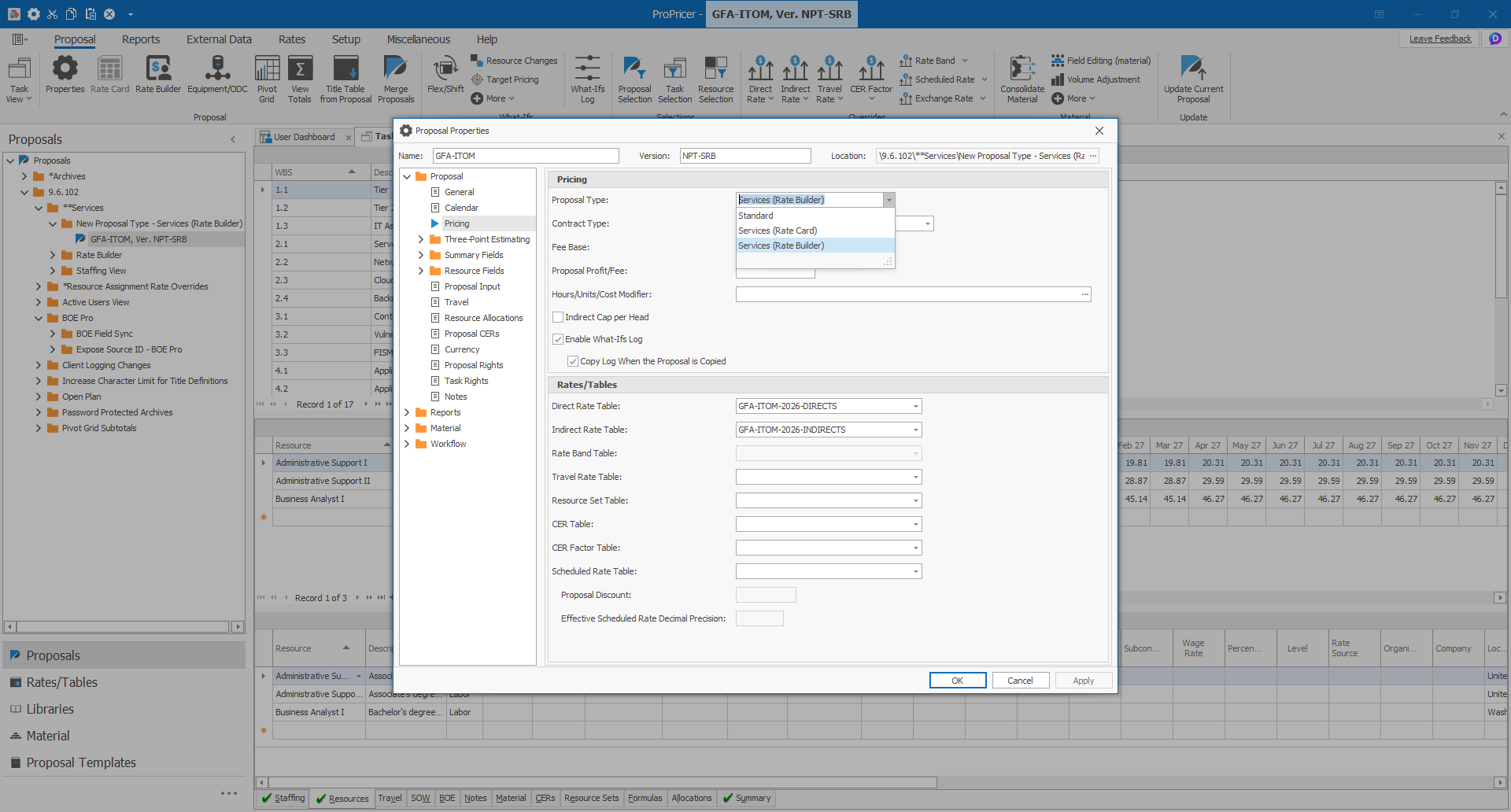
Launch Services Proposals in the Right Environment
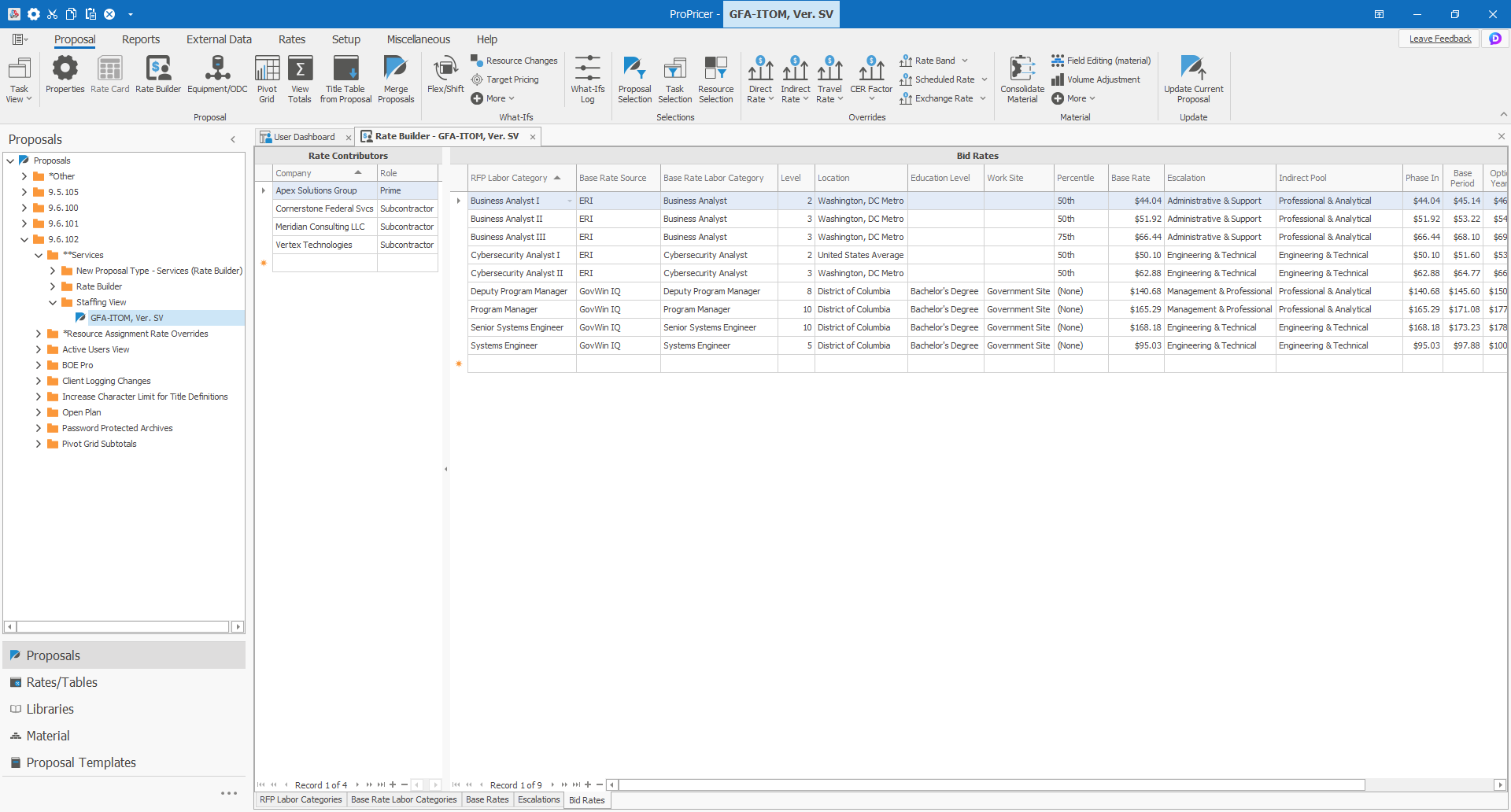
Proposal teams can now define proposal-specific labor categories, manage rate sources, account for escalation across performance periods, incorporate subcontractor rates, and build services proposals entirely within ProPricer. The separate model goes away. The manual reconciliation goes with it.
For the first time, the workflow that has historically existed outside the pricing system can now be managed within the same governed environment as the proposal itself.
Bring Labor Pricing into the Governed Workflow
Services proposals also start in the right place. Rather than forcing teams to adapt a standard workflow to a fundamentally different pricing problem, ProPricer provides a dedicated services pricing experience designed specifically for labor-driven contracts.
The expertise doesn't change.
The process does.
The Standard Just Changed
Services contracts are the majority of the federal market. The pricing workflows behind them should be held to the same standard of governance and defensibility as everything else in the proposal process.
For the first time, they can be.
If you're a services-focused contractor not currently using ProPricer, this is the reason the conversation changes. A purpose-built, governed services pricing system now exists — one designed for the full complexity of labor-driven proposals, without a spreadsheet running alongside it.
If you're an existing ProPricer customer with services contracts, the new services-focused capabilities extend the governance you already trust into the part of the proposal process.
Services pricing no longer needs to live outside the system of record.
And that changes what government contractors should expect from their pricing platform.
See It in Action
Join us June 30 for a live walkthrough of how services proposal pricing now happens inside ProPricer.
From RFP to Submission: Take Control of Services Labor Pricing
We'll show exactly what it looks like when labor category mapping, rate governance, and services proposal pricing happen inside ProPricer — from the moment the RFP arrives to the moment the bid goes out.