It’s no secret that generative AI is increasingly being integrated into the SLED (state, local and education) government procurement space, appearing in bids, RFPs, and RFIs through specific requests for AI-based or AI-included products and services.
At Deltek, the researchers behind our GovWin IQ solution of government market intelligence have been using our proprietary system of Smart Tags and used specific keywords to analyze trends in bids that feature AI prominently or include AI-related language in the bid documents. Our latest report, The Rise of AI in State and Local Contracting, provides a look at the landscape and impacts of AI in SLED procurement.
Generative AI in SLED Procurement
In addition to AI-related bids, RFPs and RFIs, governments may also require vendors to disclose AI use or suggest AI applications for the requested services. This integration enhances procurement efficiency and decision-making in areas like spend analysis, supplier selection, demand forecasting, contract management, risk management, invoice data extraction, and the use of chatbots and virtual assistants. AI can help governments optimize costs, manage suppliers, predict demand, ensure compliance, mitigate risks and streamline processes.
Examples of SLED AI Contracts
- In Georgia, the Georgia Technology Authority released a request for information seeking AI technologies to enhance the procurement lifecycle to lessen the manual effort, reduce inefficiencies and potential inconsistencies.
- The State of Rhode Island has released a solicitation to establish an artificial intelligence task force to evaluate the advantages and disadvantages that adoption of AI technologies could have across state departments.
Support for AI Projects From State Governments
State governments, as in the examples of Georgia and Rhode Island above, have shown strong support for AI in this year’s “state of the state” addresses, with several governors emphasizing the importance of understanding AI and exploring its benefits for government operations. This highlights their intent to stay current with technological advancements.
However, regulatory measures are also being considered, such as Tennessee’s proposed legislation to prevent improper AI use, reflecting a cautious approach that emphasizes transparency and ethics in AI deployment.
Growth in Artificial Intelligence Government Bids
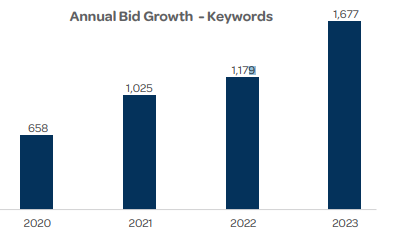
Before the full report dives deeper into some of the detailed analysis, it begins with an overview of the last four full years showcasing AI growth within bid documents based on keyword search and Smart Tag data. By analyzing AI bids using the keyword search method from 2020 to 2023, we observed modest growth for the first three years. However, 2023 experienced a notable 42% increase in bids. This surge meant SLED governments enhanced their understanding of generative AI, aiming for greater transparency and better insights into vendor submissions, as well as to request specific AI products and services.
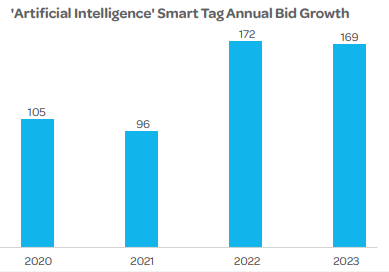
The Smart Tag method reveals a different visual trend compared to the keyword method, but both show similar directional growth. After a flat period in 2020-2021, bids featuring the Artificial Intelligence Smart Tag surged in 2022, remained flat in 2023, and have significantly increased in the first half of 2024, reaching 74% of 2023’s total by Q2. The long-term trend indicates continued growth. The advantage of using Smart Tags is they are more effective at tracking actual instances of purchases where that particular theme is the main item in the scope of work. Before ChatGPT’s arrival, SLED buyers were already preparing to implement AI through new contracts in 2022. Although AI-related keywords surged in 2023, significant growth in dedicated projects did not appear until 2024.
State Governments, Colleges and Universities are Purchasing AI the Most
Analyzing interest in AI by specific levels of government from 2020-2023 reveals that state governments, cities, and colleges/universities are the most likely to mention AI in their bids, with state governments leading at 42%. This data highlights a relatively greater interest in AI technologies from state governments and higher education institutions, which have the scale, expertise and research capabilities to adopt advanced technologies.
Similarly, from 2020 to 2023 utilizing the Smart Tag method, colleges and state governments again showed the highest propensity to purchase AI or include it in their projects, with propensities above 1.00. This aligns with keyword analysis findings, highlighting these entities as primary sources of AI interest. In particular, colleges and universities have been early adopters. They're using AI in research labs and educational tools, indicating a strong likelihood to buy AI-related products and services. Vendors should consider tailoring their marketing strategies to emphasize the most sophisticated buyers who are more inclined to include AI in their projects.
Further Analysis on AI in State and Local Government Procurement
The complete report offers a detailed quarterly breakdown of data, providing an in-depth analysis of trends. It examines which of the 12 government industries are currently most interested in AI. Additionally, it includes forecasted data based on these trends and discusses the value of typical AI-related purchases.
Request your copy of this report today and learn essential insights about AI as it increasingly dominates the SLED government procurement market.
Free Report
Stay Ahead of the SLED AI Curve
This free report breaks down market perception, government interest levels, and where AI applications are gaining traction across the SLED market.