ASC 606 revenue recognition standards have reshaped how professional services organizations manage contracts and financial reporting. Compliance isn’t just about ticking boxes—it’s about ensuring accuracy, transparency, and trust in every transaction. With complex rules around performance obligations and timing, businesses need a clear framework to avoid costly errors.
This guide explains ASC 606 in practical terms, covering the five-step model, common challenges, and proven strategies for implementation. You’ll also discover how Polaris PSA can automate compliance, streamline workflows, and reduce risk. Whether you’re a finance leader or operations manager, this resource equips you with the tools to stay compliant and competitive.
Key Takeaways
- ASC 606 standardizes how companies recognize revenue: It provides a unified framework to ensure revenue is recorded consistently across all customer contracts.
- The five-step model guides compliant revenue recognition: Identify the contract, identify performance obligations, determine the transaction price, allocate the price, and recognize revenue as obligations are satisfied.
- Compliance requires updated systems and detailed tracking: Organizations must redesign processes, review contracts carefully, and implement rules-based tracking to avoid misstatements and meet disclosure requirements.
What Is ASC 606 for Revenue Recognition?
ASC 606 is one of the revenue recognition standards that regulates when companies can officially account for revenue earned. It was drafted by the International Accounting Standards Board (IASB) and the Financial Accounting Standards Board (FASB) in 2014 and is similar to the IFRS 15 standard.
ASC 606 offers a definitive standard to measure and recognize revenue for all businesses. This guide will walk you through the concept of ASC 606 and help you understand its role in revenue recognition.
What Is ASC 606?
ASC 606 is the revenue recognition standard that helps businesses recognize revenue consistently. Financial Accounting Standard’s Board (FASB) and International Accounting Standards Board (IASB) designed to overcome accounting variations and ensure overall consistency.
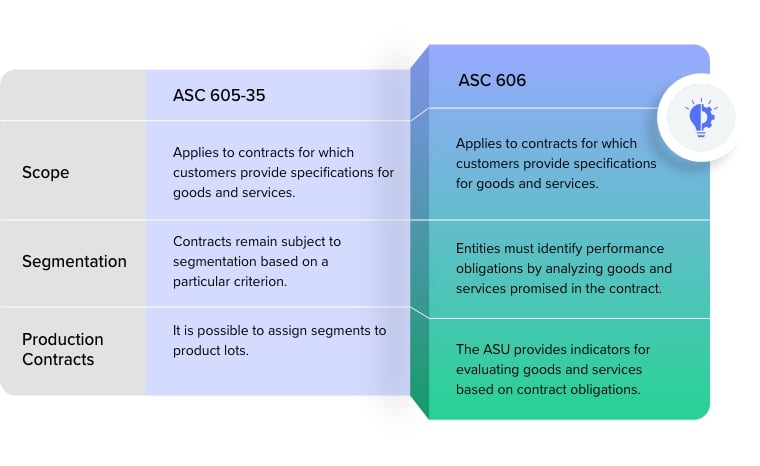
Officially titled Revenue from Contracts with Customers (Topic 606), ASC 606 applies to businesses when they enter into contracts with their customers. In addition to contracts, it can also regulate the transfer of goods or services. The standard applies to public, private, and non-profit organizations.
FASB and IASB’s goal was to update the existing standards to make the creation of financial statements and comparative analysis simpler. The standards help businesses streamline their financial and accounting processes to remain in sync. The ASC 606 guidelines also help streamline revenue calculations for tax purposes.
ASC 606 helps standardize the revenue recognition timeframe for business entities; it can aid anyone from manufacturing companies to SaaS-based organizations in streamlining their revenue-recognition accounting processes.
ASC 606 provides businesses with a framework that helps them recognize revenue with consistency.
Implementing ASC 606 – The 5 Step Model
Implementing ASC 606 will help you enable consistent financial reporting and improve comparative analysis. Here’s how the five-step model works.
1. Identify the Contract Criteria
You’ll need to outline the criteria essential for inclusion in a contract with your customer for the supply of services or goods.
2. Identify Performance Obligations
You’ll want to enumerate the obligations you’ll need to fulfill during the course of the contract.
3. Determining the Transaction Price
You’ll need to determine an appropriate transaction price for the goods and services you’re offering, taking into account factors like profit margin and competitor pricing.
4. Calculate the Transaction Price
You will define a method for calculating transaction prices that factors in all contract obligations. The customer will have to agree to the price determined by this method.
5. Recognize Revenue Based on Performance Obligations
Your businesses will begin recognizing revenue as they start meeting the performance obligations outlined in the contract.
What Is the Impact of ASC 606?
ASC 606 provides a framework and simplifies the recording of revenue in customer contracts. It provides a guideline for businesses to report on the nature and amount of earnings based on contract obligations.
ASC 606 has had its biggest impact on SaaS-based businesses with license-based, subscription-based and recurring revenue models.
Let’s consider the example of a SaaS-based company that offers annual subscriptions. When one of their clients upgrades or downgrades the service, their contracts will need to be revised accordingly. This makes it difficult to identify the contract, the starting point of the 5-step model, which creates revenue recognition problems.
Similarly, complex and lengthy subscriptions can also make recognizing revenue a difficult task. For example, a company may have non-refundable subscription fees, in addition to a pay-as-you-go model, where clients only pay for what they use. All of these factors contribute to the complexities associated with recognizing revenue.
Benefits of ASC 606 Compliance
Implementing ASC 606 compliance will help your business in several ways:
1. Investments
Most investors and financial institutions require up-to-date and industry-compliant financial records. ASC 606 offers standard compliance measures that make it easy for you to seek investments.
2. Sales Cycle
Complying with ASC 606 can improve and standardize your sales cycle, helping you remove bottlenecks and overcome inconsistencies. For example, you could streamline your quoting process and eliminate contract discrepancies.
3. IPO
ASC 606 complies with the regulatory norms of IPOs. So, if you ever want to apply for an IPO, the process will be simpler.
Penalties for Non-compliance
IASB and FASB work with the Department of Justice (DOJ) and the Securities and Exchange Commission (SEC) to enforce compliance with financial laws. Companies that fail to comply with ASC 606, by reporting revenue different from actual earnings, are subject to penalties ranging from fines to jail terms.
Recognizing Revenue With ASC 606
Under ASC 606, revenue recognition occurs when businesses meet their contractual obligations and receive payment for their services or goods. As outlined earlier, recognizing revenue is much more complicated when it comes to the SaaS industry, and such organizations cannot afford non-compliance. Revenue recognition software helps overcome the challenges SaaS organizations have recognized revenue.
In addition, SaaS-based businesses manage different billing methods and models based on the usage levels of customers. Revenue recognition software allows for accurate calculation of revenue in service upgrades, downgrades, or cancellation scenarios.
Latest Updates to ASC 606
One of the major changes to ASC 606 is the need for wide-ranging disclosures by businesses. They also need to share qualitative data, which was not the norm previously.
How to Implement the ASC 606 Standard
Here’s how you can implement the ASC 606 standard for your business in seven steps:
1. Design the ASC 606 Dataset
To account for sales, it is essential to assign them commissions. You must also apply them at each credit level, from account executives to sales heads. It’s also beneficial to have a process to capture contract commencement and commission record lengths – such a method will help you categorize sales based on new subscriptions, renewals, etc.
2. Create a Dedicated Ruleset
You will need a dedicated ruleset compliant with the ASC 606 standard that accurately calculates the expense allocations for each sale. Since this can be a difficult process, feel free to begin slowly and scale up as you gain experience.
3. Identify Contracts
A contract is a financial agreement between two parties for GAAP accounting purposes. Contracts are also agreements between the customer and organization. You can identify contracts after making less formal agreements. The companies will identify the payment terms and obligations of both parties.
4. Identify Performance Obligations
Contract obligations will depend on the type of product or service offered by the business. There could be delivery timelines and stipulations to oversee project execution.
The timelines should remain reasonable for both parties. Similarly, there could be additional flexibilities if it is a complex project. Fulfilling performance obligations is easiest for retail businesses; the business delivers the product or service, and the customer pays.
Multi-year contract obligations take time to fulfill since they may include several project-based milestones whose fulfillment constitutes meeting contract obligations.
5. Understand the Transaction Price
Transaction prices may be simple for shorter contracts. However, your data and ruleset should support the inclusion of various transaction price formats depending on contract types and durations.
6. Allocate the Transaction Price
Contracts with multiple obligations should have a transaction price allocated to each one. You can categorize transactions based on the obligations listed in the contract.
7. Recognize Revenue
The last step is to make the revenue calculations. The outcome of calculations will depend on the revenue recognition method used by your business.
Frequently Asked Questions
ASC 606 helps businesses recognize revenue more accurately through consistent financial reporting. It also enables streamlining of financials and accounting processes.
ASC stands for Accounting Standards Codification in accounting terms.
Completed contracts under ASC 606 include those where all or substantially all revenue has been recognized. The IFRS 15 completed contracts include the ones where an entity has transferred goods/services.
ASC 606 in revenue recognition helps businesses recognize revenue more accurately by laying a strong foundation for accounts and financials.
ASC 606 defines a customer as a party contracted to an entity for obtaining goods or services. These transactions should be a part of the entity’s ordinary activities.