For the first time since FY 2019, we have entered into a U.S. federal government shutdown, as federal funding expired at midnight on October 1, 2025.
Federal government shutdowns have a wide range of effects. The severity is largely determined by the duration and specific directives from the Office of Management and Budget (OMB) guiding how agencies operate (or not operate) during a shutdown. Deltek’s Federal Market Analysis Research team recently published an article, "Anatomy of a Federal Shutdown: FY 2026 Edition", that explains the mechanics of a shutdown, implications to agencies, federal workers and federal contractors; and contractor considerations to consider while Congress works towards a funding agreement.
The Latest 2025 Government Shutdown Updates
After more than a month of the government being shut down, a 13th vote to advance a continuing resolution to reopen the government fell short of the 60 votes needed to pass, which has innumerable impacts. From a procurement standpoint, some contractors performing funded work may be facing invoicing backlogs due to the contracting staff responsible for processing being furloughed.
Some contracting officials, however, have remained in office and are responsive to inquiries. And contract activity has continued: Contracting offices are continuing to post sources sought, solicitations, amendments and even awards. Contractors should note that federal government agencies like the Air Force, Navy and DOD are still looking to procure goods and services.
Government Shutdown Considerations
Shutdowns are extremely disruptive and costly, but we want to offer up some shutdown takeaways that may offer some "comfort":
- Not all operations cease. Operations that are deemed "essential" continue to operate (but the government can change the "essential" classification whenever it wants). Federal employees and contractors can continue to work UNPAID (however, only federal employees are guaranteed back pay after the shutdown ends). OMB recently issued guidance directing mass layoffs in the event of a shutdown, but agencies' ability to pull that off during a shutdown is questionable.
- Not all operations are funded by appropriations. Shutdowns occur due to the absence of Congressionally directed appropriations, but some agencies have other budgetary resources called "offsetting collections" and "offsetting receipts". This is funding from other sources, such as passport fees collected at the Department of State, registration and inspection fees at the FDA, and passenger security fees at TSA.
- Rollover appropriations can be used. If agencies have unexpired funding from previous appropriations that they are allowed to roll over, that can serve to float agency operations for a time.
- Additional funding from the OBBBA. The funding from the One Big Beautiful Bill Act is still available to agencies. You can access our report to identify agencies that received appropriations for potentially contractor-addressable work.
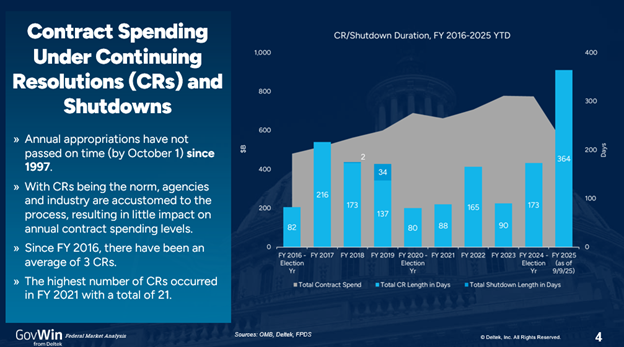
- Contract spending recovers. Although operations in this administration are in some areas very different from the norm (and unpredictable), historical data shows us that contract spending recovers after shutdowns. The last shutdown occurred in FY 2019 and lasted over a month (34 days to be exact), after which agencies were able to get back on track with FY 2019 contract spending.
Free Report
See Where DOD, DHS, and NASA Are Investing
Get agency-level insights into the One Big Beautiful Bill Act, plus the contractor-addressable markets across defense, IT, and infrastructure.
Agency Contingency Plans
Agencies are required to develop contingency plans that identify the type of work and number of federal employees that are exempt, and which ones are subject to furlough. Not all of the details are currently available, but we've identified plans for the largest agencies:
Federal Contractor Takeaways
A shutdown is not great in the best of times, let alone after months of significant change across all facets of acquisitions. Contractors' best course of action is to stay in contact with their agency POCs where possible, assess potential risk scenarios for a range of duration timeframes and hope for the best.
Deltek’s team of federal market research analysts will continue to monitor developments in the appropriations process. Stay tuned to our market analysis for the latest developments, and for further advice on how federal government contractors can move forward.