


The ups and downs in SLED (state, local and education) government contracting revolve around what is known as the “fiscal year end” or end of a given public organization’s fiscal year. The federal year end is September 30, while the most common year end for SLED governments is June 30th. Tax-supported governments generally follow the classic “spend it or lose it” budgeting principle that states the unused funds remaining may end up being cut in the next budget cycle.
The experts at Deltek behind the GovWin IQ product of government market intelligence track the levels of spending from SLED governments all through the year. In this article, we’ll use that information to provide your business with pro tips on how to optimize your business development approach and increase your SLED government contract win rates by understanding and leveraging fiscal year dynamics.
The Significance of the Fiscal Year End
The seasonal cycle of state and local government contracting means that toward the end of the fiscal year, a larger number of decisions will be made about authorizing new bids or RFPs (request for proposals). They will either 1) be awarded and paid for out of the remaining annual budget, or 2) fully or partly be paid out of the following year’s budget, but the government had to wait until this point in the current fiscal year before there would be enough visibility into the finances of the coming year to justify moving forward.
June is the most common fiscal year end month for SLED governments overall. The share of bids was reported at 52% for June (heavily states, education and larger cities and counties), and the runner up was 30% for December (heavily smaller local government).
Understanding Fiscal Year End Differences by SLED Government Types
Cities and towns are the leading form of government with a December year end, with 53% December and only 22% June as a year-end month. So that might suggest December would work as a rule. However, 66% of all city/town governments with a December year end are either a township or town while only 21% are a city.
When you remove towns or villages from the city category and just look at the actual “cities,” there is a balance of June versus December (about 4,000 for each) in the number of governments. Independent K-12 school districts and higher ed institutions were at 83-90% June. The fairly large minority of non-June and non-December month organizations has to do with the fact that a few of the only states to not use June didn’t use December either.
How Fiscal Year Affects the Pattern of Bids and RFPs Issued
Bids issued by SLED governments tend to peak around March to May each year. They are about average for June (the most common fiscal year end) and well below average for December (the runner up fiscal year end).
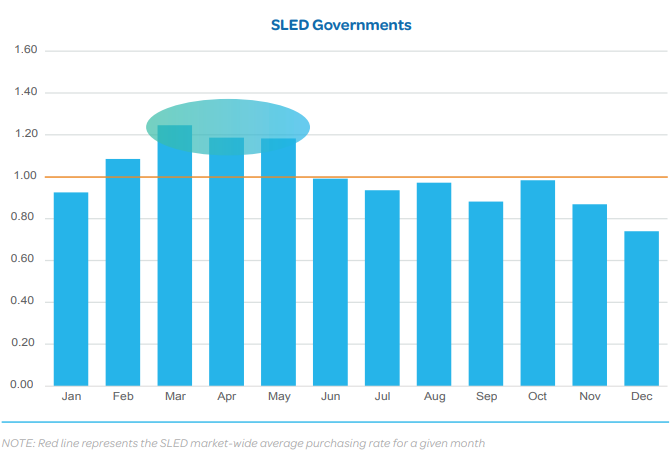
In terms of volume, what we notice is this elevated period lies almost perfectly in the last several months before the June fiscal year end. Even though the purchasing rates go up to 1.25 for March (or 25% higher than normal), the overall average amount of variation across the year was 0.12, or about 12% plus or minus for any one month. December represents a low of 0.74, at a time when many are on holiday vacation and the lower-volume December year end governments are wrapping up for their year.
Fiscal Years and the Motivation of Government Staff
The fiscal year affects the planning and operations of government procurement at the local and state levels. Buyers are busier in the final few months and may have less time for engaging with firms trying to do outreach. The beginning of the fiscal year can be useful for identifying priorities for the coming months. Knowing how these cycles work can help you not only set aside time to respond to the surge of new opportunities, but also speak their language and build winning relationships.
About 2-3 months prior to the end of the [fiscal] year, the spending peaks as departments have to finish out the year and spend their money. Those funds don’t typically get carried over to the next year—you spend it or lose it.
Fiscal Year and Types of Products & Services
We also examined seasonal patterns of bids/RFPs issued based on our 12 primary industry groups and noted meaningful differences in how strongly fiscal year considerations affect the volume of opportunities. At the “low” end of seasonal variation are architecture and engineering, professional business services, technology, transportation and environmental related opportunities, which vary by 6-8% on average across the months. Firms representing these items will notice that demand will vary less across the months, but fiscal year considerations will still apply to some extent. Educational products and services along with construction had the greatest variation, at 15% on average. These figures can be compared with the 0.12 or 12% overall average variation per month for SLED government overall.
How to Optimize Your Business Development Strategy Throughout Your Customer’s Fiscal Year
The below graphic depicts a month-by-month timeline of the fiscal year with key milestones and ranges of months highlighted and comments added. This gives us a visual of the fiscal year cycle as it looks to the typical government customer.
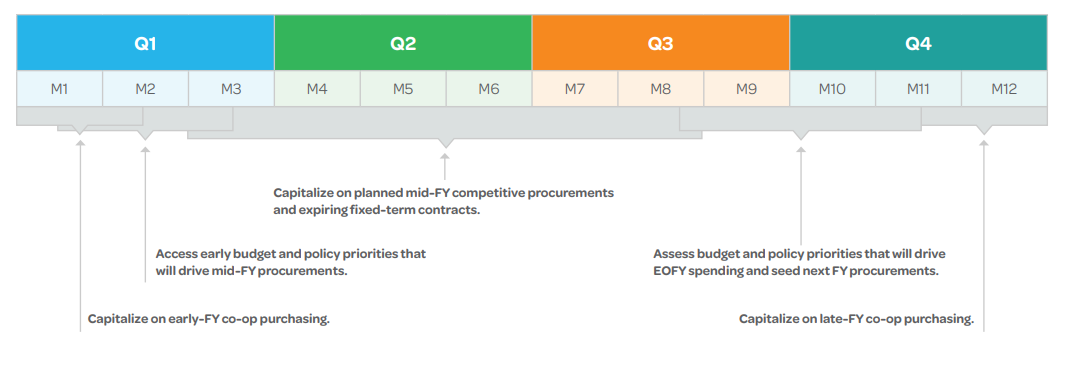
Unless the organization being targeted is a smaller, traditional county, city or township that uses a December year end, the “calendar of operations” in purchasing won’t be geared to the calendar year. Their “Q1” will be the first three months of the fiscal year, which would typically be July to September for a June ending year. We note here the opportunity to capitalize on opportunities for cooperative purchasing. By “cooperative” we’re referring to a long-term multiple-buyer contract administered by an independent organization that satisfies the rules for being competitively sourced. Any SLED government can conveniently use them without having to go out for a new bid request—saving time, hassle and potentially money as well due to the pooling of purchasing power across hundreds or thousands of government buyers. These purchases are often stronger in the “down months” when the volume of traditional competitive bid purchases is naturally lower, such as the very last month of the fiscal year or the very first month. Often we find cooperative buying is strong in the first month of each quarter.
Looking for more specific tips on how to tailor your business development strategy to the fiscal calendars of SLED governments? Download this guide to the SLED fiscal year-end from GovWin IQ.
Guide
Know When SLED Governments Buy
Get pro tips on how fiscal year-end timing shapes state, local, and education buying patterns, so you can pitch at the right moment and win more.


