Summary
Government contractors don’t lack opportunity intelligence. They lose it between qualification and submission. That’s the intelligence-to-revenue gap. It drives up B&P spend, cost per bid, and proposal cycle time. GovWin IQ and GovWin Proposals connect the two stages. Dela™, Deltek’s AI assistant, helps teams carry analyst-backed context into the response.
Key Takeaways:
- Intelligence is lost between qualification and proposal: Teams rebuild agency priorities, competitor history, and capture research after the RFP lands, paying for the same work twice.
- The intelligence-to-revenue gap pressures growth KPIs: It strains B&P cost, cost per bid, pursuit capacity, proposal cycle time, on-time submission, and compliance.
- GovWin IQ and GovWin Proposals stay connected: A GovWin Proposals project launches from a GovWin IQ opportunity in one click, carrying pipeline stage, NAICS codes, and solicitation files.
Opportunity Intelligence: The Intelligence that Shapes the Win
Public sector opportunities rarely start with an RFP. An agency signals a need months, sometimes years, before a solicitation is written: a budget line gets approved, a decision-maker starts asking questions, a contract nears recompete. That early signal is where opportunity intelligence begins. It continues as teams qualify, compare, and reassess opportunities so they can focus their time and resources on the pursuits they are best positioned to win.
This intelligence exists. The problem is that most teams either can't see it early enough, can't use it to keep making the right pursuit decisions, or can't carry it through to submission. The agency priorities, competitor history, and capture research they worked hard to build must inform decisions throughout the pursuit and survive the handoff into a proposal, and too often they don't.
That handoff is where the problem shows up. Business development (BD) teams identify, qualify, and continually reassess opportunities within their own workflow. Capture and growth teams build a strategy that lives in their heads or sits in inboxes and documents. Then the RFP lands, and the proposal team kicks off cross-functional pursuit readiness: rebuilding context that already exists somewhere, on a deadline, while juggling a handful of other pursuits for the same hours.
The gap between a team's opportunity intelligence, the decisions it shapes, and what ultimately makes it into the response is the intelligence-to-revenue gap. It can undermine the submission's competitiveness, make it harder to focus resources on the right opportunities, weaken differentiation, and force teams to spend valuable time reconstructing the past rather than improving the submission in front of them.
The Business Cost of the Intelligence-to-Revenue Gap
The intelligence-to-revenue gap first appears in the economics of a pursuit. A company has already invested in market research, relationship-building, and capture planning long before proposal work begins, not to mention the subject-matter expertise behind it. When that context is lost, rebuilt, or applied too late, the business ends up paying for the same work twice. B&P spending rises, cost per bid climbs, and scarce growth resources get consumed without adding any real submission capacity.
That added effort has a direct capacity cost. Hours spent re-entering opportunity details, tracking down source material, and clarifying requirements someone already answered once are hours that the same team isn't spending qualifying another opportunity or improving another response. The result is longer proposal cycles, greater reliance on nights and weekends, and harder choices about which qualified pursuits the business can afford to pursue.
The cost compounds as the deadline approaches. Missing context leads to more review cycles, late rewrites, and duplicate SME requests. Those delays raise labor costs and increase the risk of missed requirements, rushed reviews, and late or no-bid decisions, often after the business has already sunk real money into the pursuit.
The gap pressures the KPIs growth leaders care about most: B&P cost, cost per bid, pursuit capacity, proposal cycle time, on-time submission, and compliance. When well-qualified opportunities go unpursued, or strong pursuits reach review without the intelligence needed to differentiate, the business absorbs both the operating cost and the revenue it failed to convert.
A Connected Workflow Built to Preserve the Advantage
GovWin IQ, Deltek's analyst-backed opportunity intelligence application, helps teams find, understand, and qualify public sector opportunities earlier. GovWin Proposals carries that foundation into execution, shaping a validated opportunity and the intelligence around it into a structured, collaborative proposal project. Together, they create a connected path from signal to submission, so teams don't have to choose between early market insight and disciplined proposal execution.
This connection matters because an opportunity is not a static record. GovWin IQ ties it to related contracts, agency spending, forecasts, documents, and the people and competitors around it. As proposal work progresses, deeper metadata and links back to the source opportunity can keep the pursuit connected to that broader intelligence network, giving teams a direct route to the context they need as requirements evolve and strategy gets refined.
That foundation looks nothing like starting from a public solicitation feed or a document dropped into a general-purpose AI tool. GovWin analysts validate, contextualize, enrich, and connect information from more than 50,000 sources covering 95% of published public-sector spending. That matters because it gives teams a trustworthy starting point for deciding where to compete, understanding what shaped the requirement, and carrying that context into the response.
Dela™, Deltek's industry-tuned AI assistant, adds another layer of value because it's working from this connected foundation. Instead of generating in isolation, teams use Dela inside GovWin IQ and the proposal workflow to draft, research, and refine work against the opportunity, the solicitation, and the strategy already captured in the system. The person stays in control. Dela helps the team apply its intelligence consistently, so people spend more time on judgment, strategy, and quality only they can bring.
From Signal to Submission, In Practice
That philosophy shows up in how a pursuit moves through GovWin Proposals and in the workspace that holds it together.
Starting with context instead of setup
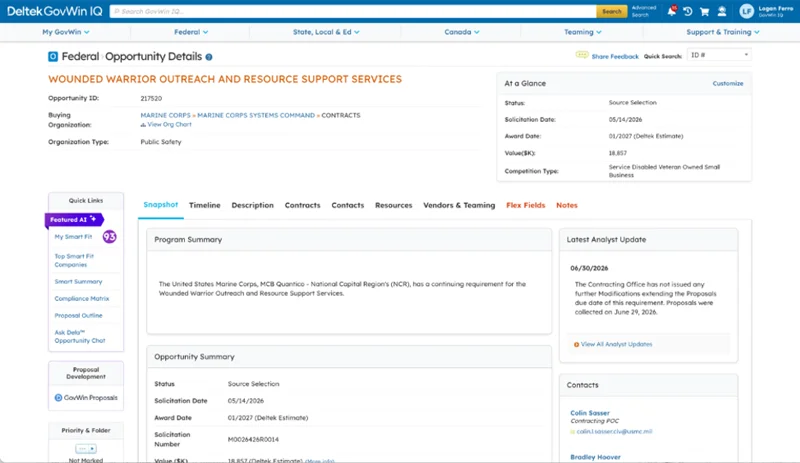
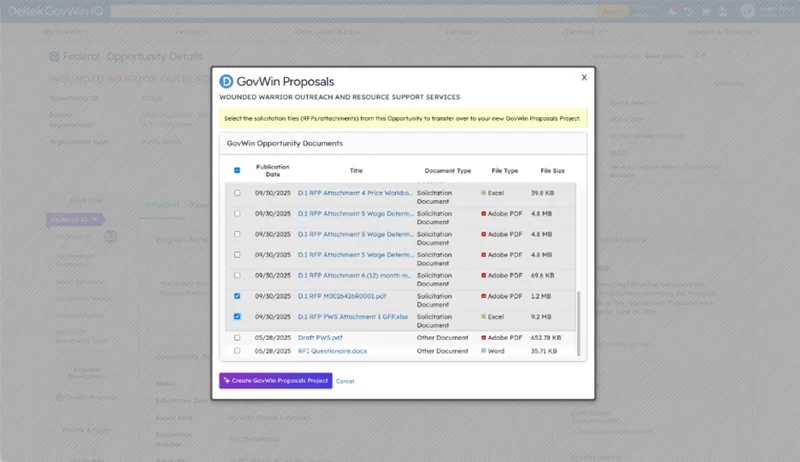
The first few days of most pursuits get spent recreating things that already exist: capturing opportunity details, uploading documents, and figuring out who should be involved, all before anyone has read a single requirement. A GovWin Proposals project launches from a GovWin IQ opportunity in one click. It displays critical details such as pipeline stage, solicitation date, NAICS codes, and solicitation files, and keeps links to GovWin IQ open for continued research and updates. With that setup already done, teams can add contributors right away and start the pursuit with the right people and context from day one.
Turning a solicitation into a plan
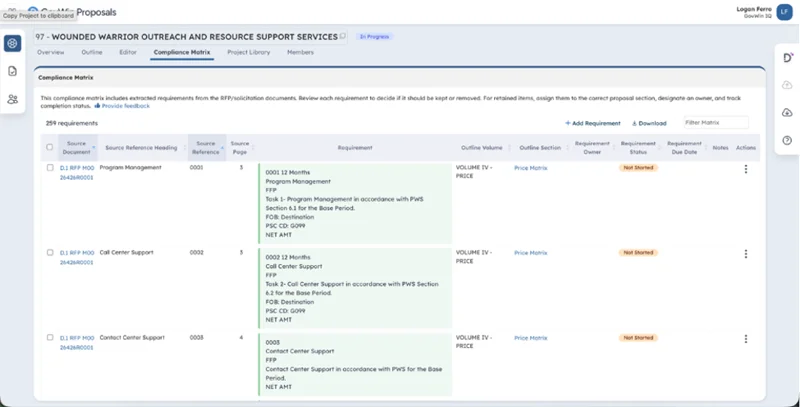
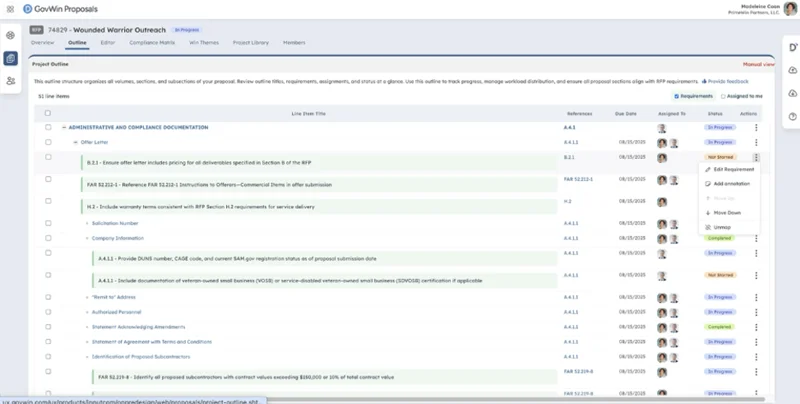
A solicitation on its own isn't a plan. GovWin Proposals builds the outline and compliance matrix from the solicitation, placing requirements where they belong and flagging anything that can't be auto mapped, so the team should double-check. From there, the plan keeps pace with the work: writers can see where their content fits, reviewers can spot gaps sooner, and proposal managers can tell where the team is getting stuck. Because the plan, response, and progress stay connected, teams spend less time piecing together status updates and more time keeping the pursuit moving.
Keeping the proposal current as the procurement changes
Procurements rarely stand still, and proposal work shouldn't depend on someone manually noticing, circulating, and interpreting every update. As amendments are issued, dates shift, attachments are added, or requirements change, teams can bring the new opportunity documents into the proposal workflow and adjust their plan earlier. Because those updates come from the GovWin IQ intelligence environment, the analyst-backed context around them stays within reach as teams assess what changed and how to respond. The payoff is less risk of writing against outdated information, fewer manual handoffs under deadline pressure, and more time to adapt the response while there's still room to act.
Turning diverse expertise into one strategic response
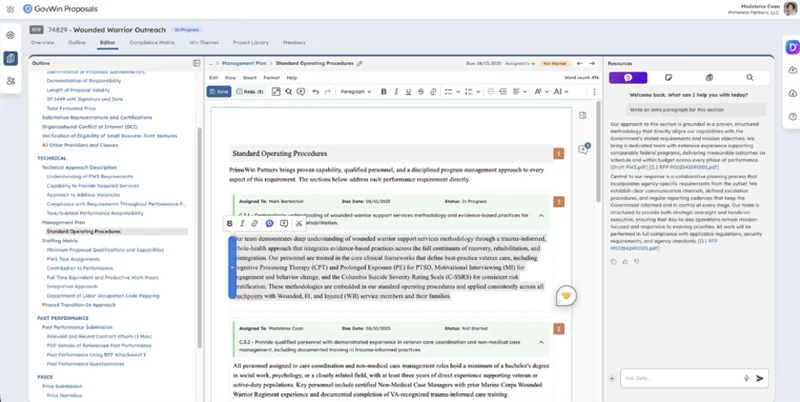
When subject matter experts are stretched thin, proposal teams need a faster way to pull existing knowledge and individual contributions into one cohesive, buyer-focused response. GovWin Proposals brings source content, pursuit strategy, drafting, and compliance into a single workflow, with citations running throughout. With that context in one place, Dela helps writers draft and refine content that stays true to the team's strategy and is grounded in the response structures that strengthen a proposal. Citations make the source easy to check, and the compliance matrix shows which requirements are covered and where gaps remain. Teams spend less time tracking down inputs and piecing together disconnected documents, and more time building a clear, responsive response.
One system that compounds intelligence across pursuits
Each pursuit should make the next one easier to start, not just the current one easier to finish. As opportunity context becomes part of the project, the team's plan, strategy, writing, and compliance work remain connected rather than becoming separate files to reconcile later. That continuity helps contributors work from the same understanding and gives proposal managers a clearer view of how the response is taking shape. Over time, the content and decisions captured along the way become a stronger starting point for future pursuits, so teams build on what they already know rather than starting from scratch, freeing up capacity for opportunities they haven't found yet.
One Workflow from Signal to Submission
The question worth asking isn't whether opportunity intelligence exists for a given pursuit. It always does, somewhere. It's whether that intelligence survives the trip from a qualified opportunity to a submitted proposal, or whether it gets rebuilt from scratch every time a deadline hits, especially in a funding environment where contract consolidation means every pursuit matters more.
GovWin IQ and GovWin Proposals are built to close that gap together, so the context a team already compiled becomes the proposal a team already deserves to submit, without losing the control or the judgment that got them there in the first place.