Summary
This article explains why Finance belongs in proposal development earlier, using a lesson from three proposals submitted at once and the requirements that were missed. It also shows how Costpoint Proposals helps teams bring Finance into requirements review while the response is still taking shape.
Why It Matters: Many of the costs Finance manages after an award start with something the proposal team didn’t fully understand before submission. Bringing Finance in earlier gives teams time to ask the right questions while they can still act on the answers.
Key Takeaways:
- Proposal gaps become delivery costs: Requirements that go unexamined before submission can turn into unpriced work and lower margins after award.
- Finance asks different questions: Bringing Finance in early helps teams spot reporting, documentation, and assumption issues while there’s still time to act.
- Costpoint Proposals supports collaboration: Requirement annotations, assigned contributors and approvers, and drafting in Word keep Finance in the conversation while the response takes shape.
When you're working on a proposal, the deadline has a way of becoming the center of everything. You're gathering input from busy subject matter experts, working through reviews, and making sure the response tells a clear story about why your company should win.
I've been there. And when I look back at my time in government contracting, there are conversations I wish we'd had earlier, especially with Finance.
Some of the costs Finance ends up managing after an award begin with something the proposal team didn't fully understand before submission. A requirement takes more effort than expected. A reporting obligation calls for resources nobody planned for. An assumption turns out to be wrong.
By then, the team has a contract to deliver.
A Lesson That Stayed With Me
I've worked as a capture manager, proposal manager, and project manager. At one small business, three solicitations we had spent years cultivating arrived two weeks before Christmas. All three were due January 15.
About twenty of us spent the holidays splitting up the writing and reviews across three proposals. We got every one of them in.
One included contract requirements we hadn't worked with before. With three responses moving at once, we didn't give those requirements the attention they deserved. We won the contract, and then we found out what we had missed.
Meeting those obligations meant spending money we hadn't priced and taking on deliverables we hadn't planned for. It affected the program and cut into the profit we expected to make.
We had a capable team working hard to meet the deadlines. But we needed a fuller conversation with the teams that would eventually manage those obligations and their costs. What we missed in the proposal followed us into delivery.
What I See Differently Now
Earlier in my career, I went through price-to-win and capture leadership training at large defense contractors. Those experiences helped me think about the customer, the competition, and how to build an approach that could win. Working as a project manager gave me a close look at what it takes to deliver on that approach.
What I had less exposure to was the Finance side of that equation. For the past five years, I've worked in product strategy for Deltek's Costpoint ERP, and that's given me a much closer look. I've learned more about the accounting practices, documentation, and internal controls that support government contracting compliance and DCAA audit readiness. I knew those things mattered before, but some were outside my day-to-day responsibilities. I have a better appreciation now for what Finance has to manage and the questions they need answered.
Looking back at that small-business experience, I would ask more questions. What does this requirement actually mean for the team delivering the work? What will we need to document or report? Who should review our approach before we commit to it? I also would have brought more people into those conversations earlier.
Give Finance a Chance to Weigh In
Teams across Capture, Proposal, Finance, Contracts, and project delivery can read the same solicitation and notice different things. Each brings experience that can help the team understand the work and write a stronger response.
For Finance, that might mean asking:
- Does this requirement create reporting or documentation work we haven't considered?
- Are we making assumptions that need to be clarified?
- Does our response explain how we'll meet the obligation?
- Who else needs to review this before we submit?
The stakes are real. In this year's Deltek Clarity Government Contracting Industry Study, contractors reported bid and proposal costs climbing from 14% to 19% of contract value. When that much investment goes into a response, getting the right stakeholders involved before submission matters even more. Getting those questions on the table early gives the team time to work through them, and it helps writers explain the approach more clearly because they understand what fulfilling the requirement will involve.
Of course, everyone is busy. Asking for more collaboration only helps if contributors can find the requirements, understand what they're responsible for, and see where their input is needed.
Where Costpoint Proposals Fits
That's a big part of why I'm glad Costpoint customers now have a way to manage proposal development inside Costpoint.
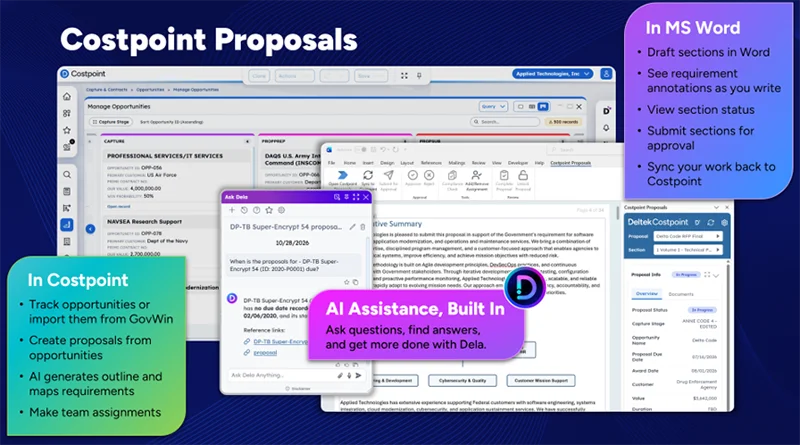
It starts with finding the right work. GovWin IQ is where many teams identify and research opportunities, and those opportunities can be brought into Costpoint to manage in your pipeline. Costpoint 2026.4 also introduced a new way to view your records, a Kanban board, so you can track pursuits as they move forward.
From there, the proposal itself is built and managed in Costpoint. You upload the solicitation, and AI builds a structured outline with requirements mapped to the sections they belong to. Writers draft in Microsoft Word, thanks to Costpoint's new integration that adds a Costpoint Proposals panel, with section details and requirement annotations right alongside the response. Costpoint stays the document of record.
Here's where I think it matters for Finance. You can bring Finance in as a contributor or approver on the sections where cost and reporting obligations show up, and reviews and approvals are part of the workflow. The annotations are the part I think about when I remember those January deadlines. Having the requirements alongside the section you're writing gives you a place to start the conversation: Have we addressed this? Do we understand what it involves? Should someone else take a look?
Your team still needs to read carefully, interpret the requirements, and make the decisions. Costpoint Proposals helps organize that work so the team can spend more time developing and reviewing the response.
What happens next is the part I'm most interested in. Once the proposal is submitted and an award comes in, the work moves into the same Costpoint environment where contracts, projects, costs, billing, and collections are managed. That can give Finance a clearer line of sight from what was proposed, to what was awarded, to what's being delivered and billed. It's the connection I wish we'd had on those three proposals.
Where We're Headed
In this year's Clarity study, federal contractors named implementing AI as their top priority for preparing for growth. I can understand the interest, and I think finance leaders are right to ask how that investment will fit into the way their business already works.
At Deltek, we're investing in bringing AI into the work teams already do inside Costpoint. Costpoint Proposals is now available to Costpoint customers, and we'll keep building on that foundation.
Over upcoming releases, our direction includes helping teams check their work against solicitation requirements, draw more easily on their own past proposals and performance, and get additional writing help when they want it. We're also exploring ways to bring technical proposal development and pricing together more easily. What we hear from customers will help shape that work.
I still remember the effort it took to get those three proposals submitted. With what I know today, I'd also make room for a few more questions before they went out the door. Bringing Finance into proposal development earlier gives teams the chance to ask them while there's still time to act on the answers.
Join us on November 4 for Build Better Proposals, Start Better Projects to see what Costpoint Proposals can do today, how it fits into the path from pursuit to cash, and share your thoughts on what comes next.