This article outlines key findings from the 2026 SPI Professional Services Maturity™ Benchmark Report, covering how the professional services industry performed in 2025 and where firms should focus in 2026 and as they plan for 2027.
Why it matters: With revenue growth still below historic norms and utilization at a record low, understanding these benchmarks helps leaders identify where to focus investment to improve performance in 2026.
Key Takeaways:
- Utilization hit a record low in 2025: Billable utilization fell to 66.4% in 2025, the lowest in SPI Research's survey history and well below the 75% target.
- Financial KPIs show cautious recovery: Project margins rose to 37.7%, and revenue per consultant climbed to $210K in 2025, even as overall profitability stayed near 9.9%.
- AI adoption accelerated sharply in 2025: Generative AI use in projects rose to 27.1% in 2025, a 40% increase, as firms embedded AI more broadly into service delivery.
These numbers tell a story of cautious progress. Here's what happened in 2025, and what it means for your firm.
2026 is shaping up to be a pivotal year for the professional services industry. Firms continue to navigate a competitive global market, shifting client expectations, and mounting pressure to improve operational efficiency, automation, and profitability.
Each year, Deltek sponsors the SPI Professional Services Maturity™ Benchmark Report, a comprehensive study of hundreds of professional services organizations worldwide. Now in its 19th year, the 2026 report surveyed over 500 firms representing more than 245,000 employees and $63 billion in professional services revenue. This year's findings highlight where the industry gained ground in 2025, where challenges persist, and how top performers are pulling ahead.
How the Professional Services Landscape Changed in 2025
Following a difficult 2024 marked by economic volatility and regulatory uncertainty, 2025 brought a modest recovery — though the industry still has some ground to make up. The 2026 SPI Professional Services Maturity™ Benchmark Report found:
- Revenue growth improved to 5.2% in 2025, up from 4.6% in 2024, but still roughly half the 10% rate SPI Research considers healthy for the industry.
- EBITDA held nearly flat at 9.9%, essentially unchanged from 9.8% in 2024 and still well below the five-year average of 13.8%.
- Billable utilization fell to 66.4%, its lowest point in SPI's survey history, and well below the 75% threshold SPI considers optimal.
These numbers still paint a challenging picture, but they also reveal opportunities. Deal pipeline coverage rose to 175% of quarterly bookings forecast, up from 166% in 2024, suggesting client demand remains healthy even as firms struggle to convert it into delivered, profitable work.
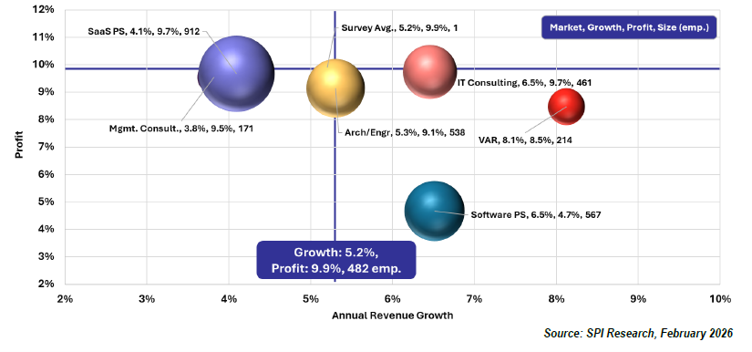
PS Market Growth & Profit Comparison
Zooming Out: How 2025 Fits the Five-Year Trend
2025's results aren't a one-off. They're the latest data point in a longer run of change as the professional services industry navigates shifting client demands, faster technology adoption, and a tougher macroeconomic backdrop. The six areas below show this most clearly.
1. Revenue Growth Remains Below Historic Norms
Revenue growth reached 5.2% in 2025, an improvement from 2024's 4.6% but still far below the 10.6% high recorded in 2021 and the five-year average of 8.0%. Client caution, longer sales cycles, and delayed decision-making continue to weigh on top-line performance.
The bright spot is backlog health. Deal pipeline coverage climbed to 175% of quarterly bookings forecast for 2025, up from 166% the year before, indicating that client appetite for services hasn't disappeared. The challenge is converting that pipeline into delivered, billable work.
2. Operational Inefficiencies Persist
One of the clearest indicators of operational health, billable utilization, fell to 66.4% in 2025, down from 68.9% in 2024; the lowest level SPI has recorded. This continues a downward trend from the 73.2% high seen in 2021 and remains well below the 75% threshold SPI considers optimal for maximizing workforce revenue potential.
There is an encouraging counter-trend, however: revenue per billable consultant rose to $210K in 2025, up 6% from $199K in 2024, while revenue per employee climbed to $168K, also up 6%. On-time project delivery held roughly steady at 73.8%, essentially unchanged from 73.4% the prior year but still well below the 76% five-year average and the 80.2% high recorded in 2021.
3. Talent Dynamics Continue to Shift
Total attrition eased slightly to 11.3% in 2025, down from 11.7% in 2024 and below the five-year average of 12.8%. At the same time, headcount growth improved meaningfully, rising to 2.8% from 1.9% the prior year. This 50% increase signals that firms are cautiously investing in workforce capacity again, even as growth remains far below the double-digit rates SPI expects from a healthy market.
Firms also continued to lean on external talent to fill gaps, though slightly less than before: subcontractor contributions to revenue eased to 10.4% in 2025, down from 10.9% in 2024. This suggests firms are working to rebalance their mix of full-time and flexible talent as hiring conditions gradually improve.
4. Client Relationships Show Mixed Signals
Client dynamics were a mixed bag in 2025. On the positive side, deal pipeline coverage and the percentage of bids won both improved, with bids won climbing to 48.1% from 47.3% in 2024. On the other hand, the percentage of referenceable clients slipped to 68.2%, down from 70.1% the year before, a signal that client satisfaction and advocacy may be under quiet pressure even as new business metrics improve.
Project overrun, a key driver of client trust, improved to 10.7% in 2025 from 11.3% in 2024, but it remains above the 10% threshold that SPI Research flags as the point at which overruns start to meaningfully damage client relationships, margins, and future bookings.
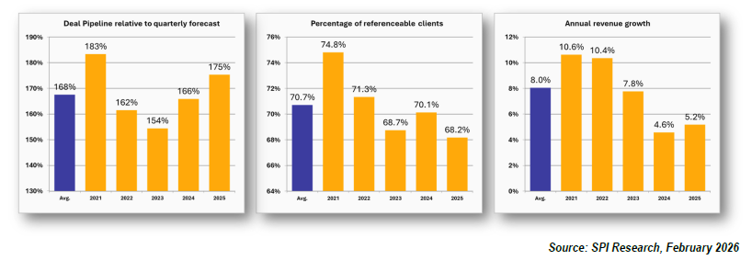
Client Relationships Trends
5. Profitability Shows Early Signs of Stabilizing
Profitability remains one of the industry's toughest challenges. EBITDA held at 9.9% in 2025, essentially flat from 9.8% in 2024 and still far below the 16.1% high recorded in 2022 and the 13.8% five-year average.
There is genuine good news within the numbers, though: project margins rose to 37.7% in 2025, continuing an upward trend from 35.9% in 2024, and the percentage of firms hitting their annual margin targets improved to 88.8% from 86.9%. This suggests that when firms execute well at the project level, profitable delivery is still achievable. The deeper challenge lies in converting that project-level discipline into firmwide financial performance.
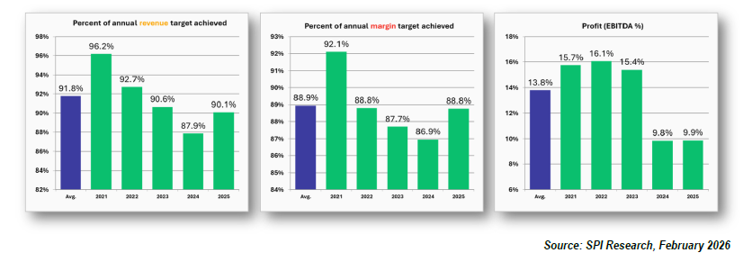
Finance & Operations Trends
6. AI Adoption Accelerates
AI adoption saw one of the sharpest increases in this year's report. The share of projects using generative AI jumped to 27.1% in 2025, up 40% from 19.3% in 2024. A clear signal that firms are moving from experimentation to operational use.
SPI Research also found that as AI use deepens, so does revenue growth, headcount growth, and on-time delivery, reinforcing AI's growing role as a performance differentiator rather than a side experiment.
Firms are also continuing to invest in the technology ecosystem that supports AI at scale. Professional Services Automation (PSA) adoption reached 68.9% in 2025, while CRM adoption stood at 84% and HCM adoption at 74%. Yet only 38.7% of firms have adopted a Project-based ERP solution that unifies these systems with core financials, and those that have report 20% faster year-over-year revenue growth and an EBITDA of 10.2%, compared to just 8.6% for firms without one.
As in prior years, the value of these tools depends heavily on integration. Firms running disconnected point solutions continue to report weaker visibility, more manual workarounds, and slower decision-making than those with a connected technology stack.
Strategic Focus Areas for Professional Services in 2026
The 2025 data paints a mixed picture, but professional services firms have real levers to pull in 2026, particularly as AI and automation mature. The areas below stand out as priorities.
Continuing the Focus on Conversion
With deal pipeline coverage at 175% of quarterly bookings, the opportunity is there. The work now is converting it into delivered, billable revenue. Streamlining the handoff from sales to delivery, sharpening pricing and value propositions, and using predictive analytics to prioritize the right opportunities can all help firms close more of the pipeline they already have.
Strengthening Client Relationships
With referenceable client rates slipping to 68.2%, firms should double down on client experience, transparency, and proactive communication. Expanding value-added services and using AI-powered tools to flag early warning signs of client dissatisfaction can help firms protect the relationships that drive repeat business and referrals.
Rebuilding Talent Capacity
Headcount growth is recovering, but slowly. Firms should pair renewed hiring with a clear focus on retention and upskilling, and continue to use flexible workforce models — including subcontractors — to scale capacity without overcommitting during an uncertain recovery.
Closing the Utilization Gap
With billable utilization at a record low of 66.4%, this remains the single highest-leverage area for improving both revenue and margin without adding headcount. A comprehensive time-tracking solution, such as Deltek Replicon, can help firms see exactly how time is spent across projects, tasks, and clients — surfacing underutilized or overallocated resources so they can rebalance workloads and increase billable hours. Pairing this with a tightly integrated PSA, CRM, and ERP ecosystem also improves skills-to-project matching and demand forecasting.
Scaling AI Deliberately
With generative AI use up 40% year-over-year, 2026 is the year to move from pilot to practice. Firms that pair AI adoption with strong data governance and integration across their core systems are best positioned to convert AI investment into measurable gains in efficiency, client value, and delivery quality.
The Path to Sustainable Growth
The 2026 SPI Professional Services Maturity™ Benchmark Report makes one thing clear: firms that benchmark themselves against peers and act decisively on the results are best positioned to turn 2025's modest recovery into real momentum in 2026 and beyond. Understanding where your firm stands, and where the highest-performing organizations are pulling ahead, is the first step toward closing the gap.
SPI Report
Benchmark Your Profiessional Services Firm
Discover the KPIs, AI trends, and best practices driving higher utilization, predictability, and profitable growth.