Current inflation rates are some of the highest since the “Great Inflation” period, which stretched from the late 1960s into the early 1980s. These elevated rates are making a significant impact on the American economy at large, and government contracting is no exception.
Deltek’s research team previously outlined how inflation is impacting state and local government spending. In this article we will take a closer look at the other side and examine the impact inflation is having on federal contractors, plus what some of the short-term and long-term consequences might be.
Free Report
Navigate Record Inflation Risk
This free report examines what's driving today's inflation and how past periods of high inflation shaped contractor relief strategies.
What is Driving Record Inflation Rates?
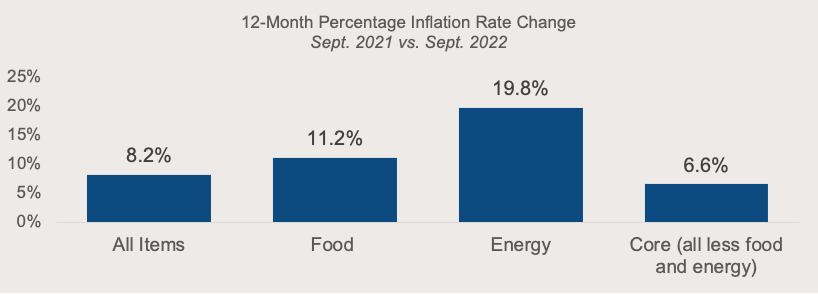
While there are several contributing factors, including the effects of the pandemic and the war in Ukraine, current inflation trends are largely driven by rising food and energy costs, two areas known for their volatility due to exposure to external influences. Energy inflation impacts nearly every industry, so its effect is felt across a broad swatch of the federal contracting community. And the rising food costs are part of the same story that we have seen in SLED contracting, where prices of nondurable goods (fuel, food, apparel and other commodities) were up 36% year-over-year on average in Q2 of 2022.
According to the Bureau of Labor Statistics, inflation is significantly up overall even after taking energy inflation and food costs out of the equation. Core inflation – which excludes food and energy – is still significantly higher than the average total inflation rate for FY 2021 of 4.7%, as shown in the below chart.
Challenges in Federal Government Contracting Related to Inflation
In our free report, Inflation: Causes and Consequences for Federal Contractors, our research has identified four unique challenges that federal contractors are facing in this current economic environment.
- Unpredictable Inflation Levels: The federal procurement process is a lengthy one. Many contracts awarded over the last 2 years are now more expensive to perform due to rising costs for materials, shipping, labor, energy and loans.
- Limited Government Obligation: Although federal agency leadership is sympathetic to the cost pressures that contractors are currently experiencing, options for relief, especially for firm fixed-price (FFP) contracts, are limited. Unless the contract states otherwise, the government has no obligation to compensate a contractor for unanticipated inflation under an FFP contract.
- Small Business Challenges: According to the U.S. Chamber of Commerce’s Small Business Index, overall U.S. small business outlook appears to be improving, rising to 66.8 - the highest level since the start of the pandemic. However, small federal contractors face unique challenges of limited resources and strict contractual price limitations that challenge their strategic response.
- Competitive Pricing: Pricing strategy in an inflationary environment is difficult. Pricing that overestimates inflation may result in bids much higher than the competition, but underestimation can result in significant losses on a contract.
Consequences of Inflation in Federal Government Contracting
Companies across a wide range of industries that serve the federal government are experiencing increases in wages and salaries compared to 2021, along with the general increase in prices that we have noted. These have led to a few notable consequences related to personnel, budget and supply.
Personnel: Contractors must contend with growth in wages as they compete for talent during the “Great Resignation”. This creates challenges for these contractors in not only fulfilling currently contract requirements, but also for pursuing new ones.
Budget: Although there is some room for pricing modifications, agencies’ ability to accommodate them rely on them having the supplemental funds to pay for them. Agencies are currently operating under a continuing resolution for FY 2023, which only exacerbates the problem by limiting budgetary flexibility.
Supply: The supply chain issues that emerged during COVID-19 have not abated and in some areas have been exacerbated by the war in Ukraine. Supply chain instability impacting access to critical raw materials and components has made it more difficult for contractors to fulfill current and future contract requirements. On top of that, contractors seeking supply substitutions may run into issues with the substitutions violating some aspect of the contract.
Recommendations for Federal Government Contractors to Fight Inflation
So what can businesses do that have a large portion of their sales revenue tied to the federal government? Aside from simply staying on top of the latest developments in the industry by following trusted sources of research and government intelligence, here are six steps that your business can take to remain competitive.
- Perform a risk assessment of your organization’s mix of fixed vs. cost-type contracts. While having a larger percentage of fixed-price contracts is typically a benefit, organizations need to determine whether the risks in the current environment are manageable.
- Check your contracts for existing Economic Price Adjustment (EPA) and Request for Equitable Adjustment (REA) clauses that clearly allow for inflation as a basis.
- Include an EPA clause for upcoming request for proposals (RFPs) and request for quotes (RFQs), and ask the government to if the additional reporting burden is manageable.
- Ensure that you are up to date on industry conditions and indexes, and plan for inflation accordingly when negotiating EPA clauses for future fixed-price contracts.
- Organize your documentation when asking for price increases (such as freight costs, explanation of supply chain bottlenecks, detail about affected labor categories, etc.)
- Reassess your pricing strategies for future contracts to offset inflationary losses on existing contracts.
For a more thorough look at how inflation is impacting federal contractors, including an examination of federal regulations supporting price increases and a look at how agencies like the DoD and GSA are addressing inflation, click the link below to download our free report.