Remember Carl Sagan, the captivating host of Cosmos: A Personal Voyage, telling his viewers, “You haveto know the past to understand the present”?
Project managers worldwide live with this wisdom too! Past experiences are a fundamental building blockfor building your future projects. In project management, this concept finds expression in analogousestimating — a technique that draws historical data from similar projects to forecast the outcomes of afuture project.
In this article, we’ll explore how you can implement analogous estimating in your next project. Furthermore,we’ll identify the advantages and disadvantages of this technique and how it differs from other types ofproject estimation.
Key Takeaways
- Limited data leads to rough estimates: Early-stage projects often lack detailed requirements, forcing teams to rely on high-level assumptions that can introduce initial uncertainty.
- Inaccurate parallels reduce estimation accuracy: When historical projects aren’t truly comparable in scope, complexity, or context, teams risk misjudging timelines, budgets, and resource needs.
- Smart use of historical data improves planning confidence: Leveraging well-matched past projects and adjusting for differences enables faster, directionally accurate estimates that support better early decision-making.
What Is Analogous Estimating?
Analogous Estimating is a project estimation technique that allows a project manager to determine acurrent project’s cost, time and other key elements based on data from past projects of a similar nature.
Various elements can determine a project’s viability. The three big ones are time, cost, and scope. Someadditional ones include resources, quality, and risk. A good project estimate ensures that all these keyelements are accounted for, so that once the project starts rolling, there are no surprises down the road.
Through analogous estimating, project managers can come up with an estimated value for each of theseelements. They go through the data of past projects that have a similar scope or budget and identify whichelements of those projects are applicable to the current project.
Though managers can use analogous estimating for all the elements discussed above, they mainly use itfor costing. Having the historical costing data of similar projects helps a project manager bring their currentproject’s cost estimate as close to the actual numbers as could be.
How Does Analogous Estimating Work?
Suppose you’ve been working at a construction company and finally got involved with managing your firstproject.
The only problem?
You’re drawing a blank about where to start or what kind of resource allocation you need to consider. Let’ssee how analogous estimating can work in this scenario.
Step 1: Define Project Scope
This is the information you have about the project’s requirements:
| Project Name | ABC Apartments |
|---|---|
| No. of Units | 16 |
| No. of Floors | 4 (4 units per floor) |
| Plot Area | 16000 sq.ft. |
Your project’s scope, however, is so much greater. Once you have clarity on what you need to accomplish,you’ll be able to choose the appropriate parameters for your project to estimate.
Deliverables
Get further information about your project. For example, for ABC apartments, apart from the 16 units with 4units on 4 floors, identify what other deliverables are expected from you. These could be:
- Common areas (lobby, corridors, etc.)
- Landscaping and outdoor spaces
- Parking area
- Provisions for utility connections (water, electricity, gas)
Quality Requirements
Moreover, it could be the quality standards that you’re expected to meet, like:
- Compliance with building codes and regulations
- Design specifications
- Quality standards for materials and construction
- Safety and compliance requirements
- Accessibility
- Environmental and sustainability considerations
Boundaries and Exclusions
In addition, a good project scope will include the boundaries of your deliverables. To manage expectationsfrom the start, you can define what will not be done as part of the project. For example:
- The project will not include furnishing the apartments
- Maintenance of the building post-construction is not included
Constraints
Identify any constraints that might affect the project. Common constraints include:
- Budget limitations
- Time constraints (project deadlines)
- Regulatory constraints (local building codes and zoning laws)
- Availability of resources (labor, materials)
Scope Description
To get the buy-in from all your key stakeholders and to ensure everyone is on the same page, you can usea Work Breakdown Structure (WBS). A WBS will have detailed information about the project’s scope andthe different tasks that you aim to accomplish as part of the project.
Sample Work Breakdown Structure (WBS) of a Construction Project:
- Phase 1: Planning and Permits
- Phase 2: Site Preparation
- Phase 3: Foundation and Structure
- Phase 4: Utility Installation
- Phase 5: Interior and Exterior Finishing
- Phase 6: Landscaping and Outdoor Spaces
- Phase 7: Inspections and Final Approvals
By ensuring you have all the above information, you now have a clear and comprehensive project scope forthe ABC Apartments project. This will ensure that you compare similar aspects when referencing historicaldata of other projects. This brings us to the next step of analogous estimating.
Step 2: Identify Similar Past Projects
Now, say your construction company has historical information below about some of the projects they builtin the past.
| Project Name |
#1 PQR Condos |
#2 XYZ Apartments |
#3 WYW Office Spaces |
#4 Sun Apartments |
|---|---|---|---|---|
| No. of Units | 8 | 20 | 4 | 9 |
| No. of Floors | 2 each | 5 (4 units per floor) | 4 (1 unit per floor) | 3 (3 units per floor) |
| Plot Area | 24000 sq.ft. (3000 sq.ft. each) | 15000 sq.ft. | 8000 sq.ft. | 6000 sq.ft. |
Which among these projects do you think you can use as a foundation to start an estimate for your project?
- Project #1 is for a condominium complex with 8 units, each having 2 floors.
- Project #2 is for an apartment complex with 20 units and 5 floors.
- Project #3 is for office space with 4 units, with each floor having 1 unit.
- Project #4 is again for an apartment building with 9 units and 3 floors.
It goes without saying that projects #2 and #4 would have the closest similarities to the current project,since they’re both apartment complexes with a multi-floor structure. But this decision may not be as easy asthis example. That’s why expert judgment is required to shortlist the projects on which you want to baseyour new project. An expert would be able to identify the projects having the closest similarities to yourproject, which could act as the basis for its estimation.
NOTE – Analogous estimation relies heavily on the assumption that the current project will follow a similarpattern to past projects, which may not always be the case. Therefore, the more data available, the better!
Step 3: Collect Historical Data
Remember the key elements of your project? Time, Cost, Scope, Resources, Risk and Quality. These are the characteristics for which we can collect information from historical records. Choose the key element you’re trying to estimate, for example, cost, and then gather the related data. For example, for a project costing exercise, the data that you can collect should include costs of:
- Land Acquisition
- Site Preparation
- Foundation and Structural Work
- Materials
- Labor
- Equipment
- Utilities and Services
- Finishing Costs
- Contingency Costs
- Overheads
Let’s use the same example as above to add some additional costing data:
| Project Name |
#2 XYZ Apartments |
#4 Sun Apartments |
|---|---|---|
| No. of Units | 20 | 9 |
| No. of Floors | 5 (4 units per floor) | 3 (3 units per floor) |
| Plot Area | 15000 sq.ft. | 6000 sq.ft. |
| Land Acquisition | $500,000 | $200,000 |
| Site Preparation | $150,000 | $90,000 |
| Foundation and Structural Work | $800,000 | $350,000 |
| Materials | $1,200,000 | $540,000 |
| Labor | $1,000,000 | $450,000 |
| Equipment | $200,000 | $100,000 |
| Utilities and Services | $250,000 | $100,000 |
| Finishing Costs | $700,000 | $300,000 |
| Contingency Costs | $250,000 | $100,000 |
| Overheads | $300,000 | $120,000 |
| Administrative Costs | $100,000 | $60,000 |
| Total Actual Cost | $5,450,000 | $2,410,000 |
NOTE – In addition to collecting the cost data of historically similar projects, it’s also a good practice to collect project scope information to understand what all these costs were able to cover.
Step 4: Normalize the Data
Since we’re working with historical data in analogous estimating, it’s always a good idea to take into consideration the financial implications of the market. In the time between those old projects and your new project, there could have been a change in factors like inflation, currency exchange rates, and technological advancements that could have an impact on your estimate. Therefore, adjust your historical data to account for any cost escalation differences these changes could have brought upon.
Step 5: Identify Key Parameters
Now, looking at the normalized data, we’re able to draw some conclusions about the different parameters that have the highest impact on your cost structure.
For example, in order of highest impact on cost, the top cost drivers for your construction project would be material costs, labor rates and project size (foundation and structural work, finishing costs and land acquisition costs). This will give you an insight into where all your current project’s highest costs are going to be.
| Project Name |
#2 XYZ Apartments |
#4 Sun Apartments |
|---|---|---|
| Materials | $1,432,800 | $625,860 |
| Labor | $1,194,000 | $521,550 |
| Foundation and Structural Work | $955,200 | $405,650 |
| Finishing Costs | $835,800 | $347,700 |
| Land Acquisition | $597,000 | $231,800 |
Step 6: Apply Scaling Factors
We already saw how the current project may have some similarities and differences to your historical project data. Normalizing the data to reflect the current rates for costs was the first step to bringing them under the same criteria of “year of completion”.
Moreover, you can apply other scaling factors to your data, like the size of the project or complexity of your project, to be able to compare them more easily. We need to first identify the metrics you want to use for scaling. For example, let’s look at it objectively from a cost/size perspective. We can bifurcate the costs of the projects into three categories –
- cost per unit
- cost per floor
- cost per square foot
For XYZ Apartments, it looks like this:
| Project Name |
#2 XYZ Apartments |
|||
|---|---|---|---|---|
| No. of Units | 20 | |||
| No. of Floors | 5 | |||
| Plot Area | 15,000 sq.ft. | |||
| Total Normalized Cost | $6,507,300 | |||
| Cost Category | Total Normalized Cost | Cost per Unit | Cost per Floor | Cost per sq.ft. |
| Land Acquisition | $597,000 | $29,850 | $119,400 | $40 |
| Site Preparation | $179,100 | $8,955 | $35,820 | $12 |
| Foundation and Structural Work | $955,200 | $47,760 | $191,040 | $64 |
| Materials | $1,432,800 | $71,640 | $286,560 | $96 |
| Labor | $1,194,000 | $59,700 | $238,800 | $80 |
| Equipment | $238,800 | $11,940 | $47,760 | $16 |
| Utilities and Services | $298,500 | $14,925 | $59,700 | $20 |
| Finishing Costs | $835,800 | $41,790 | $167,160 | $56 |
| Contingency Costs | $298,500 | $14,925 | $59,700 | $20 |
| Overheads | $358,200 | $17,910 | $71,640 | $24 |
| Administrative Costs | $119,400 | $5,970 | $23,880 | $8 |
| Total Cost | $6,507,300 | $325,365 | $1,301,460 | $434 |
For Sun Apartments, it looks like this:
| Project Name |
#4 Sun Apartments |
|||
|---|---|---|---|---|
| No. of Units | 9 | |||
| No. of Floors | 4 | |||
| Plot Area | 6,000 sq.ft. | |||
| Total Normalized Cost | $2,793,190 | |||
| Cost Category | Total Normalized Cost | Cost per Unit | Cost per Floor | Cost per sq.ft. |
| Land Acquisition | $231,800 | $25,756 | $77,267 | $39 |
| Site Preparation | $104,310 | $11,590 | $34,770 | $17 |
| Foundation and Structural Work | $405,650 | $45,072 | $135,217 | $68 |
| Materials | $625,860 | $69,540 | $208,620 | $104 |
| Labor | $521,550 | $57,950 | $173,850 | $87 |
| Equipment | $115,900 | $12,878 | $38,633 | $19 |
| Utilities and Services | $115,900 | $12,878 | $38,633 | $19 |
| Finishing Costs | $347,700 | $38,633 | $115,900 | $58 |
| Contingency Costs | $115,900 | $12,878 | $38,633 | $19 |
| Overheads | $139,080 | $15,453 | $46,360 | $23 |
| Administrative Costs | $69,540 | $7,727 | $23,180 | $12 |
| Total Cost | $2,793,190 | $310,354 | $931,063 | $466 |
From both of these samples, we’re now getting a better clarity of what the costs would look like for a new project.
At this point, we now have the costs of two historically similar projects, starting from an overall total cost boiled down to the cost per square foot. If we calculate the average cost using these two data points, we now have the data for a new project which follows these historical trends.
| Cost Category | Total Normalized Cost | Cost per Unit | Cost per Floor |
|---|---|---|---|
| Land Acquisition | $39.50 | $39 | $39.50 |
| Site Preparation | $12 | $17 | $14.50 |
| Foundation and Structural Work | $64 | $68 | $66 |
| Materials | $96 | $104 | $100 |
| Labor | $80 | $87 | $83.50 |
| Equipment | $16 | $19 | $17.50 |
| Utilities and Services | $20 | $19 | $19.50 |
| Finishing Costs | $56 | $58 | $57 |
| Contingency Costs | $20 | $19 | $19.50 |
| Overheads | $24 | $23 | $23.50 |
| Administrative Costs | $8 | $12 | $10 |
| Total Cost | $434 | $466 | $450 |
NOTE – Here, we have chosen the cost per square foot as the average value to use. Moreover, theaverage can be based on cost per unit or cost per floor.
Step 7: Make Estimation
Finally, you now have the data required to draw up an estimate for your new project. From the above step, we know thecosts for different categories per square foot. Using this data, we can calculate the total cost for our newproject.
Remember, this is the data we started off with:
| Project Name | ABC Apartments |
|---|---|
| No. of Units | 16 |
| No. of Floors | 4 (4 units per floor) |
| Plot Area | 16000 sq.ft. |
Since we now know the cost per square foot of different cost categories, we can now draw up the estimate as:
| Cost Category | Average Cost per sq.ft. | Total Cost for ABC Apartments (16000 sq.ft.) |
|---|---|---|
| Land Acquisition | $39.50 | $632,000.00 |
| Site Preparation | $14.50 | $232,000.00 |
| Foundation and Structural Work | $66.00 | $1,056,000.00 |
| Materials | $100.00 | $1,600,000.00 |
| Labor | $83.50 | $1,336,000.00 |
| Equipment | $17.50 | $280,000.00 |
| Utilities and Services | $19.50 | $312,000.00 |
| Finishing Costs | $57.00 | $912,000.00 |
| Contingency Costs | $19.50 | $312,000.00 |
| Overheads | $23.50 | $376,000.00 |
| Administrative Costs | $10.00 | $160,000.00 |
| Total Cost | $450.00 | $7,200,000.00 |
ABC Apartments are therefore estimated to cost around $7,200,000 to complete.
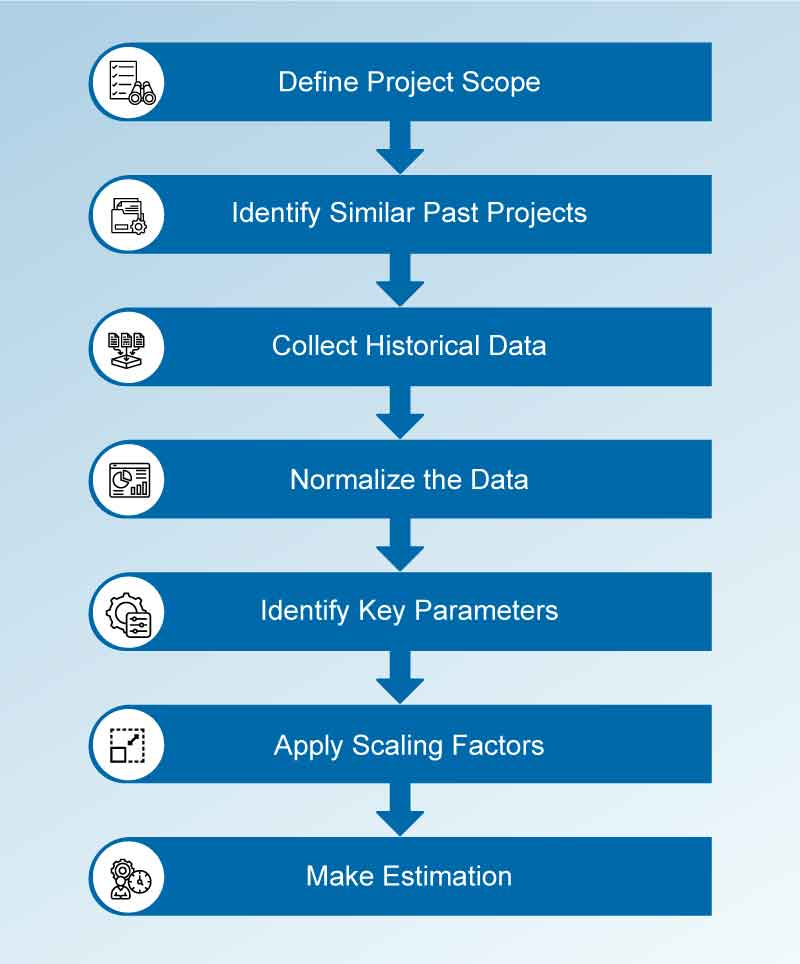
You should now have some understanding of the budgetary constraints and other planning you need to do, based on thecost done for this project. Below is a summary of the steps for analogous estimating that was implemented:
Analogous Estimating – Advantages vs. Disadvantages
Analogous estimating is a valuable tool for project cost estimation, particularly in the early stages. Its simplicityand efficiency make it a practical choice when quick, high-level estimates are needed. However, there are definitelysome limitations you should be aware of. Let's look at the advantages and disadvantages of this technique.
Advantages of Analogous Estimating
Quick and Efficient
Analogous estimating allows for rapid cost estimation by leveraging historical data from similar projects. Thisefficiency is particularly useful in the early stages of project planning when detailed information may not beavailable.
Leverages Experience
It utilizes the expertise and experience gained from previous projects. By comparing similar projects, you can drawfrom proven practices and benchmarks, increasing the estimate's reliability.
Cost-Effective
Since analogous estimating doesn't require the detailed breakdown of costs and resources that other methods do, itcan be less resource-intensive and more economical.
Early-Stage Feasibility
It provides a high-level estimate that's sufficient for initial feasibility studies and budgeting decisions. Thishelps stakeholders make informed decisions about whether to proceed with a project or not.
Simplicity
The process is straightforward, requiring less detailed data collection and analysis compared to other estimatingtechniques, making it accessible even for those with limited estimating experience.
Disadvantages of Analogous Estimating
Accuracy Limitations
Analogous estimating relies heavily on the accuracy and relevance of historical data. Differences in projectspecifics, market conditions, and technological advancements can lead to significant estimation errors.
Assumption-Heavy
This method involves making assumptions about the similarities between the past and current projects. Any incorrectassumptions can skew the results, leading to inaccurate estimates.
Lack of Detail
Since it doesn't delve into the granular details of the project, analogous estimating might overlook specific costsand risks. This can result in unanticipated expenses or project delays later on.
Dependence on Historical Data Quality
The quality of the estimate is directly tied to the quality of the historical data. Incomplete, outdated, orinaccurate data can compromise the estimate's reliability.
Not Suitable for Unique Projects
For projects with unique characteristics or innovations, analogous estimating may not be applicable as there might beno comparable historical data to draw from.
Market Changes
It may not adequately account for current market conditions, inflation, or changes in material and labor costs.Adjustments for these factors can be complex and might still introduce uncertainties.
Types of Analogous Estimates (With Examples)
The types of analogous estimating can be classified into four categories.
- Single-Point Estimate (or Absolute Value Estimate)
- Three-Point Estimate
- Ratio Estimate
- Estimated Range
Let's explore what each of them will look like in a practical business use-case.
Single-Point Estimate (or Absolute Value Estimate)
A single-point estimate uses a single historical data point from a past project to estimate the cost or duration ofthe current project. Basically, this method relies on the assumption that the current project is very similar to thepast project.
Example
Scenario: You're estimating the cost of building a new 4-story office building.
Historical Data: A similar 4-story office building completed last year cost $4,000,000.
Single-Point Estimate: The estimated cost for the new building is $4,000,000.
Three-Point Estimate
A three-point estimate uses three different estimates to account for uncertainty and variability: the most likely(M), the optimistic (O), and the pessimistic (P) estimates. This method often utilizes the PERT (Program Evaluationand Review Technique) formula to calculate the expected value.
Example
Scenario: You're estimating the cost of a new software development project.
Historical Data: Based on similar projects:
- Optimistic Estimate (O): $50,000 (if everything goes perfectly)
- Most Likely Estimate (M): $70,000 (normal circumstances)
- Pessimistic Estimate (P): $100,000 (if many issues arise)
Three-Point Estimate (PERT):
Expected Cost = [O + 4M + P] / 6 = [50,000 + 4*70,000 + 100,000] /6 = ~ $71,667
Ratio Estimate
A ratio estimate uses proportions between the historical data and a key project parameter to derive estimated values.This method is useful when there's a clear and consistent relationship between project variables.
Example
Scenario: You're estimating the resource cost for manufacturing a new product.
Historical Data: A similar product's manufacturing cost was $2500 per head for 40 employees,totaling $100,000.
But you're aware that according to a new union contract, the per head resource cost has increased by 15%.
Therefore, your total cost would also increase by 15%.
Ratio Estimate:
Per head cost = $2500 + 15% of $2500 = $2875
Total cost = $2875 * 40 = $ 115,000
Estimated Range
An estimated range provides a range of possible costs or durations based on historical data, reflecting theuncertainty and variability in the estimate. This method gives stakeholders a sense of the potential spread of thecosts, time, and other key project elements.
Example
Scenario: You're estimating the time that a new marketing campaign for a soft drink featuring afamous basketball player will take.
Historical Data: A past campaign for a cookie brand with a similar scope took 3 months to complete.However, another campaign for a fruit juice brand with the same stakeholders took 6 months to complete.
Estimated Range: The new campaign is expected to take between 3 to 6 months.
Difference Between Analogous and Parametric Estimating
Parametric estimating is another estimation technique that project managers can use to derive accurate estimates.While there are some similarities between parametric and analogous estimating, they're largely different techniques.Let's explore how.
| Analogous Estimating | Parametric Estimating | |
|---|---|---|
| Definition | Based on historical data from similar projects | Based on the statistical relationships between historical data and other key elements |
| Basis for Estimate | Historical data and expert judgment from past similar projects | Mathematical models and formulas derived from historical data and project variables |
| Accuracy | Generally, less accurate due to reliance on high-level similarities | Typically, more accurate, assuming relevant and high-quality data is available |
| Data Requirements | Requires data from similar past projects but can work with limited detail | Requires detailed and specific historical data and well-defined project parameters |
| Time Required | Faster to produce estimates as it relies on existing project comparisons | More time-consuming due to the need for detailed data collection and statistical analysis |
| Complexity | Simpler and easier to use, especially for those with less estimating experience | More complex, requiring statistical analysis and understanding of cost drivers |
| Use Case | Early project phases, feasibility studies, and when quick estimates are needed | Projects with well-defined parameters, needing high accuracy and detailed estimates |
| Suitability | Suitable for projects that are similar in nature to past projects | Suitable for projects with measurable and scalable parameters |
| Example | Estimating the cost of a new residential building based on costs of previous ones | Estimating software development costs based on the number of lines of code |
| Flexibility | Less flexible as it relies heavily on past project similarities | More flexible as it can adapt to various project sizes and levels of complexity |
| Level of Detail | High-level, broad estimate | Detailed, itemized estimate based on specific parameters |
| Risk of Bias | Higher risk of bias due to reliance on expert judgment and subjective comparisons | Lower risk of bias due to reliance on statistical methods and objective data |
Therefore, if you have the time and expertise to implement parametric estimation, it's recommended to use that asyour estimation technique, purely because the result you end up with will have a higher degree of accuracy and willbe closer to the real-world costs as much as possible.
When to Use Analogous Estimating
Analogous estimating is a practical and efficient method for project cost estimation under specific circumstances.Understanding when to use this technique can help ensure accurate and useful estimates while optimizing resourceutilization. Here are the key situations where analogous estimating is most appropriate:
Early Project Phases
Feasibility Studies
During the initial feasibility studies, when detailed project information is limited, analogous estimating provides aquick and reasonably accurate cost estimate to help determine whether a project is viable.
Initial Budgeting
In the early stages of budgeting and financial planning, analogous estimating offers a ballpark figure that can beused to secure funding and allocate resources.
Projects With Similar Scope and Complexity
Repeat Projects
When a new project closely resembles previous ones in terms of scope, complexity, and requirements, analogousestimating can leverage historical data to accurately predict costs.
Standardized Projects
For projects that follow a standard model or template (such as residential buildings, standardized manufacturingfacilities, or repeatable IT implementations), analogous estimating can be highly effective.
Time Constraints
When there's limited time to develop a detailed cost estimate, analogous estimating allows for a quicker turnaroundby using data from similar projects rather than conducting a time-consuming detailed analysis.
Limited Data Availability
If detailed project data is not available, analogous estimating provides a way to generate a reasonable estimatebased on available information from previous projects.
Preliminary Project Planning
Conceptual Planning
During the conceptual planning phase, when the project scope is still being defined, analogous estimating helpsprovide a cost framework that can guide further project development and decision-making.
Stakeholder Presentations
When presenting project proposals to stakeholders, a high-level estimate based on analogous data can effectivelycommunicate the anticipated budget and scope.
Supplementing Other Estimating Methods
Cross-validation
Analogous estimating can be used alongside other estimating methods (like parametric or bottom-up estimating) tocross-validate estimates and enhance overall accuracy.
Risk Mitigation
By comparing estimates from various methods, project managers can identify potential discrepancies and betterunderstand the risks and uncertainties associated with the project cost.
Conclusion
Analogous estimating is a versatile and valuable tool in the project manager's toolkit. It's particularly useful inthe early stages of project planning, for projects with similar scope and complexity, and when time or dataconstraints limit the feasibility of more detailed estimation methods. By understanding when and how to applyanalogous estimating, project managers can effectively utilize historical data to inform project decisions andenhance cost estimation accuracy.
So, if you decide to conduct analogous estimating for your next project, remember that the fundamentals of whatyou're doing are akin to what astronomers do to understand more about the cosmos — learning the past to understandyour present (project) better!