Summary
Enterprise risk and project delivery information usually live in separate systems. Deltek just linked them with Deltek PPM Risk, the first module in its new Deltek PPM product. It brings enterprise risk management closer to project execution, helping organizations connect the risks they manage across the business with the projects where those risks can have an impact.
Why It Matters: Enterprise risks can have different implications across projects. Better context helps organizations focus attention where risk matters most and make more informed decisions.
Key Takeaways:
- Manage the full risk lifecycle: Deltek PPM Risk supports risk discovery, assessment, mitigation, monitoring and action through governed workflows and AI-powered assistance
- Keep people in control of AI: Dela assists throughout risk management, while people control formal assessments, mitigation strategies and decisions about changes in exposure
- Connect enterprise and project risk: Integration with Deltek Acumen extends enterprise risks into quantitative project-level schedule and cost risk analysis.
Every project-based organization manages risk.
A permitting delay threatens a major capital project. A supply chain disruption affects multiple programs at once. A regulatory change introduces new compliance requirements. A key contract creates concentrations of financial exposure.
Yet many organizations still manage these risks through spreadsheets, disconnected systems, and processes that make it difficult to know which risks deserve attention, how they affect project delivery, or whether mitigation efforts are actually working.
These disconnected processes can make it harder to surface important risks early and understand their potential effect on business performance.
Today, Deltek is introducing Deltek PPM Risk, the first module within the new Deltek PPM product.
Purpose-built for project-based organizations, PPM Risk helps teams identify, assess, mitigate, and monitor enterprise risks while connecting risk management decisions to project execution and business outcomes.
Introducing Deltek PPM and Deltek PPM Risk
Deltek PPM is Deltek's new cloud-native project portfolio management (PPM) product, designed to bring together the disciplines that help organizations successfully plan, govern, and deliver projects.
Built on the Deltek Platform and powered by Dela, Deltek's AI orchestrator, Deltek PPM provides the foundation for a new generation of intelligent project portfolio management capabilities.
PPM Risk, originally called “Deltek PPM Enterprise Risk,” provides an enterprise risk management capability within Deltek PPM. It combines governed workflows, expert collaboration, AI-powered assistance, mitigation management, executive visibility, and project risk connectivity in a single experience designed for project-based organizations.
Why Enterprise Risk Management Needs to Connect with Project Reality
Organizations face a persistent tension in risk management. Encouraging broad participation surfaces issues early, but it can flood executive reporting with unreviewed concerns.
Restricting who can report risks keeps that reporting clean, but it can discourage the people closest to the work from raising issues until it is too late.
At the same time, enterprise risk management and project execution are too often managed separately. Risks identified at the enterprise level may never be evaluated within the individual projects they actually affect.
Project teams may surface important risks that never reach organizational leadership.
PPM Risk was designed to address both challenges.
How PPM Risk Turns Risk Signals into Informed Action
Risk management is not a single event. It is an ongoing process that moves from discovery and assessment through mitigation, monitoring, and action. PPM Risk helps organizations manage that entire lifecycle.
Intelligence That Accelerates the Process Without Taking Control
Dela is embedded within PPM Risk, helping teams by researching risks, improving risk quality, coordinating expert input, recommending mitigation actions, and surfacing portfolio insights.
Dela's actions are logged and auditable, creating visibility into how AI-supported activity contributes to the risk-management process.
People determine which risks enter the formal Risk Register, approve official assessments, select mitigation strategies, and decide how to respond to changes in exposure.
Dela accelerates the process. Human judgment governs the decisions that matter.
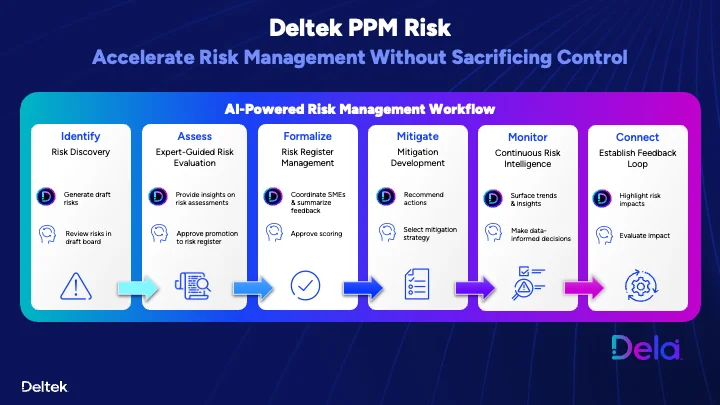
Across that lifecycle, PPM Risk combines governed workflows with AI-powered assistance to help teams move from early risk discovery to informed action. Here's how that works at each stage.
Identify: Surface Potential Risks Without Compromising Executive Reporting
Finding risks early is often the hardest part of risk management.
Users can create new risks directly or ask Dela to research and generate potential risks, with suggested categories, probability assessments, and impacts to help accelerate early discovery. Users can also upload business documents and have Dela identify risks that should be considered based on that information.
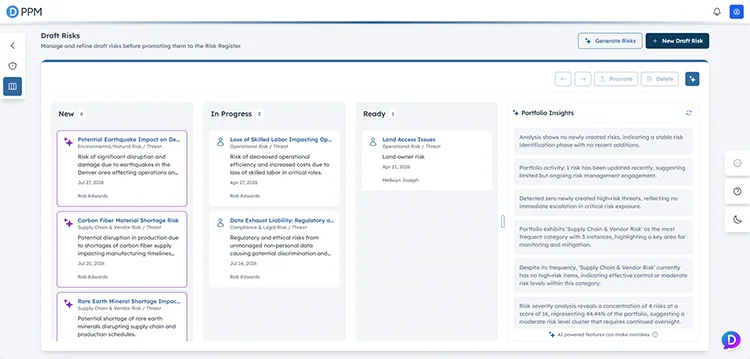
Identified risks do not immediately enter executive reporting. All new risks begin on the Draft Risk Board, a governed staging area where teams can investigate, refine, and assess risks before they reach the formal enterprise risk program.
This approach encourages broader participation in risk discovery while ensuring executive reporting is based only on risks that have been reviewed and promoted into the Risk Register.
AI-generated risks cannot enter executive reporting until a person has reviewed and chosen to promote them.
Assess: Develop Stronger, Decision-Ready Risk Information
As risks are reviewed and refined, Dela helps identify missing information, incomplete descriptions, and areas requiring additional context.
Risk owners review that guidance, then set probability, impact, and response strategy. The result is a more consistent assessment process that helps organizations build a clearer, more useful picture of the risks they are managing.
Formalize: Establish Accountability and Bring Experts into the Decision
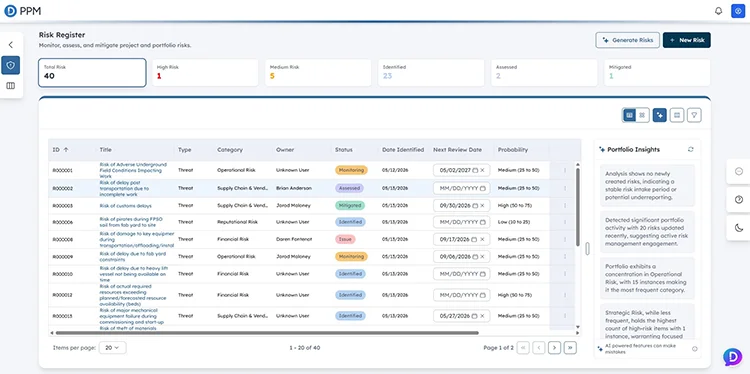
When a risk is ready for formal governance, a person promotes it into the Risk Register, the organization's centralized system of record for approved enterprise risks and opportunities.
Enterprise risk management is rarely a one-person job. Risk owners often need input from specialists across finance, compliance, engineering, procurement, operations, and other functions.
When a risk is promoted, Dela can help identify relevant subject matter experts and invite them to participate in the risk assessment. Invited experts can provide input through Microsoft Teams without opening PPM Risk directly.
Risk owners review those contributions and decide whether to apply consensus results to the official record. The final decision always rests with the human risk owner.
Mitigate: Build an Informed Response and Measure Its Expected Effect
Identifying a risk is only valuable if the organization can respond effectively and understand whether that response is working.
PPM Risk supports structured mitigation planning. Risk owners can create plans from reusable templates or build custom plans, estimate mitigation costs, assign responsibilities, establish timelines, and track implementation activities.
As risks progress through the workflow, Dela can suggest mitigation actions for consideration. Those suggestions are advisory; risk owners decide which approaches to adopt.
Organizations can also compare exposure before and after mitigation, helping leaders evaluate the expected effect of planned mitigation investments.
Monitor: Understand Exposure, Mitigation Effectiveness, and Areas Requiring Attention
Dela analyzes information across the risk portfolio, surfacing concentrations, emerging patterns, and areas that may need attention.
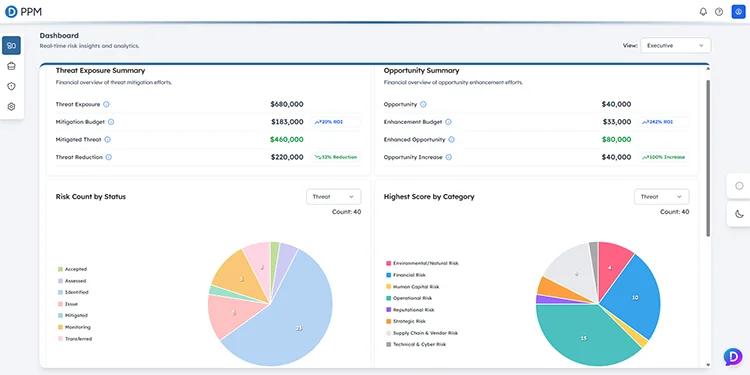
PPM Risk provides two purpose-built dashboards. The Executive Dashboard gives leadership visibility into organizational exposure, mitigation investment, and risk trends. The Risk Manager Dashboard focuses on process health, helping teams stay on top of governance activities.
Executive reporting draws from the formal Risk Register rather than the Draft Risk Board, helping leaders work from reviewed information.
Connect: Bring Enterprise Risk Decisions and Project-Level Analysis Together
Enterprise risks do not affect every project equally. PPM Risk lets organizations assign enterprise risks to individual projects, so teams can evaluate how the same risk affects different initiatives. This provides a clearer view of where an enterprise threat or opportunity may have the greatest impact across the project.
Extending Enterprise Risk Management with Deltek Acumen
For organizations already using Deltek Acumen Risk for project risk analysis, PPM Risk does not replace that investment. It extends it.
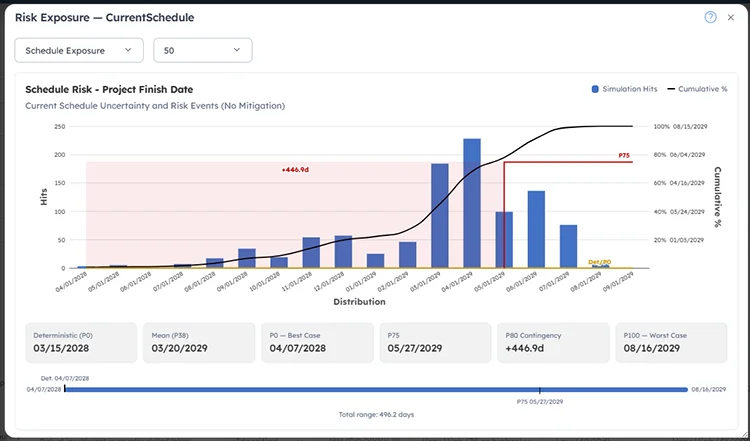
Through native integration between the solutions, enterprise risks can be assigned to projects and analyzed further within Acumen, where analysts can run quantitative schedule and cost risk analysis to evaluate potential impacts and develop response strategies.
Results can then be published back into PPM Risk, giving enterprise risk owners greater visibility into project-level risk impacts.
Connecting Risk Strategy to Project Execution
Together, Deltek PPM Risk and Deltek Acumen create a continuous feedback loop between enterprise risk management and project execution. Enterprise threats and opportunities can be evaluated in the context of the projects they affect, while project-level findings provide additional context to inform business decisions.
For project-based organizations, this creates a more connected approach to risk management, helping leaders understand not only which risks matter across the organization, but how those risks may affect project delivery.
Looking Ahead
PPM Risk marks the beginning of the broader Deltek PPM journey. As the first module within the new product, PPM Risk establishes a foundation that will continue to expand with new modules, capabilities, and AI-powered experiences in 2027. An additional cloud deployment option designed to support organizations with FedRAMP requirements is also planned for 2027.
This release is the first step in a broader vision to bring the disciplines behind successful project planning, governance, and delivery together within a unified, cloud-native Project Portfolio Management solution on the Deltek Platform.
Webinar
Stop Risk Data from Living in Silos
Unvetted risks clutter executive dashboards while critical issues surface too late. See how Deltek PPM Risk connects enterprise and project data to close the gap.