Summary
This article shows how Dela addresses time and expense workflows from both ends: for submitters, it removes friction at the point of capture using ICR and smart project suggestions; for approvers, it automates policy reviews and flags anomalies so they focus only on exceptions that need human judgment.
Time and expense management touches everyone in a project-based firm, but it's often where data quality breaks down and approval bottlenecks occur. Automation that respects existing permissions is critical to both efficiency and compliance.
Key Takeaways
- On the submission side: ICR (Intelligent Character Recognition) and Timesheet Assist remove friction by capturing expenses immediately and suggesting the right projects, so timesheets are completed faster and more accurately.
- On the approval side: Dela automates policy reviews, surfaces only genuine exceptions, and operates entirely within existing Vantagepoint permissions, meaning approvers focus on what matters instead of routine administrative checks.
- The complete picture: When intelligence addresses the workflow from both ends, the result is cleaner data, fewer approval delays, and early detection of policy violations before they affect project financials.
Time and expense management is one of those workflows that touches everyone in a project-based firm. Every employee submits. Every manager approves. And somewhere between the two, things go wrong: receipts get lost, policy violations slip through, timesheets sit in approval queues longer than they should, and by the time anyone catches an issue, it has already affected a project's financial picture.
Dela addresses both sides of that equation in Vantagepoint. For the people submitting, it removes friction at the point of capture. For the people approving, it handles the checks so they can focus on the exceptions that actually require their judgment. Here is what it does today.
For the People Saving and Submitting
Capture Expenses the Moment They Happen
The gap between "this happened" and "this is in Vantagepoint" is where accuracy breaks down. Receipts pile up, details get fuzzy, and expense reports become a Friday afternoon obligation nobody wants.
Dela ICR (intelligent character recognition) closes that gap at the point of capture. Photograph a receipt on your phone and an expense record is created immediately, fields pre-populated and ready for review. No manual entry, no digging through a bag for crumpled paper later in the week. The information goes in when it is fresh, which means it goes in accurately.
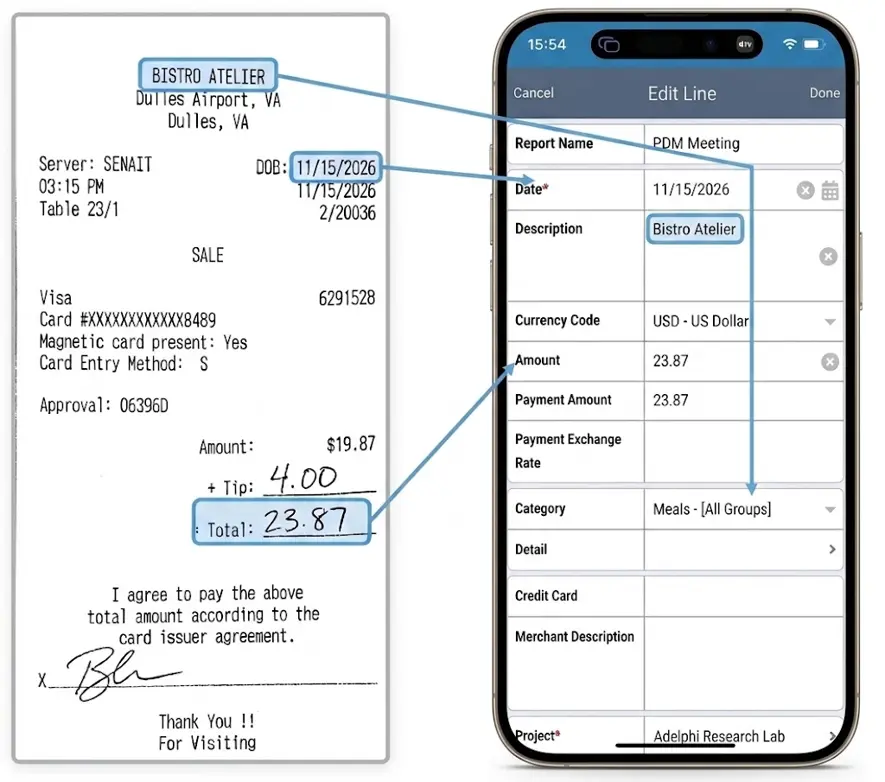
Dela ICR automatically populates expense details from a photo of a receipt, eliminating manual data entry and delays.
Log Time Faster with Timesheet Assist
Getting employees to complete timesheets consistently is one of the more persistent operational challenges in a project-based firm. Timesheet Assist addresses it directly.
When users log into Vantagepoint, Timesheet Assist surfaces a reminder and immediately suggests the projects most likely to belong on their timesheet: ones they charged time to in the previous period, plan assignments that fall within the current period, and projects linked to recent expense lines. One click adds a project row. No hunting, no searching for project numbers, no blank screen to fill from scratch.
Users can also see any approved absences or company holidays for the period in context, so the full picture is there before they start entering hours. If the timing is not right, they can snooze the reminder and return to it from within the timesheet itself.
The result is more frequent timesheet completion, more accurate project coding, and less time spent by managers chasing down late or incorrect entries before the period closes.
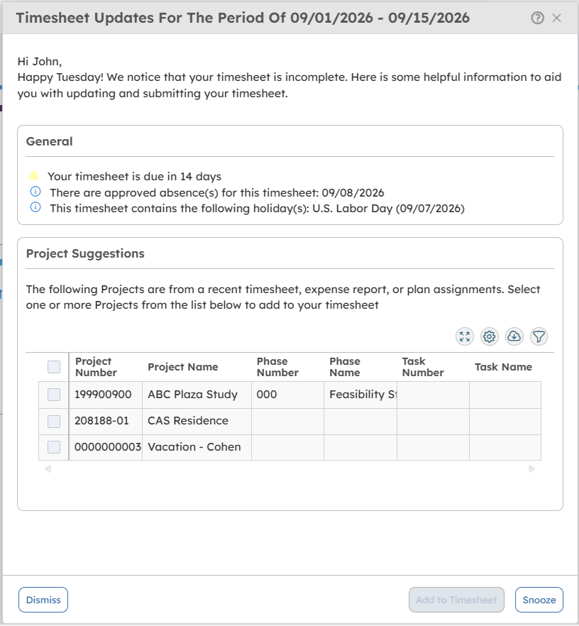
Timesheet Assist suggests relevant projects based on past assignments and current project plans, reducing time spent searching for the right coding.
Check Your Absence Balance Without Navigating
Before submitting a time-off request, most people need to check their balance. With Ask Dela, that is a plain language question rather than a navigation task. Ask Dela returns the answer immediately, without requiring the user to open a separate hub or run a lookup.
Small friction, but the kind that adds up across an entire firm over the course of a year.
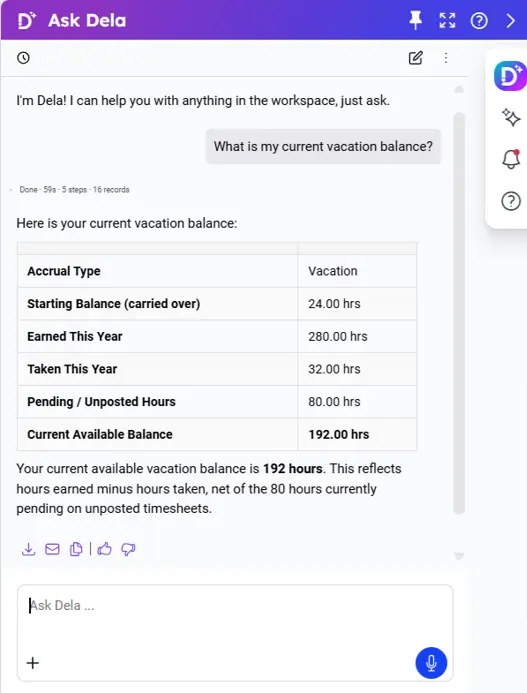
Ask Dela answers absence balance questions instantly in plain language, eliminating manual navigation through system menus or separate lookups.
For the People Approving
This is where Dela's impact on the T&E workflow becomes most significant. Approvers are often the same principals and project managers who already manage client relationships, monitor project performance, and run their own billable work. Time spent manually reviewing submissions against company policy is time taken from everything else.
Dela changes that dynamic by automatically performing the review work and surfacing only the situations that genuinely require human judgment. Because Dela operates entirely within Vantagepoint's existing security model, every recommendation is based only on data the approver is already permitted to see. The three sections below show what that looks like in practice.
Timesheet Approvals That Tell You What to Do
For each timesheet submitted for approval, Dela analyzes the entry against your firm's company policy and surfaces a clear recommendation alongside the relevant context. When no anomalies are detected and the timesheet complies with policy, Dela suggests approval in a single click. When something needs attention, Dela flags the specific issue so the approver can focus exactly where it matters.
This means the stack of timesheets waiting in your queue is no longer a uniform review task. It is a sorted list: here are the ones you can approve immediately, and here are the ones that need your eyes.
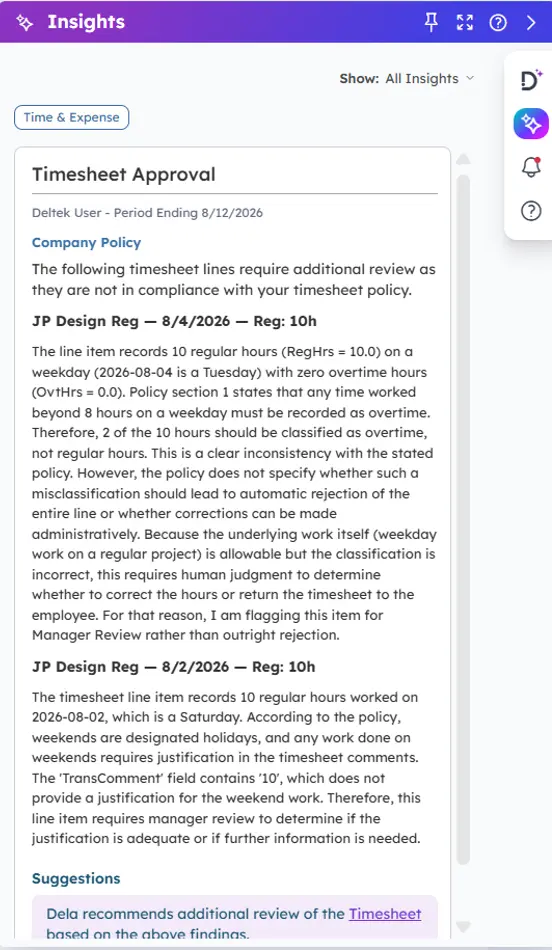
Dela analyzes each timesheet against company policy and surfaces a clear recommendation, reducing manual review time and ensuring consistent enforcement.
Absence Request Approvals, Handled the Same Way
The same intelligence applies to absence requests. Dela reviews each submission against your firm's absence policies and surfaces a recommendation with the relevant context, so approvers are not manually cross-referencing policy documents or trying to remember the rules for a specific leave type.
For firms managing large teams, this alone represents a meaningful reduction in the time spent on routine administrative decisions.
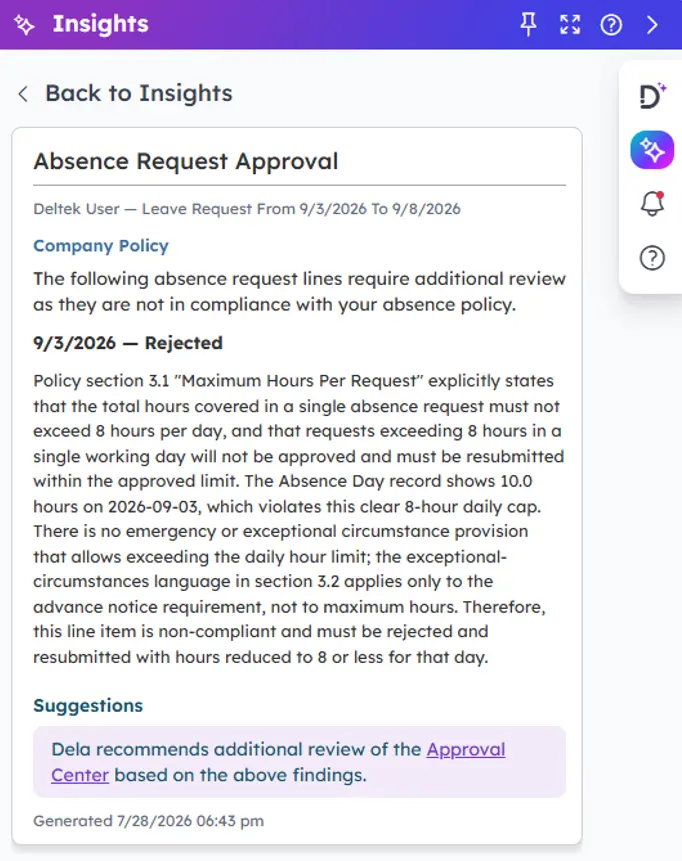
Dela reviews absence requests against company policies and surfaces policy-compliant recommendations, so approvers don't need to manually cross-reference policy documents or interpretation rules.
Expense Reports That Flag Their Own Problems
Expense approvals carry real financial and compliance risk. A single approved violation costs money and can create audit exposure. An approver reviewing a full expense report line by line, against a policy they may not have memorized, is doing the work that Dela can handle automatically.
When an expense report contains a policy violation, Dela identifies the specific line item, explains the issue, and suggests a corrective action: remove the charge, split the expense, or resubmit without the non-compliant item. The approver sees exactly what the problem is and what to do about it.
Beyond policy compliance, Dela also detects expense anomalies that a manual review might miss: duplicate submissions, category spend that exceeds historical patterns for that employee or project, and other signals that warrant a second look before approval.
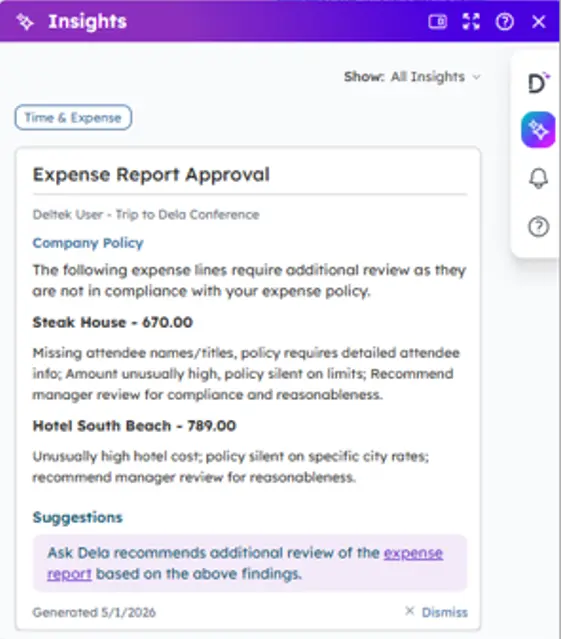
When an expense violates policy, Dela identifies the specific line item, explains the issue, and suggests corrective action—no manual cross-referencing required.
The Complete Picture
What makes this story compelling is not any single capability in isolation. It is the way Dela addresses the T&E workflow from both ends simultaneously.
On the submission side, it removes the friction that causes late entries and inaccurate records. On the approval side, it replaces manual policy review with intelligent recommendations, so approvers spend their judgment on exceptions rather than routine checks.
The result is a workflow that runs faster, produces cleaner data, and catches problems at the earliest possible moment, before they affect project financials, cash flow, or compliance standing. That is intelligence that gets work done, for every person in the workflow.
Also Worth Reading: Dela for Project Managers
Dela's impact on project financial health goes well beyond T&E. See how project managers are using Dela to surface billing gaps, monitor project performance, and get instant answers from their Vantagepoint data.
Customer Town Hall
See What's Next for Deltek Vantagepoint
Join Deltek experts and fellow customers each quarter to discuss product vision, recent releases, and how our Vantagepoint fits your goals.