Imagine building a complex structure without a common language between designers and builders. That's the challenge MasterFormat, a standardized classification system developed by the Construction Specifications Institute (CSI), solves.
For architects, engineers, project managers, facilities managers, building product manufacturers, and specialty contractors, it's the essential bridge between creative vision and construction reality. This valuable tool transforms how we organize specifications through a standardized framework of detailed categorization, ensuring every material, assembly, and system in construction projects is documented and communicated. When design teams embrace MasterFormat's standardized framework, they gain remarkable control over project outcomes, dramatically reducing communication issues that can compromise design intent.
This comprehensive guide explores CSI MasterFormat's structure, benefits and practical applications throughout the construction process—from initial design development to post-construction and facility management.
Origin and Evolution: From Concept to Industry Standard
MasterFormat didn't appear overnight. The Construction Specifications Institute (CSI), working alongside Construction Specifications Canada (CSC), developed it to bring order to the chaos of construction documents. Introduced
MasterFormat has evolved with the industry it serves:
- 2004: A significant expansion from 16 to 50 divisions, creating space for new technologies and materials.
- 2012 & 2016: Updates that embraced sustainability, digital project management, and emerging construction methods.
- Ongoing Updates: Continuous refinements that keep pace with technological advancements, such as BIM, green building practices, and modern construction techniques.
This willingness to adapt is precisely why MasterFormat remains relevant in today's fast-changing construction industry.
Why CSI MasterFormat is Essential: Bringing Order to Complexity
Have you ever seen what happens when construction documentation goes wrong? Delays, disputes, project cost overruns – it's not pretty.
Given the complexity of construction projects, adequate documentation is the difference between success and costly chaos. The spec book for a project, which can run into hundreds or even thousands of pages, contains precise details about each element of the build, including the specific qualities of materials required, exact material and manufacturing requirements, performance criteria, execution standards, and quality control measures that contractors must follow to meet design.
MasterFormat delivers multiple advantages across the construction ecosystem, enabling efficient processes and creating value at every stage of the project lifecycle.
Guide
The Ultimate Guide to Construction Specifications
This free guide covers five specification best practices, plus a checklist to reduce rework, cut change orders, and take project efficiency further.
Creating a Universal Language for Project Teams
MasterFormat provides everyone involved with a standardized system for organizing specifications, creating a common language that bridges professional boundaries. It eliminates the confusion that comes from everyone using their organizational systems.
With this consistent framework, interpreting distinct specifications becomes more straightforward, navigating the spec book becomes more intuitive, coordination improves, and project tasks run more smoothly. When communicating specifications, architects often reference specific lines in the three-part spec format, enabling precise identification of requirements within MasterFormat's organizational structure.
Streamlining Processes to Minimize Financial Risk
MasterFormat dramatically reduces costly misinterpretations, omissions, and discrepancies typically arising from construction project complexity by organizing everything logically and uniformly. This clarity leads to fewer on-site mistakes, more accurate bidding, and streamlined procurement, as materials, methods, and requirements precisely define the project.
Transforming Documentation into Strategic Advantage
MasterFormat does more than organize paperwork – it becomes a powerful project documentation tool that brings structure to countless project details through its comprehensive master list of divisions and sections, especially when combined with construction management activities. AIA MasterSpec® builds upon this foundation by providing detailed specification content aligned with MasterFormat's organizational structure. While MasterFormat divides construction information into 50 divisions (e.g., Division 03-Concrete or Division 09-Finishes), MasterSpec, as part of Deltek Specpoint, provides pre-written technical specifications within these divisions that architects and engineers can edit to meet specific project requirements.
This integration creates a cohesive documentation system in which MasterFormat provides the organizational framework, and MasterSpec supplies the detailed content, streamlining the entire specification process from design through construction.
MasterFormat is used in the four phases of the construction industry. By dividing specifications into clear categories using CSI Divisions, tracking progress and ensuring compliance becomes much more straightforward. MasterSpec divisions further organize these specifications, providing detailed guidelines for materials and project requirements.
It also makes it easier to identify relevant material requirements and trade contractor responsibilities. It strengthens cost estimates by providing a standard cost code structure for materials and labor planning. This integration of documentation, management, and financial planning creates a solid foundation for efficient execution and resource allocation, providing transparency in building across the entire industry.
Everything in the project document is organized by MasterFormat, a common standard that is part of the construction contract, ensuring that all parties, including specialty contractors, are aligned on project requirements, reducing disputes and enhancing accountability throughout the construction process. This clear documentation helps all parties understand the actual costs associated with specific requirements, preventing misunderstandings about financial responsibilities. When contractor disputes arise over damage, defects, errors, omissions, or nearly any other issue, they often involve the specification book, underscoring the importance of clear, organized documentation. Beyond dispute prevention and resolution, MasterFormat also makes it easy for specialty contractors to identify specific material needs and estimated costs and communicate procurement requirements to their suppliers.
Providing the Framework for AIA MasterSpec® Content
MasterFormat serves as the essential organizational infrastructure for AIA MasterSpec. It allows these pre-written specification templates to be logically arranged within the spec book, easily located through a standardized table of contents, and seamlessly integrated into project documentation. This structural foundation creates a coordinated approach in which architects, engineers, and specifiers using MasterSpec content through Deltek Specpoint automatically align with the industry-standard classification system used throughout the construction process.
Understanding CSI Divisions: A Hierarchical Structure
Think of MasterFormat as a supremely organized filing cabinet for construction requirements, where everything has its place in a logical hierarchy of divisions, each with a unique number. The current six-digit structure offers remarkable flexibility, organizing construction documentation into divisions, sections, and subsections, and providing a structured format to convey this information clearly and efficiently.
- Division Numbers (XX 00 00): The big categories – think of these as your primary file drawers
- Subdivision Numbers (XX XX 00): The folders within those drawers
- Section Numbers (XX XX XX): The specific documents within each folder
This organization eliminates confusion, reduces errors, speeds up information retrieval, ensures everyone is working from the same page, and ultimately improves project execution by providing clear, consistent documentation throughout the construction process.
Design teams and project participants frequently enhance MasterFormat's effectiveness through Deltek Specpoint, which includes MasterSpec. This complementary system leverages MasterFormat's organizational structure to deliver professionally researched specification templates for inclusion in the project spec book. These expert-crafted resources serve as refined starting points that can be customized to meet specific project requirements – significantly reducing spec book development time while ensuring consistent quality and regulatory compliance.
Breakdown of Primary Divisions: The Building Blocks of Documentation
With 50 divisions, MasterFormat creates a comprehensive organizational structure for every aspect of construction documentation, including every major construction trade. Each division contains sections following that six-digit numbering system (like 09 20 00 for Plaster and Gypsum Board).
Here's a quick tour of the major divisions of work:
- Division 00 – Procurement and Contracting Requirements: All the bidding requirements and contract documents
- Division 01 – General Requirements: Project administration, quality assurance, and overarching requirements
- Divisions 02-19 – Facility Construction: The physical building components from site work to finishes
- Divisions 20-29 – Facility Services: All the systems that make commercial buildings work – HVAC, plumbing, electrical
- Divisions 30-49 – Specialties and Infrastructure: Everything from communications to waterway systems
This carefully structured division system ensures that every element of a construction project has a logical home within the documentation framework, eliminating organizational guesswork and creating consistency across the construction industry.
MasterFormat Numbering System Explained
The MasterFormat numbering system uses a hierarchical structure that organizes the major divisions of construction and progresses from broad categories to increasingly specific elements. This offers a precise classification for every building component, with each digit providing another level of detail to precisely identify construction components using standardized technical language that ensures consistent interpretation across all project disciplines.
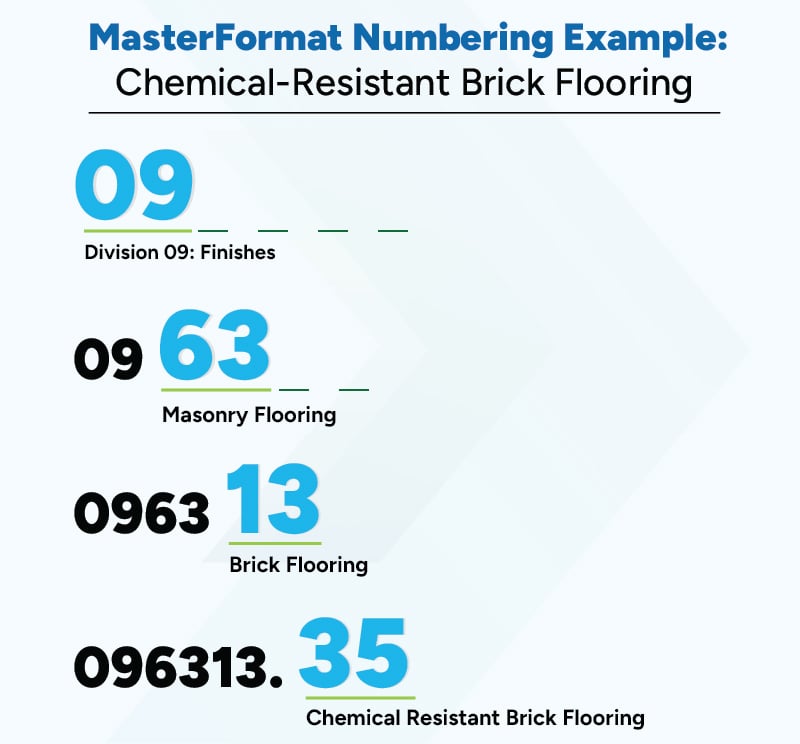
For example, flooring specifications are as follows:
- Division 09 is the division level and identifies the section as Finishes
- The third digit "6" indicates Flooring (096000)
- The fourth digit narrows it further – "3" specifies Masonry Flooring (096300)
- The fifth and sixth digits define the specific material – "13" indicates Brick Flooring (096313)
- The digits after the decimal point provide even greater specificity – ".35" designates Chemical Resistant Brick Flooring (096313.35)
This progression from broad scope (096300—all masonry flooring) to medium scope (096313—brick flooring) to narrow scope (096313.35—chemical-resistant brick flooring) represents a detailed classification system that allows project teams to specify building materials and components with exactly the required level of detail, ensuring precision in both documentation and execution.
MasterFormat: From Blueprint to Building Management
One of MasterFormat's greatest strengths is its value across the project timeline. Providing a standardized format creates a continuous thread of organization throughout the entire building lifecycle, from design to procurement through construction and facilities management. MasterSpec complements this organizational system by offering pre-written specification content that follows MasterFormat's structure.
The construction industry uses MasterFormat in these phases:
1. Design Development Phase
As design concepts transform into buildable solutions, MasterFormat provides the organizational structure that keeps everything on track.
Specification Development
Design teams use MasterFormat to translate creative concepts into technical requirements through a descriptive overview of all building systems and components. The division structure ensures proper documentation of all building materials while facilitating coordination between different disciplines, helping to maintain consistency even in the most complex projects.
Initial Cost Planning
MasterFormat divisions provide a structured framework for preliminary cost estimates that align with design intent, enable precise cost projections, and create transparency in budgeting. This organized approach allows teams to assess alternatives, identify budget challenges early, and make informed decisions about resource allocation. Project owners and general contractors often rely on MasterFormat to structure cost codes, ensuring efficient budget management and financial tracking throughout the entire construction process.
2. Pre-Construction Phase
Before breaking ground, MasterFormat plays a crucial role in communicating design requirements with remarkable clarity. Construction project manuals, on the other hand, provide essential guidelines and specifications for successful project execution.
Bidding Documentation
The standardized structure helps create documents that convey design requirements, streamlines the bidding process, reduces misinterpretations, and ensures that contractor bids address the same scope. This structure leads to more meaningful comparisons, better construction contract documents, and improved coordination across construction jobs, ensuring that projects run smoothly and efficiently.
Procurement Strategy
MasterFormat helps define performance criteria and acceptable products. These performance criteria help maintain design control during value engineering and provide clear standards for evaluating proposed substitutions.
3. Construction Phase
During the building process, MasterFormat provides a framework that maintains quality, enables logical task sequencing, and keeps projects on track. Its standardized structure allows seamless collaboration between trades and disciplines by creating a common language for all project documentation and communication.
Submittal Management
Organizing submittals by MasterFormat divisions creates direct alignment with specifications. This streamlines reviews, focuses attention on critical details, and ensures materials and systems meet design requirements before installation.
Budget Tracking
The connection between MasterFormat divisions and the Schedule of Values creates transparency in cost tracking and better control of project budgets. This connection helps monitor budget allocation, evaluate field decisions, and maintain financial clarity throughout construction.
Quality Control
MasterFormat provides a structured framework for verifying proper installation and implementing quality assurance protocols during site visits. This framework helps focus on critical details, document field conditions, and maintain consistent quality standards.
Guide
Boost Spec Accuracy With AI
Learn how AI enhances construction specifications, streamlines project planning, and improves decision-making for design professionals.
4. Post-Construction Phase
Even after completion, MasterFormat continues adding value throughout a building's life.
Project Documentation
Closeout documents organized by MasterFormat divisions become a valuable resource for owners. This structured approach helps transfer critical knowledge about building systems, supporting proper maintenance and operations.
Facility Management Support
The organization extends into the operational phase, providing facility managers with logically structured technical information and establishing a straightforward process for owners to manage their buildings efficiently. This phase becomes a legacy that supports maintenance and guides future renovations.
Dispute Resolution
MasterFormat-organized documentation clearly demonstrates design intent when conflicts arise. This documentation helps the architecture firm demonstrate due diligence, defend design decisions, and resolve disputes efficiently.
By providing consistent organization across all project phases, MasterFormat transforms the complex ecosystem of construction project specifications into a coherent system that enhances communication, increases efficiency in construction documentation, reduces risk, and delivers lasting value long after construction is complete.
Conclusion: The Foundation of Project Success
MasterFormat transforms complex construction information into a coherent system that protects design integrity and fosters collaboration. Its standardized structure creates a shared language across disciplines while reducing errors and streamlining processes from bidding through construction.
The system's power extends beyond project completion, providing organized facility information that has served building owners for decades. By consistently implementing MasterFormat, construction professionals improve outcomes, increase quality assurance, and deliver more efficient construction projects, creating more successful built environments and ensuring that creative vision becomes a constructed reality.