Construction payroll compliance can seem daunting. Complexities such as prevailing wage work, outsourcing, submitting reports, and construction reporting can quickly become overwhelming.
In this guide, we discuss the unique challenges of construction payroll and how to overcome them.
What is Construction Payroll?
Simply put, construction payroll is the total amount of wages and salaries paid from a company to its employees.
The primary goal of construction payroll is to ensure that employees get paid accurately and on time.
However, ensuring that contractors and employees submit accurate time records and comply with regulations can be an administrative nightmare for businesses.
Free Video Series
Construction Accounting University
Take the first critical step towards being a construction accounting expert and jumpstart your journey on making your construction business more predictable and profitable.
Why is Construction Payroll Unique?
Construction payroll deals with many complexities that other industries don't have to worry about, such as prevailing wage, union payroll, and multi-state/multi-city requirements.
Payroll laws frequently change, which can confuse companies and distract them from their day-to-day jobs.
Not following correct payroll laws can lead to inaccurate payroll and can be detrimental to your business. It can also erode employee trust and create problems with the unions.
On a larger scale, a single mistake can lead to serious repercussions such as lawsuits and fines. Submitting incorrect payroll amounts for taxes can result in penalties ranging from 2% to 15% of the total payroll.
The best way to stay on top of your construction payroll, ensure compliance, and reduce the likelihood of mistakes is to use a dedicated construction payroll service.
These services can reduce the burden of the following construction payroll complexities.
“Unlike conventional industries, construction payroll navigates the ebb and flow of projects, demanding a payroll system that can flexibly adapt to the changing dynamics of construction sites.”
7 Things That Make Construction Payroll Unique
1. Multiple Jobs
Keeping track of employees across multiple jobs and unions at different rates can add an additional layer of complexity to construction payroll.
It can be difficult for construction companies to juggle job costing reports with enterprise resource planning (ERP) software and create certified payroll reports for government agencies.
On top of that, construction companies will need to ensure their workers are compensated for the correct federal and overtime pay.
2. Multi-pay Rates
If employees perform more than one job for the same company, they may earn multiple pay rates.
For example, a construction worker may earn an hourly wage on one site but a different rate on another site. When overtime is added to the equation, it can make it more complicated to track each worker's hours and pay rates.
It also makes it more of a challenge to pay the correct rates for the correct duties performed.
3. Multi-state and Multi-city Requirements
Multi-state payroll refers to the process of managing the payroll of employees who live in one state but work in another.
It can also apply to businesses that operate in more than one state or to an employee who works in multiple states.
Multi-state and multi-city requirements can be particularly complex because you have to factor in managing various regulations, deadlines, and federal and local laws.
More than 5,000 cities across 17 states have their own regulations and
city-specific tax that employers have to follow.
Although multi-state payroll doesn't affect federal taxes, it can get tricky when calculating state-specific taxes and withholdings, or when processing payroll for employees who work under different trade classifications or receive different pay rates.
Some states require tax reciprocity for employees and companies in neighboring jurisdictions. This means that employers will need to calculate taxes, withholdings, and reports for workers employed in more than one jurisdiction. If this is done incorrectly, it can result in employees being underpaid and legal action being undertaken against the employers.
Construction payroll software can help to automate different tax rates, deductions, locations, and pay rates. It can also save employers significant time by assigning hours worked across multiple jobs and automatically calculating various deductions.
4. Construction Labor Shortage
Given the construction labor shortage, companies are in fierce competition for skilled workers. That's why it's more important than ever to ensure you pay your employees correctly and on time—if not, it will be hard to retain them.
5. Certified Payroll
If your construction company is working on any special projects, such as military or government-funded federal projects, then you will need to fill out a certified payroll form (WH-347) for every one of your workers to ensure that your company gets paid for the project.
This form is a reporting tool to ensure compliance, documenting information on fringe benefits and prevailing wages for workers.
Details required for compliance include personally identifiable information, worker classifications, hourly rates, daily and weekly numbers of hours worked, deductions made, actual wages paid, detailed fringe benefit plans and programs, and detailed information regarding apprenticeship programs.
6. Prevailing Wage
Prevailing wage laws require employers to ensure that their employees are paid no less than the prevailing wage rate—the hourly rate paid to similarly employed workers in a certain location.
The challenge for construction companies is that the prevailing wage for each employee is unlikely to be uniform, as there are so many different kinds of workers from different localities on a construction site.
Employers will need to be able to match employees to the appropriate job codes and wage rates to produce accurate, certified payroll.
Failure to do this could result in incorrect wages being paid and the wrong information being submitted to the government.
7. Union Payroll
Union payroll varies across states and includes different tax rates, fringe benefits, and compliance requirements.
To manage union payroll effectively, you will need flexible software that can easily set up multiple user-defined deductions to take all of the different variables and union payroll deductions into account.
This will save you from the stress of calculating payments for multiple tax jurisdictions and out-of-state unions. It should be able to process multiple unions and job codes and allow you to produce manual checks as required.
Ensuring that wages are accurately tracked and reported is vital for staying compliant with regulations and union requirements. This is another reason why investing in essential construction payroll software is essential.
Not only will it help cut costs by producing accurate project reports and tax filings, but it will also provide vital documentation and facilitate discussions with union leaders.
Free Guide
Build A Stronger Construction Accounting Strategy
Construction accounting is different from standard accounting and requires a different approach. Learn how to apply construction specific accounting best practices and tools.
Construction Payroll Reports
Contractors can manage their jobs and their business more efficiently by reviewing reports from their payroll service.
Some important reports include:
- Job costing: Job costing accurately tracks all costs associated with a job, including labor, materials, and overheads—allowing companies to make reliable estimates of said costs. In construction-specific software like Deltek ComputerEase, job costing is part of a standard payroll package.
- Job labor: Job labor reports summarize the total hours (including overtime) and labor costs on each job.
- Job hour variance: Job hour variance reports contain estimated hours and costs versus actual hours and costs of your business's labor. Typically, they summarize by job, but if necessary, can go into more detail—like comparing actual to estimated cost and hours for each type of work, and comparing actual to estimated hourly labor rates.
- EEO minority compliance: The U.S. Department of Labor collects employee information, including workers' minority percentages, classifications, trades, and totals of federal and non-federal work hours to ensure they are meeting affirmative action regulations. You will need to ensure that all of this information is accurately documented and processed so that you do not lose federal contracts or face legal penalties.
- Worker's compensation: Each state has its own laws for worker's compensation requirements, and typically, construction businesses have stricter requirements than others. It is the company's responsibility to submit the workers' compensation payroll report, and specific payroll reports are required if you are undergoing an audit.
Construction payroll software can calculate and automate all of the above reports for you so that you do not have to memorize every local, state, and federal requirement.
Benefits of Using Construction Payroll Software
The complex nature of construction payroll makes it difficult to reduce errors and comply with state and federal regulations without the use of construction software.
Software such as Deltek ComputerEase allows contractors to easily manage payroll complexities while remaining in control. Contractors maintain approval rights but alleviate themselves of the burden of double data entry and tracking tax filing deadlines.
Construction payroll software can also help in the following ways:
Automate Manual Processes
Construction payroll software automates processes that you would otherwise have to input on spreadsheets and other clunky systems.
It easily allows you to maintain compliance, so you don't have to comb through each individual payroll calculation and make lists of jurisdictions, employees, and states.
Automated timekeeping can reduce administrative and labor costs by ensuring accuracy and verifying that employees are on-site for work.
Manage Cash Flow
Small construction businesses often face cash flow challenges. Construction software can eliminate the need to sift through spreadsheets to track down individual records and transactions. It can also provide real-time tracking, allowing you to address cash shortages, make payments, and budget.
Enhance visibility
Construction payroll software enhances the visibility into your business, allowing you to manage workforce time and access real-time dashboards and fast, custom reports—anytime, anywhere.
Save Time with One Partner
When your construction accounting software and your payroll provider is the same company, you can save time and simplify entries with just one software, removing the need for double data entry and eliminating redundancies.
“Embracing construction payroll software is not just a technological upgrade; it's a strategic move to boost productivity, reduce manual errors, and provide real-time insights into labor costs.”
How to Choose the Best Construction Payroll Software
Now that you understand the benefits of construction software, the next step is to select the right payroll software for your business.
The following considerations can help ensure you choose the best one for your business needs:
- Assess your payroll requirements: Make a list of everything you need the software to do. This could include accounting for seasonal workers, unions, the number of employees, multi-state/multi-locality/multi-job processing, and pay slips, for example.
- Maintain Compliance: Any worthwhile payroll software will help to ensure that you remain compliant with state and federal regulations while remaining user-friendly and accurately delivering payroll on time.
- Compare features: Different payroll systems will vary in their features and functionality. This is another reason for assessing your payroll requirements above. Defining the features you need, such as job costing, will make it easier to compare different software and select the best one.
How Deltek Supports the Construction Industry
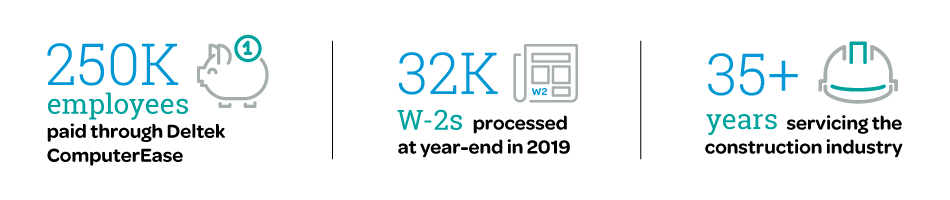
Deltek ComputerEase is the leading construction software provider of job cost accounting, project management, and payroll services—delivering solutions that help customers connect and automate the project lifecycle that fuels their business.
Deltek ComputerEase’s payroll services enable you to streamline tasks and processes with employees in ways only we can offer.
Whether it is delivering taxes, employee payments, direct deposits, and year-end documents or consulting on prevailing wage and certified payroll, Deltek ComputerEase construction payroll experts will help you every step of the way.
If you are currently using a generic accounting solution that's built for standard accounting processes, you will undoubtedly benefit from switching to Deltek ComputerEase, a dedicated construction accounting solution that includes WIP reporting.
Contact us today to learn how Deltek ComputerEase can help you to boost your profitability.
“Deltek ComputerEase handles our payroll splendidly, and the integration with the software is flawless. If I do have an issue, the payroll team is quick to react.”