


 USA
USA 

 Log In

 Deltek Platform


 Aerospace & Defense


Analyze and Audit Proposals for Government Agencies
Boost performance and reduce costly errors by accelerating IGCEs, cost analysis and proposal evaluations with ProPricer Government Edition, available on GSA Advantage.
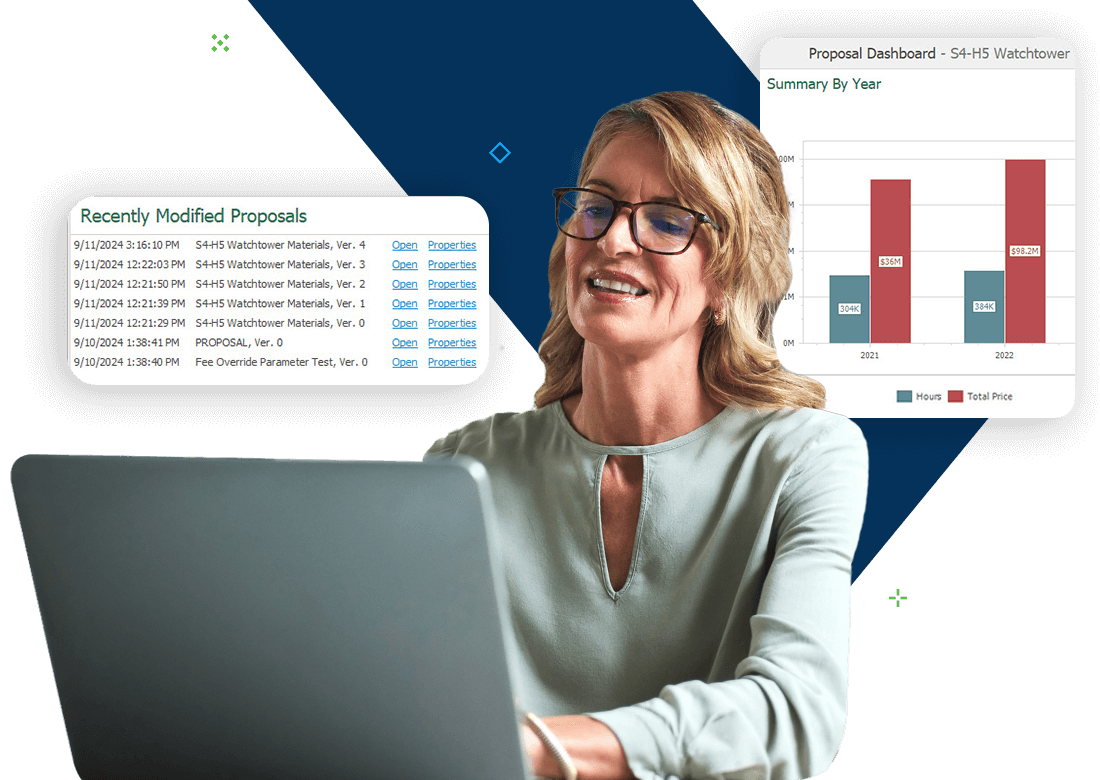
Review Cost Proposals Quickly and Confidently
In the current high-stakes acquisition environment, ProPricer Government Edition, available on GSA Advantage, helps federal teams manage IGCEs, technical evaluations and cost analyses with greater accuracy and confidence. It simplifies the receipt, negotiation, audit and award processes on the same platform as contractors for faster, more effective proposal evaluations.
Benefits of ProPricer for Government Agencies


Expedite Evaluations
Get to your objective position faster by receiving ready-to-evaluate contractor proposals in ProPricer format.


Make Faster, More Informed Decisions
Gain deep insights by analyzing pricing from the top-down and understand the rationale behind each estimate.


Improve Negotiations
Save time on both sides by updating negotiated positions in real time against a submitted proposal or your IGCE.
Features of ProPricer for Government Agencies
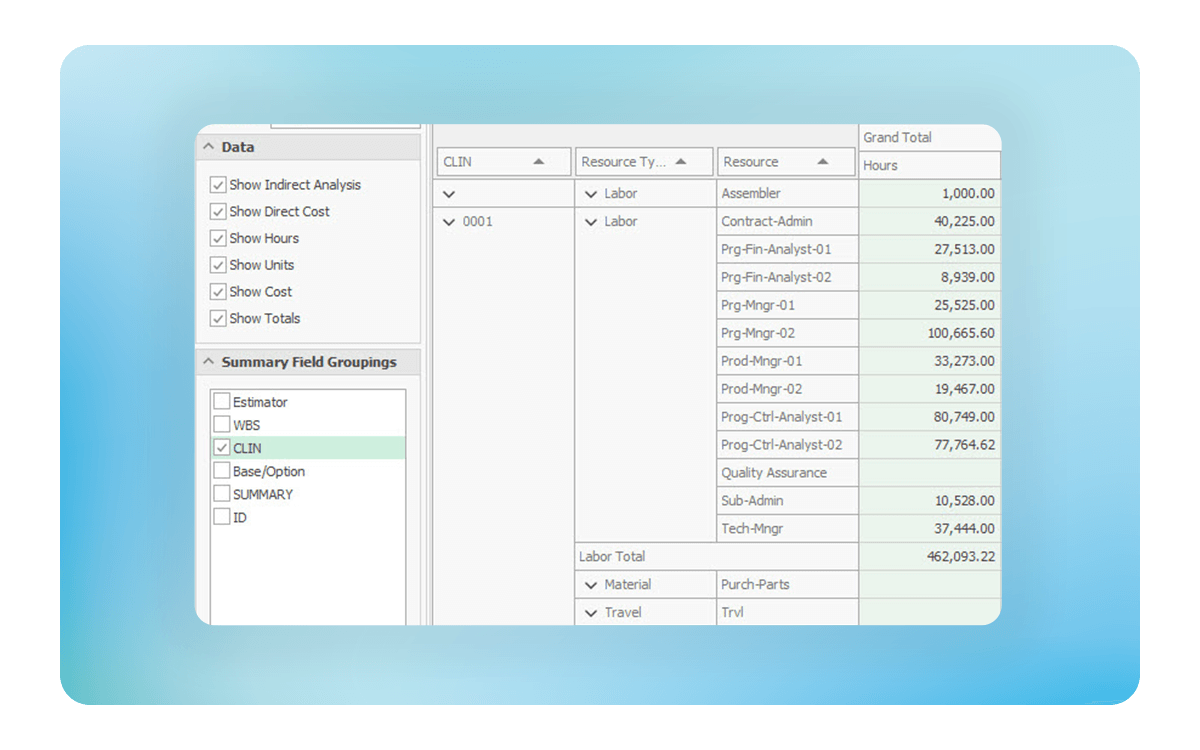
Make Smarter Proposal Evaluations with Deeper Insights
- Test outcomes instantly with What-If scenarios
- Ensure RFP compliance with comparison reports
- See proposals clearly from every angle
Gain Audit-Ready Cost Analysis and Reporting
- Make confident decisions with detailed rate comparisons
- Avoid missing or overridden rates with audit-ready reports
- Ensure CAS/FAR compliance with electronic signoffs
- Negotiate better by comparing versions
Utilize Seamless Data Exchange with Contractors
- Save time with easy data transfer between ProPricer editions
- Keep data up-to-date with backward compatibility
- Maintain accuracy across all versions and platforms
Access Fast, Flexible and Customizable Reporting
- Stay compliant with 100+ pre-built reports
- Access insights faster with over 1,000 pages/second output
- Easily export reports to Word, Excel, PDF and more
- Instantly access full cost breakdowns in Excel
Evaluate, Compare and Negotiate with Confidence
- Select the best vendor with side-by-side comparisons
- Negotiate smarter with cost position comparisons
- Drive better decisions with detailed comparison reports
- Validate BOEs with level-of-effort breakdowns
ProPricer Contractor Edition
Create compliant cost proposals and win more bids.
Explore Our Resources


Blogs

Your Material Estimation Process May Work. What Happens When You Must Prove It?
By Padma Raghunathan
It doesn't start with an audit notice.
It starts on a Monday morning. Your estimator pulls a Bill of Materials (BOM) export from the Enterprise Resource Planning (ERP) system — a few hundred line items, maybe more depending on the program. They push it into a spreadsheet, cross-reference against the last submission, fill in what's changed. Then they re-enter it into the proposal: part numbers, quantities, unit costs, supplier data, line by line.
Wednesday, a design change comes through. Some quantities are wrong. They do it again.
Friday, the proposal is close. The BOM roughly matches what's in the ERP — or close enough. Nobody has time to verify every line against the source before it goes out.
This is not a broken process. It's what the process produces. And for most Aerospace and Defense (A&D) and manufacturing proposal teams, it's the cost of doing business — survivable, knowable, and rarely the thing that visibly blows a bid.
Except when it is. And when it is, the person who built that spreadsheet is the one sitting across from the auditor trying to reconstruct a decision trail that was never designed to be reconstructed.
Getting the Cost Right Is Hard. Proving It Is Harder.
Accurate cost estimation is the number one estimating and pricing challenge facing GovCon organizations — ranked first in Deltek's 2026 GovCon Clarity Report. Not competitive pricing strategy. Not market uncertainty. Getting the cost right, consistently, is the hardest part.
And the consequences of not getting it right are measurable. Thirty-eight percent of contractors cite pricing lacking auditability or defensibility as a top reason proposals weren't selected — the single most common proposal failure mode, ahead of technical deficiencies.
The proposal didn't lose on price. It lost on what the team couldn't prove.
For A&D and manufacturing firms managing material costs through manual exports and re-entry, that finding is not abstract. When the Truthful Cost or Pricing Data Act (TINA) applies and a manually assembled BOM becomes certified cost data, every handoff between your ERP and your proposal is a gap between what you submitted and what you can defend. Deltek's Clarity Report makes the divide concrete: contractors with ERP-integrated pricing workflows are 13 percentage points more confident in producing winning, defensible bids than those without. That gap doesn't come from having better estimators. It comes from having a traceable workflow — or not.
Your BOM Workflow Works Fine. Until Someone Asks to See the Trail.
If the Defense Contract Audit Agency (DCAA) asked your team today to produce the complete material cost trail for a specific line item from a submission six months ago — ERP source to proposal number — how long would that take?
For most A&D teams, the honest answer is: longer than it should.
Finding the right export from the right date. Matching it to the right version of the spreadsheet. Confirming re-entry was accurate at that point. Verifying nothing shifted during reconciliation. The process doesn't fail visibly — it just makes defensibility slow, expensive, and dependent on whoever built the model still being around to explain it.
There's a layer to this that's easy to miss until it becomes a problem. Material data doesn't just need to be accurate at submission — it needs to be structured, traceable, and enforceable before it gets there. When required fields aren't enforced at entry, when contractor-specific data requirements aren't mapped to ERP fields, when there's no audit log of what changed and when — the gap between what your system knows and what your proposal can defend widens with every bid.
The Contracts That Need Certified Cost Data Just Got Bigger. And Harder to Defend.
The TINA threshold moves to $10 million on July 1, 2026. Fewer contracts will require certified cost and pricing data — but for the ones that do, the complexity goes up, not down.
Larger contracts mean more complex BOMs. More line items, more subcontractors, more ERP data sources to reconcile. More scrutiny on every dollar. The firms that feel this most aren't managing a handful of small programs manually — they're the ones where proposal complexity has scaled faster than the estimation workflow evolved to support it.
A process that held up at $6M starts to show its limits at $15M — not because the team suddenly became less efficient, but because disconnected workflows don't scale with complexity.
What It Looks Like When the Audit Trail Builds Itself.
The goal isn't to redesign how your estimators work. It's to remove the steps that don't add value to what they do.
BOM data should flow from the ERP directly into a structured estimation environment — not through an export that's already one step removed from the system of record. Required fields should be enforced at entry, not chased down after the fact. Contractor-specific data requirements and ERP field mappings — whether that's Costpoint or another system — should be configured once and applied consistently across every proposal, not rebuilt each time. When data is refreshed from an external source, estimators should be able to do it in bulk, with validation, not row by row.
And when a line item gets questioned, the answer should be in the system. Not in someone's memory. Not in a spreadsheet tab that may or may not match the submission version.
That's not an aspirational workflow. It's what a connected, governed estimation process looks like — and the difference between it and what most A&D teams are running today isn't complexity. It's whether the audit trail exists because it was built that way, or has to be reconstructed because it wasn't.
The way material estimation gets done is changing. And not incrementally.
If your team is still reconciling BOM data manually between your ERP and your proposal system, the gap between what you can submit and what you can defend is only going to widen. There's a better way to run this — and we'd like to show you what that looks like for teams like yours.

Fixed-Price Contracts Don't Create Margin Risk. Bad Estimates Do.
By Padma RaghunathanExplore how the Fixed-Price Executive Order is changing GovCon operations, pricing discipline, execution visibility, and profitability management.
Read More
Department of War (DoW) Acquisition Reform Signals a New Era for GovCon
By Regan RiddochDiscover how DoW acquisition reform and the Warfighter-First EO reshape GovCon. Learn what contractors need to do now to stay competitive and compliant.
Read MoreEvents
25
JunQ2 Deltek ProPricer Customer Town Hall
30
JunFrom RFP to Submission: Take Control of Services Labor Pricing
09
JulFrom BOM to Bid: Connecting Material Estimation and Proposal Pricing
26
JulNCMA World Congress 2026
11
AugThe GovCon Security, Compliance, and AI Intersection: Trends and Insights
17
Aug


