Finding the right type of work schedule that optimally supports organizational operations while fostering employee satisfaction is imperative for the organization's success.
An effective work schedule should ensure that employees maintain a healthy work-life balance, that their work operations are not interrupted, and that they can promptly meet the organization's requirements and goals.
Continue reading to discover the various work schedules employers can select from and how to choose the best schedule for their organization that aligns with their business objectives.
Key Takeaways:
- A suitable work schedule boosts productivity and work-life balance: Choosing between options like full-time, compressed week, rotating, or flexible shifts helps align company operations with employee well-being and performance.
- Flexible or compressed schedules reduce burnout and commuting costs: Schedules such as 4/10 or 9/80 give longer weekends or fewer commute days, improving retention and employee satisfaction.
- Shift clarity supports smooth operations and compliance: A defined schedule clarifies employee availability, helps avoid double-booking or conflict, and ensures compliance with labor laws — vital for steady operations.
What Is a Work Schedule?
A work schedule refers to the days and hours of the week during which employees work. It provides clarity on which shift, at which times, and on which days employees will work, helping them understand when they are supposed to be available at work.
The schedule includes all the necessary details, such as designated work hours, shift timings, working days, breaks, lunch times, and other relevant information.
Organizations can implement various types of work schedules for their employees, tailored to project requirements, work type, company objectives, employee preferences, and organizational culture.
For instance, customer services require employees to be available 24/7, so organizations can implement a roster system for such departments. On the other hand, engineering teams can work at flexible times, as they need to provide deliverables within a fixed timeline and just require some common hours to collaborate more effectively.
Popular Work Schedules Employers Can Use
Compressed Schedule
This work schedule allows employees to complete their work week hours in fewer days. For instance, generally, employees are required to work 40 hours each week by working 8 hours a day, 5 days a week. However, with a compressed workweek schedule, they can complete the same 40 hours in fewer days by working a few more hours each day and having more days off than other schedules.
4/10 Work Schedule
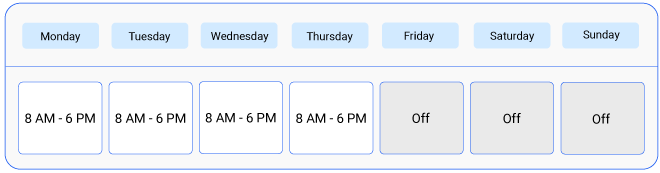
The 4/10 work schedule is an example of a compressed work schedule, where 40 hours of the workweek are compressed into four days rather than five. In other words, employees work 10 hours a day for four days, followed by three days off. This way, by working 10 hours for four days, employees can have a three-day long weekend.
Pros
- Longer weekend of 3 days
- Reduced commuting time and cost
- Increased productivity
- Improved work-life balance
- Low absenteeism
- Lesser use of paid time off
- Assists in hiring
- Improved retention rate
- Reduced operational costs
Cons
- Longer workdays of 10 hours
- Not suitable for all employees
- Increased chances of burnout
- Time incompatibility issues with clients, stakeholders, and business partners
- Challenging for small enterprises that require customer-facing staff consistently for five days
9/80 Work Schedule
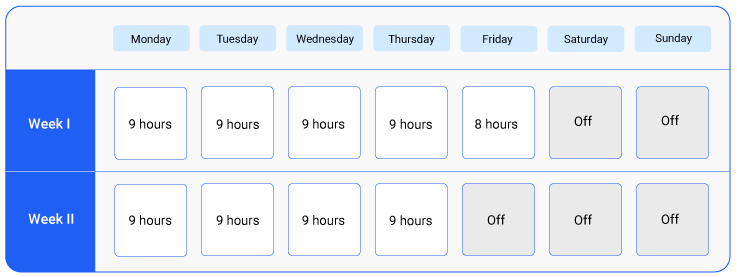
Like the 4/10 schedule, the 9/80 work schedule is also a compressed workweek schedule, where the working hours of two weeks are distributed in a way that provides an extra day off in the second week.
In this two-week work schedule, during the first week, employees work 9 hours each day for the first four days and 8 hours on Friday. During the second week, the employees work 9 hours each for four days and get Friday off.
Pros
- Longer weekend every two weeks
- For one day, employees work one hour less
- Reduced commuting time and cost
- Helps attract a bigger resource pool
- Improved work-life balance due to an extra day off
- Lower absenteeism rate
Cons
- Longer workdays
- Hampered collaboration with stakeholders and clients
- Customers, clients, and business partners may be unavailable during the extra hour
- Overtime issues due to 44 hours of work in the first week
- Not suitable for any industry that requires round-the-clock operations five days a week
Rotating Shift Schedule
In a rotating shift schedule, shifts rotate over time in a specific pattern to provide coverage for longer periods. Here, employees work the same number of hours each day but at different times almost every day. For instance, a team can work the day shift from 7 am to 3 pm one day, the evening shift from 3 pm to 11 pm the next day, and the night shift from 11 pm to 7 am the following day, and this pattern repeats.
The length of these shifts can differ depending on an organization’s requirements and work type. Organizations usually choose shifts of 8 hours, 10 hours, or even 12 hours long, and the type of rotation can be daily, weekly, or even monthly. The rotating shift ensures fairness and equity among employees in sharing less desirable shift timings, unlike the fixed shifts, where employees working in less desirable shifts may always feel dissatisfied.
2-2-3 Work Schedule or Panama Schedule
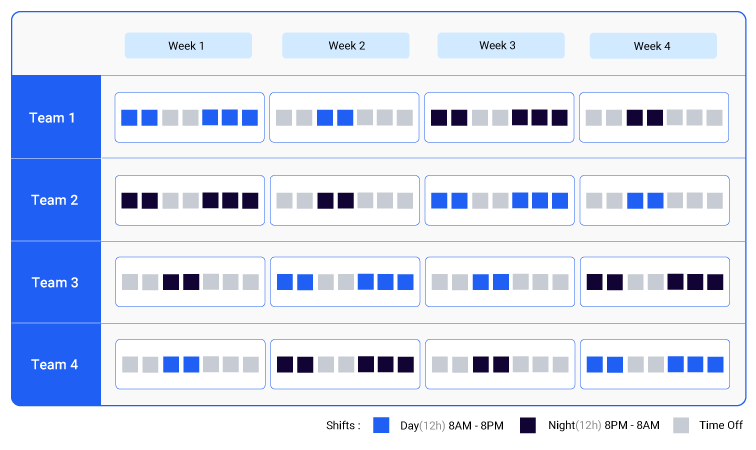
The 2-2-3 work schedule requires four teams to work together to provide 24-hour coverage. In this schedule, employees work a 12-hour shift in a 28-day cycle, providing round-the-clock coverage.
Here, each group of employees works for two consecutive days, gets two consecutive days off, and then works for three consecutive workdays. In the next week, the team takes two days off, works for two consecutive days, and then gets three days off. This work pattern repeats for 28 days.
Pros
- Employers can have 24-hour coverage
- Employees leverage more time off in this schedule than in any other schedule
- Businesses can serve more customers
- In this schedule, employees barely work more than three consecutive days
Cons
- Disruption in the sleep cycle due to fluctuating shifts
- Employees are prone to health risks due to irregular shift timings
- Hectic shifts of 12 hours
- The slow rotation can disrupt employee sleep patterns
DuPont Schedule
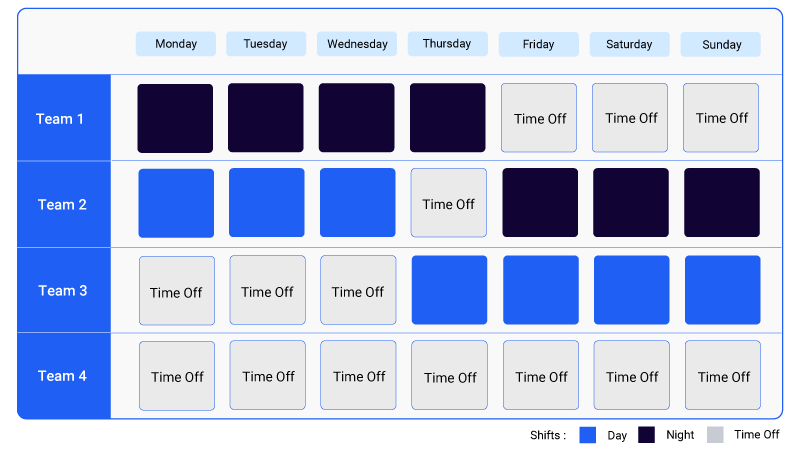
In the DuPont shift schedule, four teams work together on a 4-week cycle to provide 24-hour coverage. In this schedule, four teams rotate in a 4-week cycle to provide 24-hour shift coverage, and each team does a 12-hour shift. In this schedule, each team goes through the following stages before completing one rotation:
- Stage 1: Work four-night shifts, then get three days off
- Stage 2: Work three-day shifts, get one day off, then work three-night shifts
- Stage 3: Get three days off followed by four-day shifts
- Stage 4: Get seven days off
Pros
- Provides 24/7 coverage to serve more customers
- Uniform distribution of shifts among all employees
- Reduced commuting
- Provides seven consecutive days of time off, which is more than other schedules
Cons
- Employees may need to work six 12-hour shifts in one week, which can lead to fatigue and burnout
- In this shift, finding a replacement for the staff is difficult
- The mix of forward and backward rotation can result in disrupted sleep patterns
- A straight 12-hr shift can increase the chances of human errors and workplace injuries
Pitman Schedule
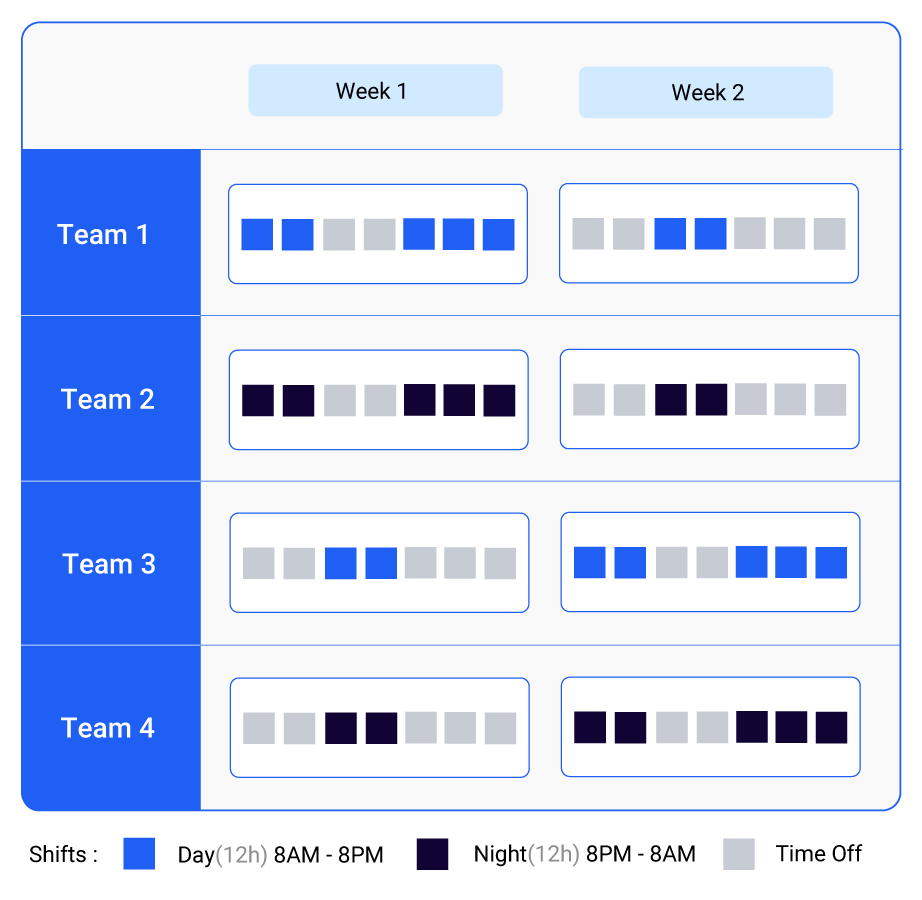
In the Pitman schedule, four teams provide 24-hour coverage by taking turns to work on 12-hour shifts. This schedule has a 14-day rotation period. During the first week, employees work two shifts, then take two days off, and work again for three days. The next week, they have two days off, then work two days, and then have three days off again.
Pros
- Employees get a 3-day long weekend every alternate week
- With a minimum of 2 days off, employees have adequate time to rest before working the next shift
- Consistent routine for employees
- Provides round-the-clock operation to businesses
Cons
- Employees may need to work up to 60 hours in some weeks
- Slow rotation can impact employee productivity
- Fluctuating shifts may impact on the social life of employees
Continental Schedule
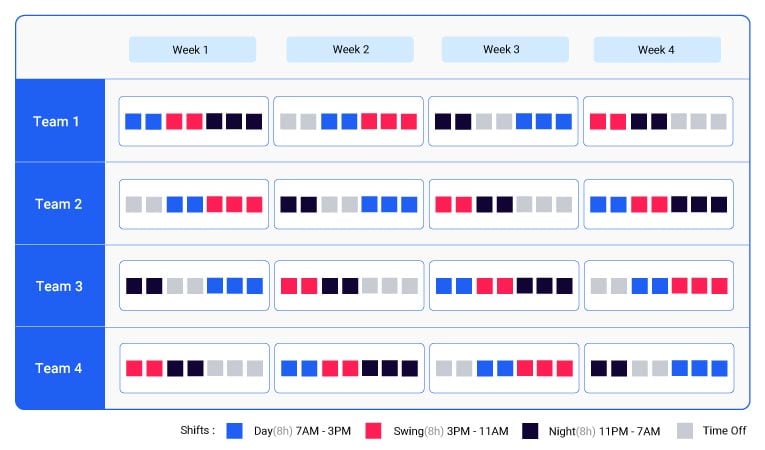
In this schedule, four teams work together to provide a round-the-clock work operation by working 8-hour shifts. The continental schedule involves three shifts of 8 hours to provide 24-hour coverage. Here, each team goes through a sequence of 2 to 3 consecutive day shifts, swing shifts, night shifts, and days off in a cycle of 28 days.
Pros
- Provides 24-hour operation coverage
- Consists of short, less hectic 8-hour shifts
- Has forward rotation that’s favorable for sleep cycle and overall health
Cons
- Seven continuous shifts in a row can be tiring
- Finding childcare services during odd working hours may be a challenge for working parents
Kelly Shift Schedule
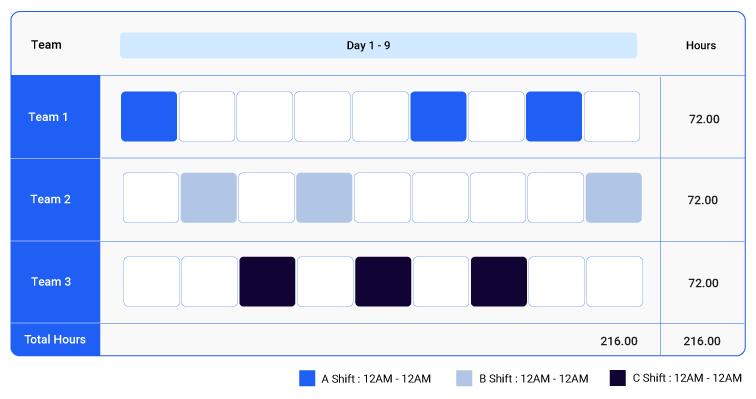
Fire departments and emergency services mostly use this rotating shift to provide round-the-clock services. Here, three teams work together in 24-hour shifts in a 9-day cycle. In this 9-day cycle, teams work a total of 3 days and have six days off.
Pros
- Employees get four consecutive days of time off
- Each team has a total of 6 days off in a 9-day repeat cycle
Cons
- Working 24-hour shifts can take a toll on employee mental health
- The shift length can lead to burnout
DDNNOO Schedule
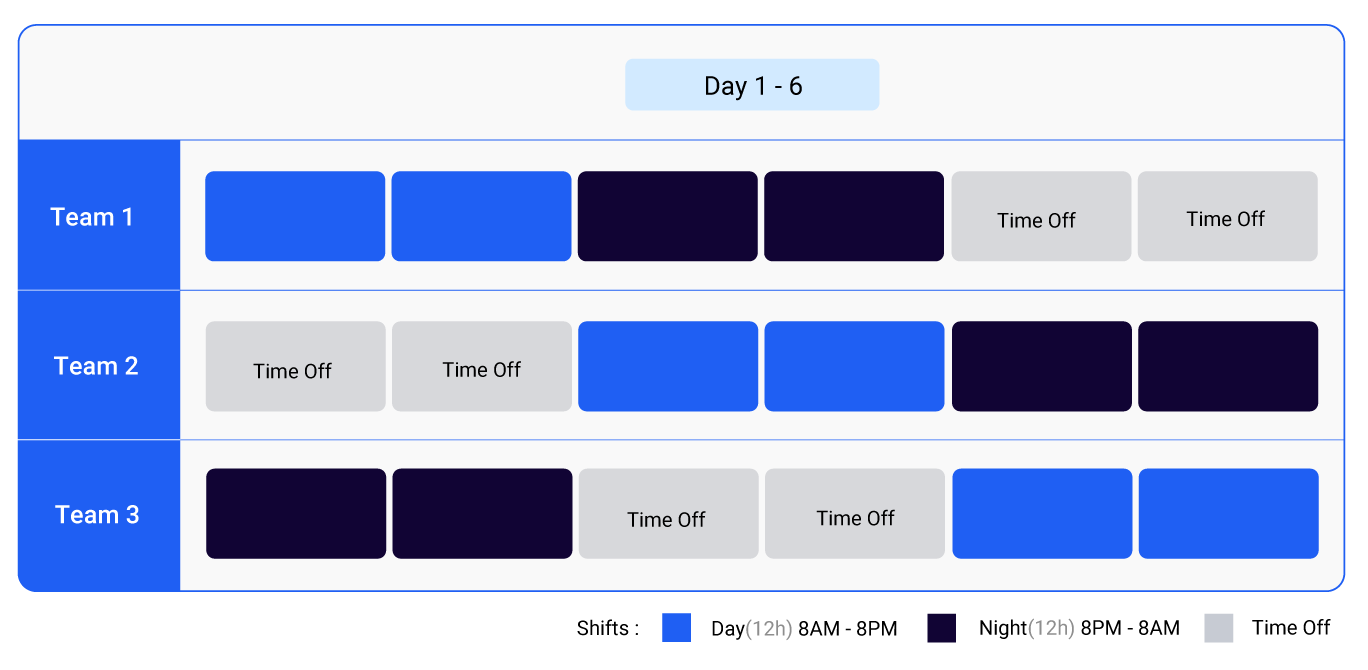
In this schedule, three teams work together in a 6-day cycle, each doing a 12-hour shift. Here, each team does two day shifts, two night shifts, and takes two days off.
Pros
- Each team gets two days off in each 6-day cycle
- Equal distribution of day and night shifts offers a sense of fairness
Cons
- Frequently changing day and night shifts may disrupt the sleep cycle
- Employees may work extra hours each week compared to other schedules
Other Forms of Work Schedules
Full-Time Schedule
This is a standard work schedule in which employees work a specific number of hours each week and follow the same pattern consistently. They can work Monday through Friday, usually in a 9-to-5 work setup.
Most employees work 35 to 40 hours a week full-time, which sets clear expectations for their professional commitments. With a full-time work schedule, employees enjoy job security and a comprehensive range of employee benefits.
Pros
- Job security and a full range of employee benefits
- Consistent work schedule
- Full-time work schedules lead to structured career growth
- Steady income
- More opportunities to advance in careers
Cons
- Limited flexibility and work-life balance
- More demanding hours
Part-Time Schedule
In a part-time work schedule, employees work fewer hours than full-time employees, but they do not receive the same benefits as full-time employees. However, the schedule may involve working nights or rotating shifts, depending on the business needs. This type of work schedule offers more flexibility due to its shorter work hours, making it the most suitable option for students or parents with other commitments.
Pros
- Better work-life balance
- Ideal for students and parents with other commitments
- Increased flexibility
- Higher employment rate
Cons
- Job insecurity
- Less committed workers
- Limited career advancement opportunities
- Employees are not entitled to some benefits like health insurance, sick leave, holiday pay, etc.
Flexible Schedule
Flexible work schedules enable employees to select the times and days of work that best suit their preferences and convenience. However, companies can choose to maintain a period of core hours during which employees must be available in the office or for work, regardless of their regular work hours. This way, employees can choose the start and end times of their workday to work around the core period mandated by the employer.
Pros
- Better work-life balance
- Increased productivity
- Employees can plan their work hours around their personal errands
- Greater job satisfaction
- Lower overhead costs
- Reduced commuting
- Reduced absenteeism and tardiness
- Better recruitment and employee retention
- More agile to adapt to emergencies, such as pandemics
Cons
- Challenges in collaboration due to different work timings
- Chances of loss of company culture
- Reduced employee engagement
- Employees may use office hours for personal errands
- Managing a diverse workforce for a flexible schedule can be difficult
Split Shift Schedule
In split shifts, a day's total work hours are divided into two or more working periods separated by periods of time off. For example, an employee may work from 8:00 a.m. to 12:00 p.m. and from 4:00 p.m. to 8:00 p.m. on the same day.
Pros
- Allows rest period between shifts
- Improved work-life balance and flexibility
- Increased employee productivity
- More time for personal development and career advancement
- Employees can make time for other commitments without losing work hours and pay
Cons
- Long workdays, if the breaks are also considered in the overall work hours
- Collaboration with team members can be challenging
- Not ideal for employees who need to commute long distances
- Reduced sleep hours due to two shifts on the same day
On-call Schedule
This schedule ensures that employees are available to work whenever needed. This way, with the on-call schedule in place, employers can meet ad-hoc and sudden requirements promptly. This work schedule is most common in emergency services, where employees must respond to sudden, urgent situations immediately. However, employees are rotated periodically to ensure that they receive uniformly distributed work responsibilities and workloads.
Pros
- Less hectic work schedule as actual work hours are fewer than regular ones
- Employees can receive additional pay for on-call shifts
- Overtime for extra hours you work
- Provides coverage whenever required
- Quicker response time
Cons
- Unpredictable work hours and timetable
- Poor work-life balance
- Employees are entitled to pay even if they don't get called in
- More chances of work-family conflicts
Seasonal Schedule
Some businesses require additional staffing during peak times of the year. A seasonal work schedule allows employers to hire more staff during busy periods and reduce the workforce during the off-season. The seasonal work schedule mostly occurs during a specific time of the year and lasts 4-6 months. This work schedule is adjusted according to seasonal fluctuations and implemented for only a brief period. However, it also allows the regular employees to earn additional income.
Pros
- Offers the opportunity to earn extra income
- Suitable for people looking for short-term employment
- More flexible staffing than other schedules
- Provides flexibility to scale your workforce up or down as per the need
Cons
- No job security and a lack of stability for employees
- Lesser pay and employee benefits
- Uncertain work timings and work period
Freelance Schedule
The freelance work schedule is more akin to self-employment, where employees are the bosses of their own schedules; that is, they decide their work hours and schedules. This work schedule offers the greatest flexibility, as employees do not adhere to particular schedules; however, they are required to deliver results by the stipulated timeline.
Pros
- Most flexible schedule
- Work hours decided by employees
- Freedom to work from the location of choice
- Large income potential
Cons
- Lack of job security and other employment benefits
- Inconsistent income and work timings
- Greater risk of isolation
Irregular Shift Schedule
Here, the shift schedule varies daily or weekly based on the employer's needs rather than the employee's preferences. The irregularity in the timetable may pose challenges in terms of health and planning personal commitments.
Pros
- Good opportunity for employees looking to earn additional income
- Stable income irrespective of work hours
Cons
- Planning personal activities is challenging due to an unpredictable timetable
- Work-life balance is impacted
- Chances of work-family scheduling conflicts
Overtime Schedule
When employees work beyond their standard work hours, which are eight, that can be termed an overtime schedule. In fact, they receive overtime pay for working extra hours beyond their regular hours. According to the Fair Labor Standards Act (FLSA), employees in the USA are entitled to receive overtime pay at 1.5 times their regular rate. However, individual employers may choose their own policies.
Pros
- Higher pay rate to work this shift or hour
- Offers the opportunity to earn extra income
- Helps meet staff shortage
Cons
- Doing overtime regularly may lead to stress and burnout
- Some employees may abuse overtime hours for personal benefit
How Does a Work Schedule Help Employees?
Improved Productivity
Work schedules that allow for adequate time to rest and relax help employees stay well-rested, energized, and productive. These provide much-needed downtime and rest periods for employees to function at their highest capacity.
In fact, surveys show that inadequate sleep can lead to a decline in productivity, and adequate rest periods boost employees' productivity, concentration, and quality of work, thus contributing to enhanced productivity and efficiency at work.
Moreover, suppose employers choose to implement flexible work schedules for their employees. In that case, this can provide employees with some freedom and flexibility in choosing their work hours, ultimately contributing to enhanced productivity.
Creates Clarity for Employees
With any work schedule in place, team members can see who's working and in which shift. This can enable them to reach out for help or know which employees they can swap their shifts with if required.
With clarity on who is working and in which shift, team members can stay abreast of each other's availability. Thus, employees on time off can disconnect from work entirely without needing to respond to their colleagues during their time off.
Helps Adhere to Labor Laws
With a specific work schedule in place, employers can ensure compliance with various mandatory laws, including rest breaks, meal breaks, and overtime pay. For example, there are provisions for a specific number of hours that employees can work, and beyond that, they're entitled to overtime pay with specified rates. Thus, having a specific schedule that is approved in accordance with regional and federal laws helps employers stay compliant with necessary regulations and rules.
Fosters Good Health
Having a fixed schedule helps employees set routines for their personal and professional lives. Regular routines allow employees to schedule time for exercise, meals, and rest periods, leading to a healthier lifestyle.
How to Choose the Best Work Schedule for Your Organization
Evaluate Your Requirements
The first step is to assess your organization's needs. Do you need 24/7 coverage, or does your work type revolve around more timeline-related projects?
- Do you need more staff during some busy periods or need a workforce consistently?
- Do you need a full-time workforce, or can part-time employees also work?
- Do you need a work schedule where employees should work specific hours, or can they set their work hours?
Such questions will help you understand your organization's needs and determine the best type of schedule for you.
Determine Core Hours
If you choose to implement a flexible work schedule for your employees, allowing them to choose their work timings, ensure that you determine the core work hours for each day. During these core hours, each employee's availability will be mandated irrespective of their shift timings.
Check the Schedule Followed in the Industry
Every industry has different work schedules based on its type of work and operational requirements.
Check which schedule is most preferred by other organizations in your industry. What sort of work schedule works best for them, and how?
Then, according to that analysis, choose the one that resonates with your business needs and aligns with employee preferences. For example, if you are in emergency services and most other businesses use on-call services, you may consider adopting the same approach.
Start a Trial Period
Regardless of the work schedule you choose, consider running a trial period before making a final decision. Implement a specific schedule for certain teams and observe the results. You can also seek feedback from employees and stakeholders to understand how this specific trial period is working for them.
Bottom Line
For most businesses, a traditional full-time work schedule works fine. However, with changing market needs, employers are gradually experimenting with alternative work schedules that better meet their needs while ensuring employee satisfaction. Regardless of which work schedule employers consider, they need to ensure that they create error-free schedules on time.
However, when it comes to rotational shifts, employers may face challenges in creating shifts manually, and it's also prone to double booking. Thus, they can leverage any efficient workforce management solution, such as Deltek Replicon, which can create conflict-free schedules according to requirements, eliminate the chances of double booking, and enable employees to swap shifts with each other.