


 USA
USA 

 Log In

 Deltek Platform


 Aerospace & Defense


Resource utilization is a key performance metric for professional services firms. It indicates how effectively teams are deployed for billable work across an organization. Measuring resource utilization helps firms accurately forecast staffing needs, uncover efficiency gaps, and make data-driven decisions. It also enhances accountability through organization-wide performance metrics.
Organizations that consistently track resource utilization benefit through:
- Optimized operations through accurate capacity planning
- Plugging revenue leakages
- Ensuring high customer satisfaction by delivering projects on time and within budget
All this fosters sustainable and profitable growth, making resource utilization a crucial performance metric for professional services firms to consider.
Key Takeaways:
- Resource utilization defines workforce efficiency: It's the percentage of available time a resource spends on billable or productive tasks, making it a core KPI for professional-services firms.
- Use the correct calculation and context: The standard formula is (Billable or Productive Hours / Total Available Hours) × 100. Adjust for part-time staff, non-billable time, and project specifics.
- Optimize utilization through visibility and planning: Gain real-time insights into resource capacity, align skills to demand, and pre-empt under- or over-utilization to boost profitability and deliver projects on time.
Why Tracking Resource Utilization Is a Strategic Priority
Professional services firms have reported a consistent decline in resource utilization over the past three years, reaching a low of 68.9% in 2024. This downward trend suggests that organizations have been unable to align their capacity planning with rapidly changing client priorities. This mismatch has affected annual revenue per consultant, impacting on the organizational bottom line.

|
Did You Know?
According to the 2025 SPI Professional Benchmarks Report, the annual average revenue per billable consultant dipped to $199,000 in 2024, compared to $207,000 in 2023. Download the Free Report to Unlock Key Professional Services Benchmarks. |
As revenue growth and profitability come under pressure, effectively turning utilization into a competitive advantage will be a business differentiator. Firms that act quickly to align employees with in-demand skills will consistently deliver greater customer value. Unfortunately, irrespective of their size, a vast majority of firms don't fully comprehend the strategic significance of measuring resource utilization rates.
In this blog, we will explore why improving resource utilization is important and how organizations like yours can accurately measure it. Plus, we will answer commonly asked questions such as:
- What are the best strategies and approaches for efficient resource utilization?
- What are the ideal methods for calculating resource utilization?
What Is Resource Utilization?
Resource utilization refers to the percentage of an employee's available time spent on billable and non-billable projects and tasks. It is a key performance indicator (KPI) that reflects how effectively each resource is used, based on individual capability and availability. This metric offers a strategic approach to measuring workforce efficiency and monitoring daily productivity across an organization, ensuring optimal resource management.
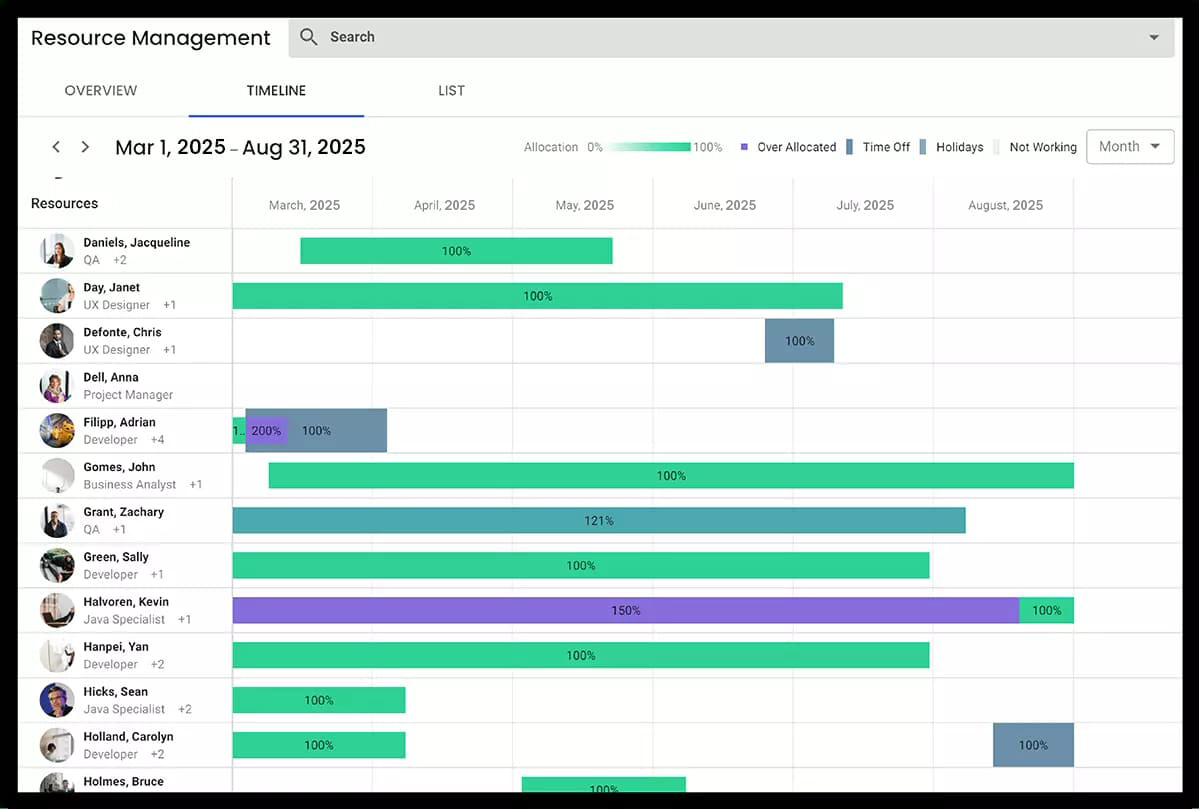
Maximizing utilization involves planning projects, allocating resources based on their skills, ensuring availability, and utilizing them efficiently. This approach helps leaders:
- Track employee assignments
- Optimize resource return on investment (ROI)
- Identify over- or under-utilized resources, and
- Reassign them to other projects when needed
Ultimately, these insights help managers ensure accurate client billing across all projects.
Why Is Resource Utilization Important?
Resource utilization must remain a priority metric for professional services firms since resource allocation directly impacts project performance. Resource utilization rate helps firms gain real-time visibility into projects, reducing the risk of oversight. Plus, you can actively identify and rectify errors before they escalate into major issues.
Optimal resource utilization offers several benefits for project-based firms, including:
- In-depth visibility into resource productivity and enhanced project management
- Optimized resource use while preventing over-utilization and burnout
- Reduced risk of project cost overruns
- More accurate planning and forecasting
- Improved overall project profitability
|
|
Did You Know?
Organizations that incentivize executives to free up resources for high-value opportunities are 1.8x more likely to report outperformance on revenue growth and 1.7x more likely to report outperformance on return on capital. Source: McKinsey & Co. |
Effective resource utilization is a key factor that determines the success or failure of any project. Resource utilization rate provides managers with a clear view of capacity needs, enabling them to plan proactively. If a project requires additional resources, managers can allocate them either through internal channels or by hiring them. Such planning helps firms boost productivity, achieve strategic goals, and maintain a healthy resource index, all while upholding high performance standards.
How to Calculate Resource Utilization in a Project?
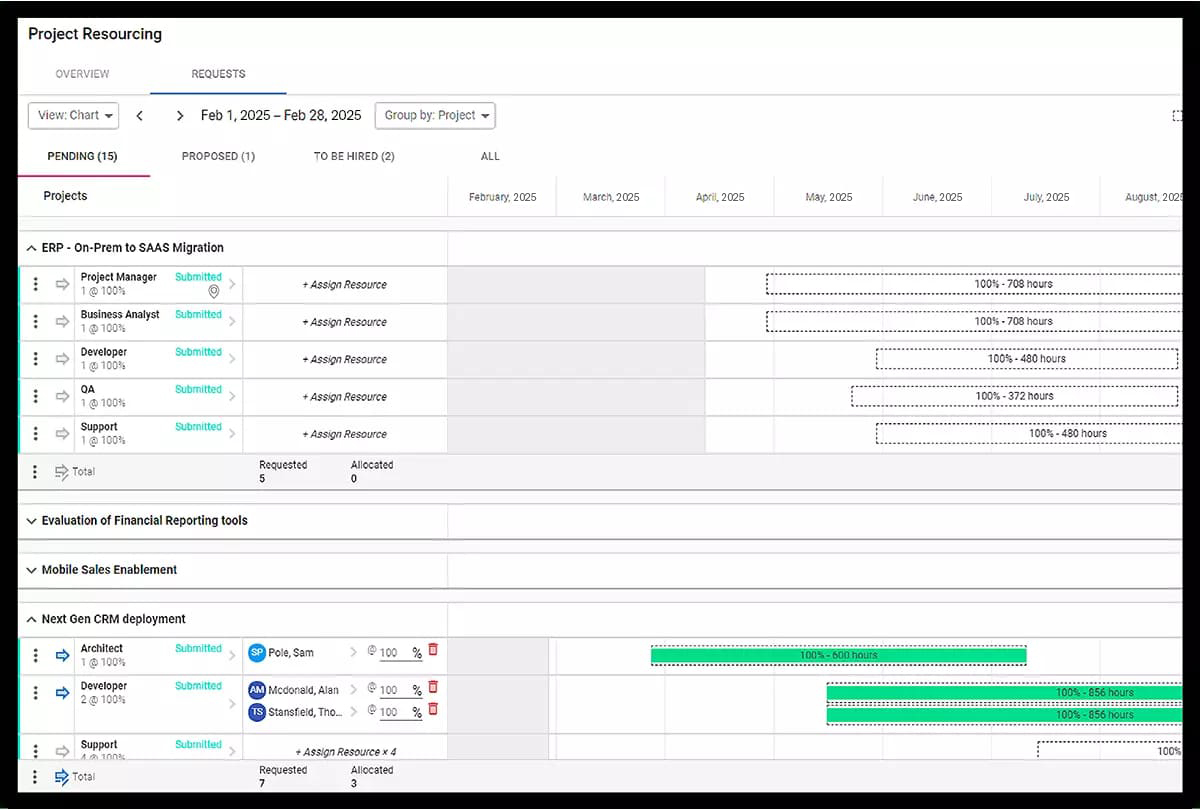
Calculating resource utilization manually or through a spreadsheet for each team member can be error-prone and extremely time-consuming. Using an advanced professional service automation solution can automate the process and ensure accurate, real-time insights.
Formula to calculate the resource utilization rate:
Utilization Rate = Billable Hours Worked / Total Available Hours x 100
Let us understand this with an example.
Suppose an employee works 8 hours each day for 5 days a week.
Total available work hours: 8 x 5 = 40 hours/week.
However, if the employee worked only 36 billable hours in a week, while they engaged in non-billable activities such as general administration and meetings for the remaining 4 hours, then the employee's resource utilization will be calculated as:
Utilization Rate: (36 / 40) x 100 = 90
This means the employee's resource utilization, i.e., the billable hours utilized toward billable projects, is 90%.
Project Scope and Costing
Let us assume that this employee is paid an annual salary of $90,000. In that case, working 8 hours a day would cost the company approximately $45 per hour. Technically, the hourly billing rate can be calculated by working backwards and accounting for margins. However, this information alone is not sufficient to accurately calculate the billing rate. For such a calculation, firms need to track both billable and non-billable hours accurately.
One of the simplest ways to monitor resource utilization is by accurately tracking employees’ time. Using a PSA solution or an AI-powered time-tracking system, firms can gain a real-time view of employees' work time data. This provides firms with visibility into both billable and non-billable hours across various projects. Additionally, they can calculate the productivity of each resource over any duration.
How AI-Powered Time-Tracking Unlocked Efficiency Gains for Capgemini
Discover How Fewer Timesheet Errors Improved Productivity and Reduced Costs
Factors To Consider When Calculating Resource Utilization Rates
Project leaders and managers must consider that the resource utilization rate acts as a baseline metric. They can adjust or refine utilization rates based on project-specific requirements. Here are some key factors to consider when calculating a project’s utilization rate:
- How many billable hours are included in the total available hours?
- Is the calculation based on planned or scheduled working time?
- Is the calculation based on actual time spent or reported working hours?
- How should the total available hours be calculated for part-time employees?
- Has team members’ time off been accounted for in the utilization rate?
Once firms have considered each key aspect, the calculation is likely to be more precise. Resource utilization charts help visualize all available resources along with their productivity and efficiency levels.
As every project is different, there is no one-size-fits-all formula that guarantees success. Hence, decision-makers must consider all key aspects of resource utilization, including data projections and scenario analysis, to efficiently calculate overall utilization rates.
After calculating the overall resource utilization rate, assessing the team's billing rate and productivity becomes much easier. This ensures accurate billing rate calculations across projects and helps maintain profit margins on a resource’s time.
Improved Resource Utilization Reinforces Bottom Line
Resource utilization plays a pivotal role in shaping a project's financial outcomes, which can be regulated in a timely manner. An effective resource utilization plan pays close attention to employees' health index, directly influencing the quality of project deliverables. This, in turn, contributes to an excellent client experience.
Completing projects on time and within budget is a powerful way to build lasting customer relationships. As a result, improving resource utilization can strengthen a firm's bottom line.
How PSA Software Can Improve Resource Utilization
Data shows that professional services firms are under increasing profit-related pressure, with EBITDA dropping from a peak of 16.1% in 2022 to 9.8% in 2024.
One of the key challenges they face is the inability to optimize available resources. This issue has been compounded by the rise of productivity and collaboration tools, globally distributed teams, and diverse employee types, working across time zones.
The use of multiple systems to track and manage project metrics has led to data silos, limiting real-time visibility into resourcing. These challenges have made data management more complex and are costing businesses significantly in opportunity costs.
Using an AI-powered PSA solution, such as Polaris PSA, can help firms gain real-time visibility into important metrics. Polaris can streamline resourcing, financials, and project information, offering a live view of the business and complete control over your resources, schedules, and costs.
Discover How Polaris PSA Can Improve Your Resourcing


Deltek Project Nation Newsletter
Subscribe to receive the latest news and best practices across a range of relevant topics and industries.


