If it feels like artificial intelligence (AI) has suddenly exploded into every part of your day—you’re not imagining it. In just a few short years, AI has gone from a vague concept to a tool many use to write emails, summarize meetings, or even help with homework.
But here's the thing: not all AI is the same, and a lot of the terms being thrown around—like bots, assistants, generative AI, and agentic AI—can sound confusing. Wondering what the difference is—or which types are actually useful? You’re not alone.
Let’s walk through the different phases of AI’s evolution—starting with the most basic and working our way up to what’s emerging today.
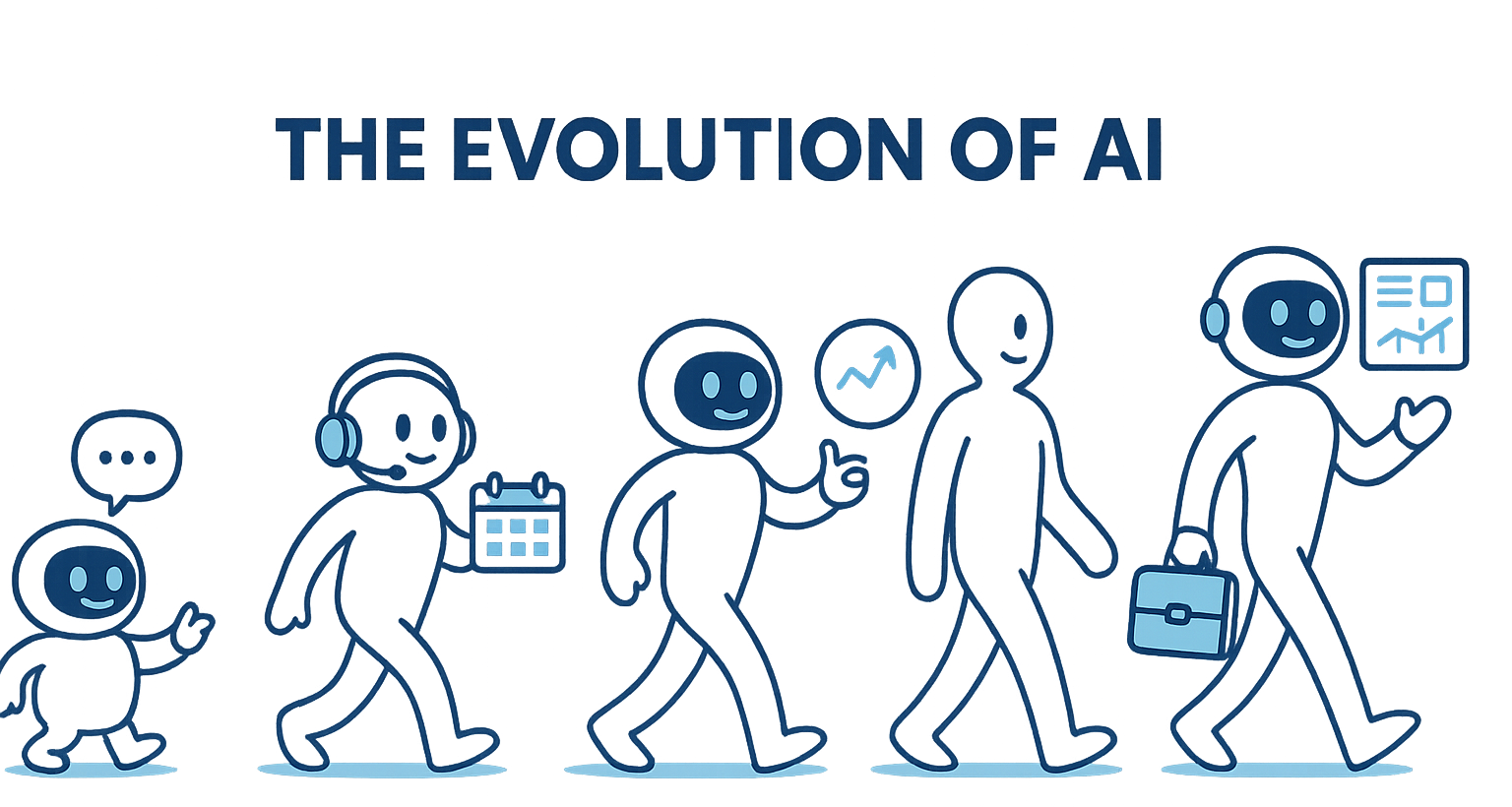
Bots – The Rule Followers
What they were good at: Answering FAQs, repeating the same response, pretending to be helpful
Remember when you’d land on a website and a little chat box would pop up? “Hi! How can I help you today?”—only to get stuck in a loop if your question didn’t match what it expected. Those were bots.
These early bots followed a script. If you asked the right thing, they’d give you a useful answer. If you went off-script even a little, they were lost. There was no learning, no understanding—just a flowchart.
Real-world example: A retail chatbot that could track your order, but only if you typed “track order” exactly.
They were helpful in narrow situations, but pretty limited overall.
Digital Assistants – The Task Doers
What they were good at: Voice commands, reminders, playing music, answering simple questions
Then came digital assistants like Siri, Alexa and Google Assistant. They brought AI into our homes and phones in a way that felt a little more…human. You could ask for the weather, set a timer, or control your lights without lifting a finger.
These assistants could understand natural language (to a point) and pull information from the internet or your calendar. But they weren’t really ‘thinking’—just following commands, one at a time.
Real-world example: “Hey Alexa, add milk to my grocery list.”
Helpful? Definitely. But you couldn’t ask them to plan your vacation or write an email draft. That came next.
Generative AI – The Creative Sidekick
What it’s good at: Writing, brainstorming, summarizing, creating images and ideas
Generative AI was the big turning point. Suddenly, instead of just reacting to commands, AI could generate something new.
Now, tools like ChatGPT, DALL·E and others can write stories, create marketing copy, design images, or even explain complex topics in plain language. You don’t have to talk like a robot to get what you need. You just say: “Write an introductory email to a customer” or “Give me a summary of this 10-page article,” and GenAI does it.
Real-world example: A manager using ChatGPT to draft project proposal or a small business owner getting help writing a social media post.
With GenAI, users share ideas and iterate to improve the quality of what they’re working on. And while it isn’t perfect, and it sometimes makes mistakes, it has brought AI out of the background and made it feel like a real tool for work and life—and it’s only getting smarter.
Agentic AI – The Autonomous Problem Solver
What it’s aiming to be good at: Taking action, managing tasks, working toward goals without handholding
This is where the next leap in AI is happening.
Agentic AI goes beyond writing or responding. These “agents” can take a goal and figure out how to get there. They can break things into steps, make decisions along the way, use tools, and adjust if something changes.
It’s like having a smart assistant—not one that waits for commands but one that knows what needs to be done and does it for you.
Real-world example: An AI agent that could schedule meetings across multiple calendars, book travel based on your preferences and send a summary of your day—all without you doing a thing.
We’re still in the early development stages of this kind of AI, and while many companies are already integrating agents into their operations, the technology continues to evolve with immense potential.
Incorporating AI Into Your Project-Based Business
If you lead or work in a project-based business, AI isn’t just another trend—it’s becoming a practical way to get ahead. As technology evolves, so does the opportunity to reduce redundancy, improve visibility and make faster, more informed decisions.
No matter where you are on your AI journey, Deltek is here to help you work smarter every step of the way. From the early days of AI and machine learning with Hey Deltek! to the launch of our AI-powered business companion, DelaTM, we are dedicated to enhancing your efficiency and productivity through our enterprise resource planning (ERP) and market intelligence solutions.
Whether it’s automating tasks, extracting insights from complex data, or anticipating resource needs, Dela is fueled by AI capabilities to meet the unique demands of project-based businesses.
Artificial Intelligence
Meet Dela: Your AI Orchestrator
Built for project-based work, Dela powers your business with industry-tuned AI to accelerate successful outcomes with speed, clarity, and control.