With projects varying in terms of budget, scope, and timelines, it can be challenging to manage them, especially when you need to align different departments and processes for successful execution.
Complications are inevitable when multiple components and departments collaborate. To ensure that a project successfully meets its objectives and requirements, many organizations resort to project integration management.
Key takeaways:
- Integration aligns all project elements: Coordinating scope, budgets, timelines, and stakeholders prevents siloed management and ensures projects meet objectives efficiently.
- Seven-step process drives success: From charter creation to project closure, structured steps keep tasks controlled, changes managed, and outcomes predictable.
- Improved decisions and conflict resolution: Integration management clarifies roles, minimizes resource conflicts, and supports informed trade-offs for on-time, on-budget delivery.
What Is Project Integration Management?
In simple terms, project integration management involves coordinating all the processes involved in a particular project seamlessly. This not only includes the tasks but also the resources, the stakeholders, and other elements that are associated with the project in question.
With all the different aspects of a project, it is rarely possible to have everything correctly in place and complete projects on time and within the given budget. Conflicts are inevitable, and when they arise, it becomes essential to make trade-offs where possible to achieve the best possible outcome. For example, if there has been a delay in completing certain tasks, you may need to make a choice. You may need to either hire more resources and exceed the allotted budget or adhere to the budget and delay project delivery.
Project managers need to assess the situation at hand using the data available to make an informed decision and arrive at a solution that meets stakeholder expectations. With project integration management, you can ensure that you aren't managing projects in isolation. It helps you understand not only how the different parts of the project are interlinked but also how different parts of your organization are related to your project. Project integration management helps you manage all these interdependencies for a more successful outcome.
The Importance of Project Integration Management
Projects can be quite dynamic and complex. Proper and efficient project management is necessary to get all the various elements working in tandem, such as the following:
- Scope
- Budgets
- Timelines
- Resources
- Stakeholders
- Risks
With project integration management, you can keep track of all these elements to achieve several benefits, as mentioned below.
1. Clarify Roles and Responsibilities
Through project integration management, you ensure that all resources, managers, and stakeholders have a clear understanding of their roles and responsibilities. It becomes easier to address any confusion and issues that may arise.
2. Minimize Potential Conflicts
Project integration management tracks and manages the various elements, helping you understand how each factor can impact the others. For example, reassigning a resource from one task to another without understanding its effect can lead to bloated costs or delays in project delivery.
Similarly, a seemingly simple decision about your project can have a significant impact on other areas of your business. For example, extending the allocation of a resource in your project may end up delaying another project within your organization. Without effective integration management, it becomes difficult to quickly identify potential conflicts, such as those mentioned above.
3. Make Better Decisions
There are multiple steps in project integration management. Each of those steps serves a purpose. By following these steps, you gain a better understanding of the best actions to take for the project at a given point in time. It also helps you clearly communicate to your stakeholders why certain actions were taken to keep everyone on track.
4. Keep Projects On Course
Of course, one of the major benefits of project integration management is that it keeps your project on course to meet established budgets and deadlines. You also ensure that the project remains aligned with the overall project management plan to deliver the results that your stakeholders expect. This is made possible by minimizing the effect of conflicts or changes on the project by resolving them quickly.
The Project Integration Management Process
To successfully implement project integration management, you need to follow seven processes. These seven steps help you coordinate and harmonize all your project activities effectively in a cohesive manner.
The seven steps are:
- Develop your project charter
- Develop your project management plan
- Allocate and manage your project tasks
- Manage project knowledge
- Track and control your project tasks
- Perform integrated change control
- Close your project
The 7 Steps Of Project Integration Management
The Project Integration Management Process
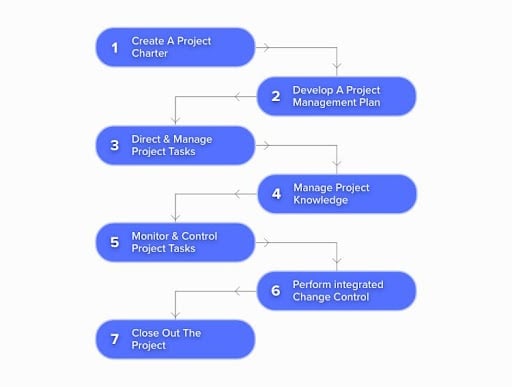
Let's look at those seven steps in detail.
1. Develop Your Project Charter
Projects generally begin with the development of a project charter. This brief document provides an overview of your project, defining key stakeholders and the project manager. The charter lays the foundation for further planning and development of your project. You can use it to gain stakeholder approvals and buy-ins to get the project rolling quickly.
Some of the elements in a project charter are:
- The Scope
- The Objectives
- The Budgets
- The Risks
- The Team Members
2. Develop Your Project Management Plan
You can start developing the project plan once the project charter is ready. The project plan is more detailed than the charter and specifies different aspects of the project. It includes the scope statement, timelines, work breakdown structures, schedules, risks, milestones, and deliverables, among others. The project plan also includes the metrics by which you will evaluate the project's success. It further directs the management and execution of your project to achieve the objectives and requirements of the stakeholders.
3. Allocate and Manage Your Project Tasks
The third step in the project integration management process involves efficient project execution. In this step, the project manager will oversee the day-to-day work involved in the project, including managing the team, holding meetings with stakeholders, and tracking progress. The project manager needs to monitor tasks and ensure they are completed according to the plan and scope statement.
4. Manage Project Knowledge
This step involves using existing information or gathering more knowledge to achieve project goals through the process known as project knowledge management. Through this step, you ensure that your team members have all the necessary data and information to achieve the desired project deliverables. It is important to note that any knowledge, data, or expertise gained during this step will be invaluable to the organization in the long run. It contributes to the overall knowledge base of the organization, which can be used for future endeavors or projects.
5. Track and Control Your Project Tasks
The different processes involved in project integration management are interlinked. Therefore, the project manager must track and control them to ensure that all elements are aligned with the project management plan. In this step, the goal is to take control of the various tasks and elements to keep the project on course. The project manager needs to identify any deviations, issues, or confusions proactively and quickly perform course corrections where necessary.
6. Perform Integrated Change Control
It is a well-known fact that changes to projects can be downright stressful, particularly if they are not appropriately managed. By implementing a change control process, you can reduce and even eliminate potential roadblocks and issues. Assess every change request that comes in to ensure it doesn't exceed the scope or cause scope creep. Consider the impact of those changes on the timelines, budgets, and resources. For the success of any project, it is essential to integrate change requests into the current project smoothly.
7. Close Your Project Successfully
Once all tasks are complete and your client has approved the deliverables, you can finally start closing the project. However, you cannot just shut down the project and call it a day. A proper project closure process must be followed. This involves having a final meeting with stakeholders and conducting a formal review of your project. You must also ensure that all project materials are organized and archived for future reference. Project closure allows you to use the data gained from the project to support future projects while providing insight on how you can improve your project integration management process.
Simplify Project Integration Management with Deltek
Project integration management is about bringing all project processes together to ensure the successful completion of the project. With Deltek, you gain a unified platform for managing all processes, tasks, resources, and data, enabling you to plan and execute your project from the bidding stage to final delivery.