Every project starts with a clear idea or goal. However, the project will remain a stagnant dream unless we take concrete actions to bring it to life. In project management, this is where project execution or implementation comes in.
As the name suggests, the term refers to taking actionable steps to achieve tangible outcomes. It's the project management phase where team members create deliverables and identify & manage risks while ensuring that goals are achieved on time.
In this blog, you'll learn more about project execution, including its importance, challenges, and how it works during the project management cycle.
Key Takeaways:
- Project execution drives real results: It's the longest and most critical phase where plans turn into deliverables, requiring strong coordination, timelines, and risk management.
- Seven steps ensure smooth execution: From task creation and resource allocation to progress tracking and scope control, these steps keep projects on schedule and within scope.
- Communication prevents costly gaps: Clear channels with teams and stakeholders reduce scope creep, misalignment, and delays, ensuring projects meet strategic goals and client expectations.
What is Project Execution?
This is the phase where all of the project planning is brought into action, and actual work is performed to achieve successful completion. It's one of the most important phases of the project management lifecycle.
A project management life cycle has four main phases, namely-
- Initiation
- Planning
- Execution
- Closure
Project execution is the longest phase of the project management lifecycle. That's why enterprises are opting to use Project Management Offices (PMOs) to deliver the desired outcomes and benefits. PMOs serve as a driving force within enterprises, especially when projects become challenging, ensuring that everything is organized and well-planned.
To gain a clearer picture, let's consider a scenario where a project team aims to develop a groundbreaking mobile application. During the initial stage, everything is detailed and planned, from the application's features to the user experience and its market impact. However, nobody takes any action, such as coding, research and development, testing, and so on.
Due to a lack of action, deadlines are repeatedly pushed forward, causing everyone involved to doubt the process and regret the wasted time. Over time, your idea can become stagnant and fail to benefit the targeted users or market.
That's why there needs to be a clear understanding of what goes on during this period, which is what we'll be discussing next.
What Happens During Project Execution?
This phase isn't just the longest, but it is also the most challenging phase of the project management lifecycle. Projects can be complex and rarely go according to plan. To simplify the process and understand its workings during project execution, let's break it down into more straightforward steps.
7 Essential Steps of Project Execution
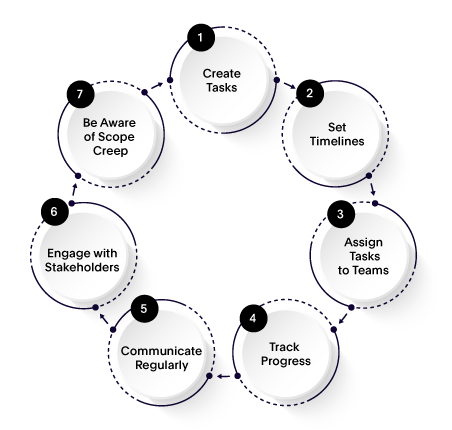
Every project has different requirements, and the steps or elements used during this phase may vary. However, these seven steps are common and essential, especially when dealing with three key management operations, namely:
- People
- Processes
- Communication
Let's take a look at each of the steps involved during project execution.
Step 1: Creation of Tasks
This is the first step that helps project managers understand the project plan. Project managers can move on with this step by doing the following things:
- Define individual tasks in the project. To achieve this, create a Work Breakdown Structure that helps divide the entire project into manageable, workable elements. This will streamline the whole process.
- Create sub-tasks under the main tasks to easily assign work across teams, making it easier to track and manage the project.
- Add details or custom fields to tasks and subtasks so that everyone working on the project is aware of the actions that need to be taken to move forward. Even if a task has been completed, it'll be visible to everyone with the help of these custom fields.
Step 2: Creation of Timelines
Setting timelines for tasks in a project is crucial for achieving maximum productivity. Here's how you can carry out this step:
- Set realistic deadlines for individual tasks irrespective of their size.
- Look out for dependencies in the project. There will always be certain tasks and/or subtasks that can only start when another task is finished. A delay in one part of the chain can cause a delay in the entire workflow. Therefore, ensure that you track all changes and delays using a reliable project management tool to carry out tasks efficiently and meet deadlines.
- Track the changing priorities and meet requirements on time.
- Don't forget to create milestones for your tasks. If needed, break these down into smaller ones and divide the responsibility among teams. Whenever a milestone is achieved, it'll tell you that you're one step closer to the goal. Moreover, doing this will boost team members' morale throughout the project.
Step 3: Assigning Tasks to Teams
With tasks created, responsibilities marked, and timelines set, the next step in project execution is to finally assign work to the teams. During this phase of the execution process in project management, managers can carry out the following responsibilities:
- Start by briefing the selected teams about the project and the individual roles of each member. With the help of a work management tool, add the selected individuals to the project team. You can attach a brief of their responsibilities and the required resources for the tasks assigned to them.
- Invite any external collaborators and agency partners who are a part of the project. Their presence can help you fill any existing skill gaps or address the need for extra support. If required, you can grant them limited access to tasks that require their expertise, also ensuring that they can communicate with the internal team as needed.
- Provide your team with the essential resources required to execute the project seamlessly. Ensure that you provide the resources needed before the project starts so that work isn't hampered along the way.
Step 4: Tracking Project Progress
This is one of the most important steps of project execution. This step determines whether your project will be completed by the deadline. Here's how you can effectively track the progress of your project:
- Keep track of the tasks daily to ensure that everything is in working order, like the log-in time of team members, completion of the service requests, and updating them on time. Failing to check such important matters may cause chaos in the project.
- Don't forget to create weekly reports to stay in the loop about the progress of each task and the project as a whole. Moreover, these reports help to keep management and clients updated on the project's progress.
- Hold status review meetings regularly to recognize bottlenecks that might leave your project in a sticky situation.
Step 5: Open Communication Channels
Communication is crucial during the execution of a project, so here's what you can do:
- Create a network for communicating with your team on one channel, most preferably a work management tool that gives access to real-time conversations and video conferences. This will save you time and improve your team's productivity.
- Conduct meetings with your team regularly to get a clear picture of the progress of tasks and the project as a whole. Doing this regularly also encourages team productivity while boosting their morale.
Step 6: Keep Clients in the Loop
Another essential step in execution is to communicate effectively with clients, ensuring they are regularly informed about the project's progress. You can do this by giving them 'guest access' to the project dashboard, where they can view all the work being carried out. By doing so, your clients will remain assured about the project's stability.
Moreover, remember to keep clients connected to key team players who can answer any of their queries about the project.
Step 7: Be Aware of Scope Creep
Scope creep is a common phenomenon in projects and is often the primary cause of project delays. This typically occurs when clients need to make changes to a project. At times, it happens due to internal miscommunication and conflicts.
You can manage scope creep by trying to understand the reasons behind the changes. If necessary, discuss with the clients why the changes are required and when they'd like them to be implemented.
Once all the requirements are clear, gather your team members and communicate the necessary changes. Based on the discussion, it's up to you and your team to devise reasonable timelines that don't compromise quality. Then, you must relay the same to the client regardless of their demands.
Challenges in Project Execution
You will undoubtedly face many challenges during project management. There could be budget overruns, missed deadlines, or even a lack of resources that might cumulatively result in unsuccessful business outcomes. These challenges may arise at any time during the execution phase, and you must address them promptly.
Some of the common challenges that occur during project execution are as follows:
Lack of Communication
Most projects have complex requirements, which can sometimes lead to miscommunication among team members. This is one of the biggest challenges that can lead to a project's failure. This typically occurs when teams lack a shared understanding of their roles in assignments or are unfamiliar with workflow reports within the project.
Inefficient Teams
Another challenge that most project managers face is assembling high-performing teams. To make a project successful, teams must include personnel who can match their skills with the best role, thus ensuring the timely completion of work. With an inefficient team, all that isn't possible.
Unclear Coals
Most projects fail due to a lack of direction and unclear project goals. Unclear project goals can affect business productivity and prevent your work from being truly completed. There's chaos everywhere, and everyone is confused about their roles and responsibilities.
Scope Creep
Clients can be unpredictable and may introduce sudden changes that alter the entire dynamics of a project. That's called scope creep, and project managers must remain alert about it. Scope creep can occur in any project and can quickly throw it off track.
Insufficient Risk Analysis
With the help of risk analysis, project managers can easily predict any factors that could jeopardize a project. Risk analysis is a crucial component of the project life cycle. That's why rushing through it could lead to negligence that could hinder a project.
Failure to Engage With Sponsors
It's essential to have a strong relationship with sponsors to ensure a project's success. If sponsors are not included in a project, challenges will appear. Hence, project managers need to refine this relationship to move a project forward effectively.
Unrealistic Deadlines
Setting impractical deadlines to meet, given the specifications and requirements, can greatly compromise the quality of work. It causes team members to rush through their tasks, resulting in a finished project that falls short of client expectations.
Lack of Good Leadership
A project manager or team leader promotes independence and self-reliance within a team. A project's success may be threatened by ineffective project management and a lack of oversight.
Lack of Flexibility
The team or organization will face obstacles such as delays and budgetary constraints if they lack the flexibility to manage projects effectively. Conversely, those who are implementing dynamic project management can easily attain the ability to swiftly respond to unforeseen large problems and maximize their chances of success.
Poor Visibility Into Task Dependencies
According to Wellingtone's The State of Project Management 2020 report, a lack of visibility is one of the top challenges that projects face. Thus, clarity is one of the most important requirements for the successful completion of the project. The lack of it creates several project management issues, while successful communication leads to successful projects.
The fact that you need to communicate is one of the characteristics that's often overlooked. A project management communication plan can go a long way in helping your project succeed.
By understanding these potential challenges in project execution, you can significantly minimize the complications that may arise in your projects.
Next, let's discuss gaps in project execution and how to address them to ensure the success of your project.
What are Project Execution Gaps?
These are gaps that occur when a project fails to meet the goals that were developed during the planning stage. These are commonly a result of broken communication or mishandling of project activities. However, other factors, such as setting unrealistic goals or disengagement with key stakeholders, can also cause this.
The best way to avoid these gaps is to identify the root cause along with the threats these pose to the project.
According to Todd Williams, author of Filling Execution Gaps, there are six primary execution gaps to be taken into consideration. These are:
- A lack of shared understanding
- Misalignment with strategic goals
- Low engagement/disengagement with stakeholders
- Poor change management
- Ineffective corporate governance
- Lackluster leadership
Let's take a look at some of the most common execution gaps, their causes, and ways to prevent them so that your project runs smoothly.
Execution Gap 1: Lack of Shared Understanding
This suggests that team members are unfamiliar with the project's overall requirements, as well as their specific roles and responsibilities. When this happens, the project is poorly executed, fails to meet its goals, or has to be abandoned.
Causes
- A lack of communication among team members about the planned strategic goals
- There's no collaboration strategy to strengthen team bonds.
Risks
- This execution gap negatively affects organizational productivity and team efficiency.
How to Prevent It
- Schedule check-in sessions with team members before the launch of the project.
- Ensure that all team members attend the kickoff meeting so that you can receive their agreement on the project goals. You can also utilize check-in methods for your team members, allowing them to communicate feedback and suggestions openly.
- Give all the team members a quick reference about the project strategy after the project charter is made. This will provide team members with a quick overview that they can easily refer to.
- Don't skip orientation and onboarding since this is where they'll learn about useful management techniques.
Execution Gap 2: Lack of Internal Communication
Poor internal communications can harm your project and team members. Ineffective communication can easily lead to poor productivity, stress, and misunderstandings, thus affecting teamwork as a whole.
Causes
- Poor channels of communication
- The absence of defined roles and responsibilities
- Lack of reporting structure
Risks
- Delay or failure of a project
- Disengagement of employees
- Poor productivity
How to Prevent It
- Don't expect people to communicate on their own. Instead, encourage them to communicate regularly.
- Ask team members whether they have a clear understanding of their roles and responsibilities in the project, as well as those of others.
- Keep the project organization chart handy to help define and provide references to team members.
Execution Gap 3: Low Engagement with Stakeholders
If you fail to engage with your clients regularly, it'll decrease their support for your efforts and make them unhappy, thus indirectly hindering the project.
Causes
- Assumptions that clients or stakeholders will engage themselves if required and that they're as imbued in the project as the project manager is.
Risks
- Missing out on useful insights, required feedback, or support
- Stakeholders having unrealistic expectations about the project's overall potential and outcome
How to Prevent It
- Keep stakeholders in the loop via a stakeholder engagement plan and regularly communicate about the project strategies and timelines.
- Always schedule update reports for the stakeholders.
- Adopt a proactive outlook in engaging sponsors and clients as a fundamental aspect of project management responsibilities.
For this, visualization tools like PERT Charts and Gantt Charts can be very handy in having a readymade progress report. For real-time insights, you can also deploy PSA software that can offer the following:
- Consistent execution with proper governance
- Intelligent resource management
- Time tracking and schedule management
- Management of client metrics like costs, billing, and profitability through detailed dashboards
Execution Gap 4: Scope Creep
This refers to the growing requirements of a project over time, which, in turn, negatively affects the timeline.
Causes
- Stakeholders changing their requirements in the project
- Internal conflicts and miscommunications
- Unclear scope definitions
Risks
- Missed deadlines
- Budget overruns
- Financial losses
- Client dissatisfaction
How to Prevent It
- Define clear and concise project prerequisites.
- Developed a detailed project plan that helps track project progress and prevents any deviations from the original scope.
- Conduct scope reviews regularly to ensure the project stays aligned with its original goals.
Parts of Project Execution
The execution phase may require many elements, but the following are some of the most important components that comprise it. Let's take a look.
Project Scope
It's one of the most important components of the execution plan that helps project managers clearly and precisely define a project's goals, which can then be effectively communicated to clients.
The scope of a project can include the following elements:
- Statement of Work (SOW): This is an extensive document that entails the duties and roles of every team member, along with other requirements like tasks, project requirements, and deliverables.
- Project limitations and boundaries: This defines the scope and limits of a project. Project limitations and boundaries mark limits as to what's included or excluded in a project.
- Timeline and milestones: These are sometimes included in the project scope to evaluate a project's progress toward the final goal.
- Final deliverables: This part of the project scope could be anything from products/services to reports or test results. It's the final output received by stakeholders once a task has been completed.
How It Helps: A well-defined project scope includes detailed reports on the entire project, ensuring that any gaps are consistently addressed.
Quality Standards
Another important element of project execution is specifying quality standards. This document defines the requirements and parameters for delivering consistent quality across projects, from initiation to completion. Some of these parameters, which may be included in the documentation, are as follows:
- Clear definitions of relevant terms and concepts that can assist team members in completing their tasks more efficiently.
- Adding specific timeframes to processes so that every individual involved in the project is aware of any ongoing developments.
- Using descriptive language along with measurable quality standards can prove helpful in identifying items and processes.
- Setting attainable goals for teams to keep them motivated and committed to the project.
How It Helps: If the execution phase doesn't proceed according to plan, quality standards help in taking corrective measures to ensure that the final deliverable is error-free.
Project Goal Statement
This document outlines the goals a project aims to achieve. The document outlines a project's purpose, perspective, and quality focus. The goal statement aligns with the company's goals, aiding its progress and improvement.
How It Helps: The project goal statement explains the anticipated outcome via measurable action items that help achieve the objective. They're important for promoting improvement and helping to move progress forward.
Resource Allocation
The project execution phase may include resource allocation to help identify the required resources and determine which task needs to be assigned. It's essential to allocate resources, as they help plan for project implementation and achieve objectives.
How It Helps: An accurate resource gap analysis helps to identify the resources that you'll need for upcoming projects, as well as your current resources. One major reason projects run out of funds, exceed their budget, or fail completely is a lack of resources. Therefore, the key to achieving success from day one is adopting a preventive mindset.
Project Scheduling
Scheduling is another important part of the project execution phase. It's the stage when a project's vision begins to transform into a time-based plan. With the help of a project schedule, you can:
- control and monitor project activities
- determine where you can allocate resources needed or if there's an excess that you can allot to another project
- evaluate the delays that might impact your project
- track the progress of the project
- manage risks
How It Helps: A well-structured schedule provides a clear roadmap for project delivery and allows managers to make informed decisions on how best to utilize resources in the event of problems or delays.
Power up Your Projects via Effective Execution
Project execution is the process by which a project is conceptualized and brought to completion. It's a crucial stage in the project life cycle, as this is where projects begin to be implemented.
You can facilitate the successful implementation of a project through the main steps, including planning, organization, funding allocation, implementation, quality control, and evaluation, as well as the tips we've discussed.
You require more than just a plan to get your project wheels turning. Project execution is the engine that drives a project's achievement of its envisioned goals.
Implementing strategic execution after navigating through all the challenges and gaps will ensure that you reach the finish line successfully.